Aug 20, 2026
How to Choose a Flag Base for Grass, Concrete, Sand & Vehicles
Choose the right flag base for grass, concrete, sand, indoor floors or parked vehicles by comparing spikes, cross bases, ballast, plates and tyre bases.
Choose a flag base by starting with the surface. Use a compatible ground spike for penetrable grass or soil; consider a longer or screw-style anchor only for suitable sand; use a cross base with appropriate ballast, a fillable base or a weighted plate on hard surfaces; and use a tyre base only under a parked vehicle wheel.
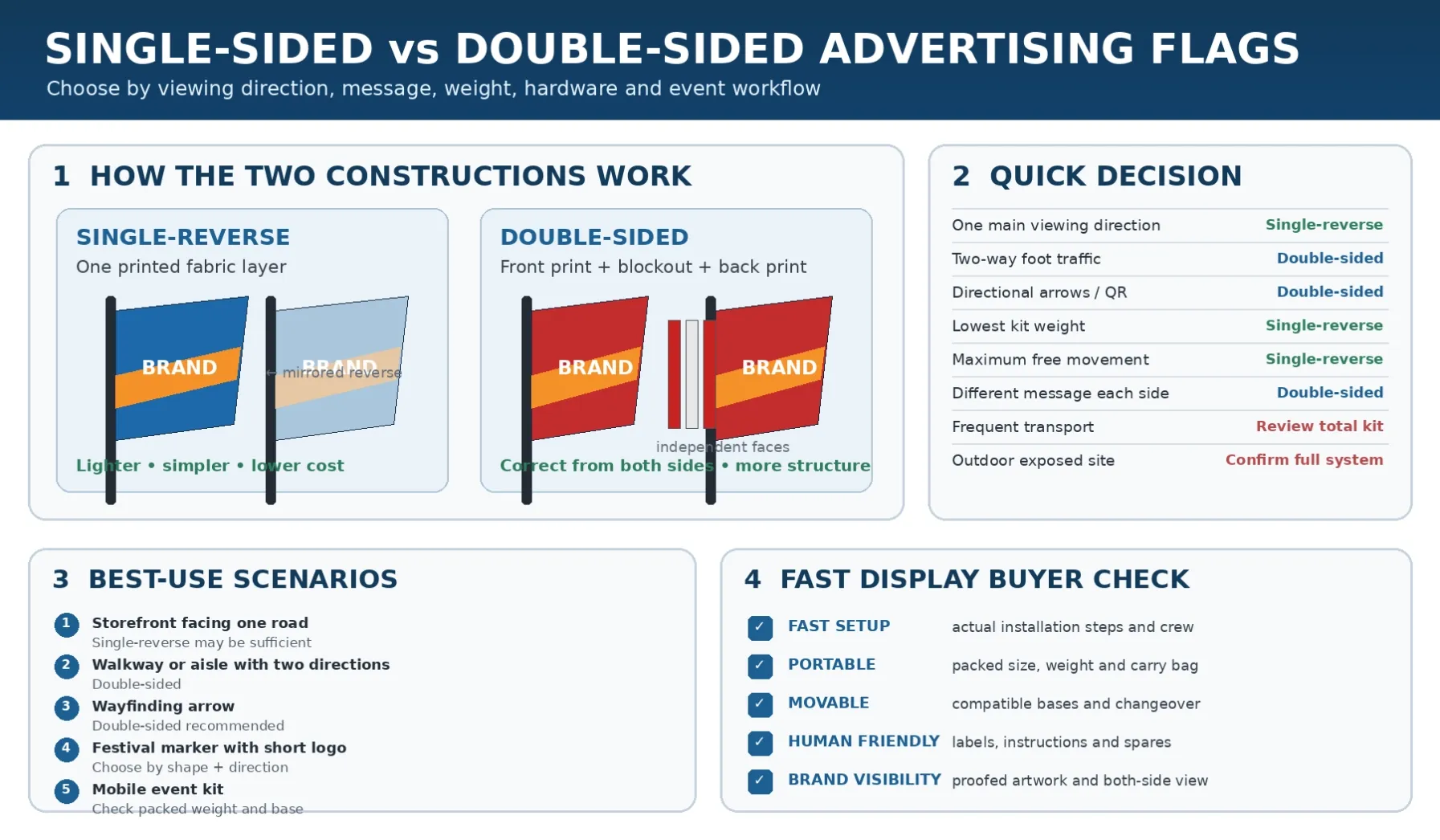
The final choice must also account for flag height, pole and spindle compatibility, single- or double-sided construction, base footprint, handling, pedestrian traffic, venue rules and severe-weather procedures.
Quick decision: match the base to the surface first
- Grass or firm soil: start with a compatible ground spike when penetration is permitted.
- Firm sand: review depth and compaction before considering a longer or screw-style anchor.
- Concrete or pavement: compare a cross base with ballast, a fillable base and a weighted plate.
- Indoor hard floor: prioritize footprint, trip risk, floor protection and presentation.
- Parked vehicle promotion: use a compatible tyre base under a stationary wheel only.
After choosing the base family, confirm the complete flag, pole, spindle, base and ballast as one compatible system.
1. Grass and soil: start with a compatible ground spike
A ground spike is normally the first option for grass, lawns and penetrable soil because it anchors directly into the ground and keeps the floor footprint compact. It is not a universal outdoor base: shallow, waterlogged, hard-packed or restricted ground can change the recommendation.
- Confirm spike length, shaft diameter, material and removal method.
- Confirm pole socket or adapter dimensions and spindle compatibility.
- Confirm the approved flag height and print construction for the complete system.
- Ask the venue whether ground penetration is permitted and whether buried services are present.
2. Sand: distinguish firm sand from loose dry sand
Sand is not one uniform installation condition. Compacted sports-ground sand, damp beach sand and deep loose dry sand behave differently. A sufficiently long spike may be a starting point in firm penetrable sand, while loose sand may require a deeper or engineered solution after site review.
- Check sand depth, compaction and whether anchoring is permitted.
- Confirm corrosion-resistant materials and cleaning requirements for salt-air use.
- Do not assume a small standard spike is suitable for a tall or double-sided flag.
- Use a screw-style spike only if it is an actual supplied option and suitable for the site.
3. Concrete and pavement: compare cross bases, ballast and plates
Hard surfaces cannot accept a normal ground spike. The practical choices are usually a folding cross base, a cross base with a compatible water bag, a fillable water base or a weighted metal plate. Compare actual dimensions and weights rather than treating each name as one standard specification.
Folding cross base
A folding cross base is compact for transport and simple to position, but its open arms create a larger footprint. Outdoor use may require compatible ballast. Confirm the open size, packed size, base weight, bearing diameter and permitted flag size.
Water bag or fillable base
Water ballast travels lighter when empty, but the event team must plan water access, filling, handling, draining, cleaning and cold-weather storage. Confirm whether a water bag is an accessory placed over another base or a complete fillable base.
Weighted metal plate
A plate base can provide a clean, low-profile appearance. Compare plate dimensions, actual weight, handle or wheel design, finish, edge treatment, floor pads, bearing diameter and packing. More weight alone is not a universal wind-performance guarantee.
4. Indoor floors: add footprint and pedestrian-safety checks
Indoor conditions reduce weather exposure, but trip risk, walkway clearance, floor protection, ceiling height and visual appearance become more important. A compact cross base or low-profile plate may work when it is compatible with the flag and fits the booth layout.
- Keep base arms and plate edges out of aisles and emergency routes.
- Protect venue floors and confirm restrictions on ballast or metal plates.
- Check that the flag can rotate without contacting walls, lighting or neighboring displays.
- Confirm that the base and pole fit the planned shipping case or carry bag.
5. Parked vehicles: use a tyre base only while stationary
A tyre base is designed to sit under the wheel of a parked vehicle. It can suit dealerships, forecourts and roadshows because the stationary vehicle provides ballast without drilling into the ground.
Never promote this system for use while a vehicle is moving. Confirm wheel clearance, pole position, pedestrian routing, spindle compatibility and site permission before installation.
6. Check compatibility before approving the base
Two bases that look similar may not accept the same pole. Ask the supplier to document compatibility instead of relying on the product name.
- Spindle or bearing diameter: must match the lower pole or adapter.
- Flag height and shape: influence the approved hardware range.
- Print construction: double-sided graphics may add weight and affect the recommendation.
- Base weight or filled capacity: supports comparison and the handling plan.
- Open footprint: affects placement, trip risk and booth layout.
- Packed dimensions: affect shipping, storage and repeat-event logistics.
7. Treat wind and stability as complete-system questions
Wind performance depends on the full configuration: flag height and shape, fabric and print construction, pole stiffness, spindle, base or anchoring, installation quality, ground condition and exposure. A base that works in a sheltered location may not suit an exposed site.
Do not rely on a universal wind number unless it comes from a test for the exact flag, pole and base configuration. Follow venue rules and remove temporary displays during unsafe conditions.
8. RFQ checklist for a correct base recommendation
- 1. Send the flag shape and total assembled height.
- 2. State whether the graphic is single- or double-sided.
- 3. Provide lower-pole or adapter dimensions when hardware is already selected.
- 4. Describe the exact surface and whether the location is sheltered or exposed.
- 5. State the required footprint, handling limits and ballast availability.
- 6. Include quantity, packing needs, destination and required event date.
- 7. Share venue restrictions or installation responsibilities.
Frequently asked questions
Which flag base is best for grass?
A compatible ground spike is normally the starting option for penetrable grass or soil. Confirm ground condition, venue permission, pole fit and flag height before use.
Can a ground spike be used in sand?
It may work in firm, penetrable sand, but loose dry sand can require a longer or engineered solution. Confirm depth, compaction, flag size and venue rules.
Which base should I use on concrete?
Compare a cross base with suitable ballast, a fillable base and a weighted metal plate. Check footprint, actual weight, handling, trip risk and compatibility.
Is a water bag a complete base?
Usually it is an accessory placed over a compatible cross or plate base, although separate fillable bases also exist. Confirm the quoted system.
Can the same base fit feather and teardrop flags?
Sometimes, but do not assume it. Confirm spindle diameter, pole socket, approved flag size and print construction.
Choose the base around the venue, then confirm the complete system
The base should be selected as part of a compatible flag system, not as a last-minute accessory. Send BESDA the flag height, pole specification, print side, venue surface, quantity and required date for a configuration review.
Use the BESDA contact form to share your venue and receive a project-specific base recommendation before quotation.