Aug 20, 2026
Feather Flag vs Teardrop Flag: A Buyer Decision Guide
Compare feather and teardrop flags by movement, readability, artwork, viewing direction, bases and venue conditions before choosing a custom flag system.
A feather flag and a teardrop flag can use similar pole and base systems, but they present artwork differently.Feather flags normally provide a longer vertical silhouette with more fabric movement, while teardrop flags keep the graphic under greater tension in a compact shape. The better choice depends on the message, viewing direction, available space and event conditions.
This guide is for buyers comparing custom event flags before requesting a quote. It explains practical tradeoffs without assuming that one shape is always superior.
Quick comparison: feather flag vs teardrop flag
- Feather flag:a tall curved profile, useful for vertical branding and messages that benefit from a larger visual presence.
- Teardrop flag:a compact closed curve that keeps more of the fabric tensioned and creates a stable outline.
- Best choice:the shape that fits the approved artwork, viewing path, site restrictions, base and transport plan.
Buyers comparing the wider product family can first review thecustom advertising flags category. Final selection should be based on a dimensional drawing and artwork proof for the exact flag size.
1. Compare the silhouette and usable graphic area
A feather flag normally has a long leading edge and a curved or angled top. Its vertical profile can be useful near entrances, roadsides and open event areas where the display must rise above surrounding visual clutter. A teardrop flag curves back toward the pole to form a closed teardrop outline.
The total assembled height does not tell you the usable printed area. Ask for the actual graphic dimensions, safe area and overall footprint. Two flags with similar height labels can present logos and copy very differently.
2. Match the shape to the artwork
Feather flags usually accommodate vertically stacked logos, short calls to action and directional messaging. Teardrop flags can suit a central logo or compact layout that works inside the curved lower section. Neither shape fixes weak artwork: long sentences, low contrast and very small details remain difficult to read.
- Place the real logo and message on both templates before choosing.
- Keep important copy away from seams, sleeves and narrow tapered areas.
- Check the proof at a realistic viewing distance.
- Confirm how the reverse side will appear for a single-sided print.
For a feather-specific quotation, use thecustom feather flag manufacturing page. For the alternative format, compare theteardrop flag manufacturing pageonce both routes are live.
3. Consider fabric movement and tension
A feather flag normally allows some movement along its free edge. That movement can attract attention, but it also changes how the artwork appears moment by moment. A teardrop flag keeps more of the perimeter under pole tension, so the silhouette can remain more compact.
Do not turn these general differences into a universal wind-performance claim. Real behavior depends on flag dimensions, fabric, pole construction, base, ground surface and local conditions. Outdoor displays should be used according to the supplied instructions and removed in severe or unsafe weather.
4. Plan for viewing direction
Start by mapping how visitors approach the display. A tall feather flag can be useful when the message must be noticed along a path or from farther away. A teardrop flag may work well where a compact logo panel is viewed near an entrance, registration point or activation area.
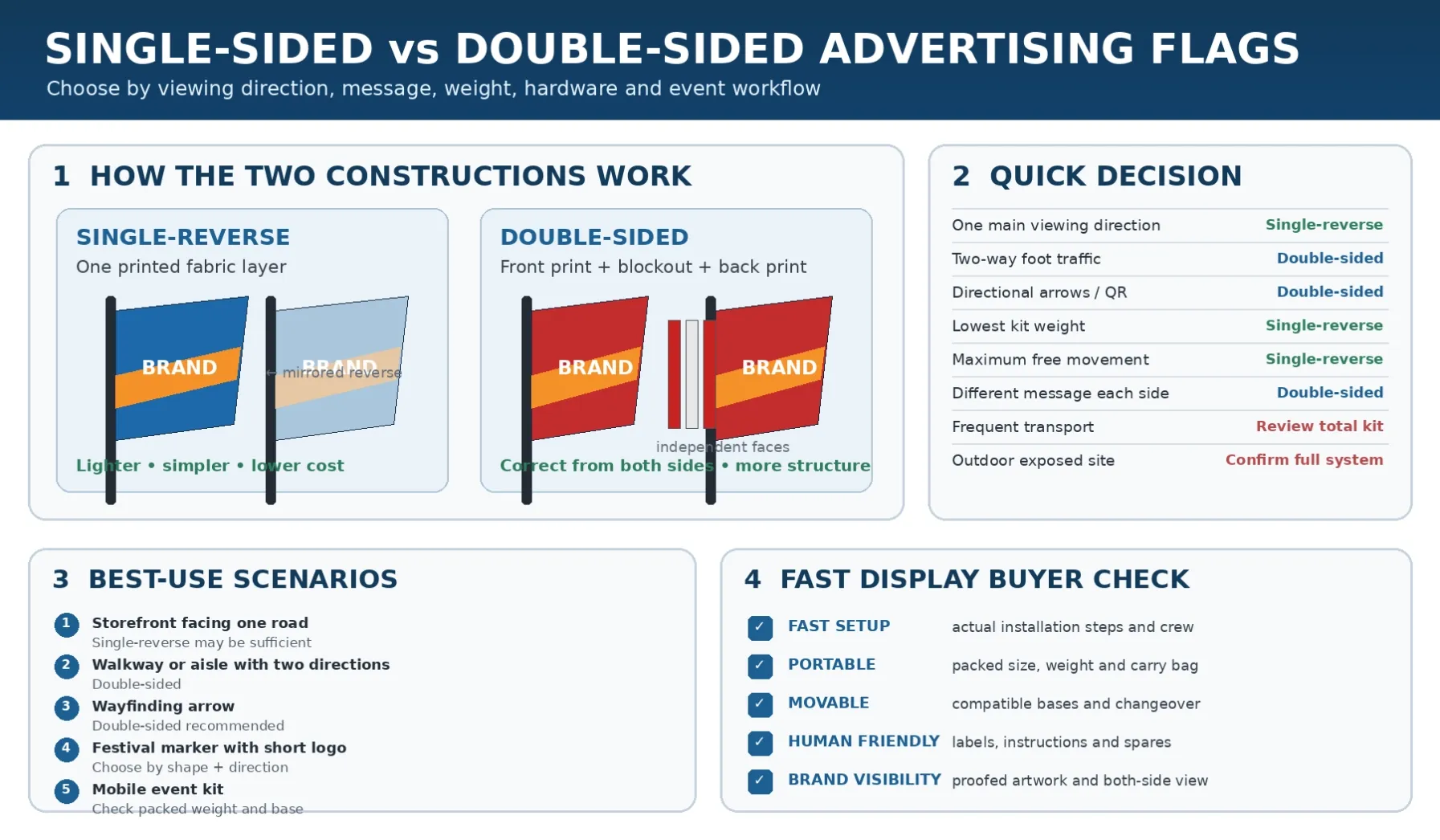
Single-sided fabric normally shows a mirrored version of the artwork on the reverse. If text must read correctly from both approaches, ask about a double-sided construction and confirm its added layers, weight and hardware requirements.
5. Check site footprint and height restrictions
Indoor exhibitions may limit overall height, stand boundaries and base placement. Outdoor events may have traffic lanes, pedestrian paths, hard surfaces or rules against ground penetration. Compare the complete installed dimensions rather than the graphic alone.
- Restricted height:request the assembled height including the base.
- Narrow walkways:check base footprint and trip-risk management.
- Soft ground:confirm whether a ground spike is permitted and appropriate.
- Hard ground:specify a compatible weighted base or approved base-and-weight combination.
6. Compare the base and pole as one system
The flag shape should not be separated from its hardware. Confirm the pole set, rotating spindle or connector, base, optional weight, carry bag and replacement parts in the same quotation. Ask whether replacement graphics remain compatible with the same pole system.
A cheaper graphic-only offer is not equivalent to a complete display set. Record every included component so quotations can be compared line by line.
7. Think about transport, setup and repeat use
Event teams often reuse flags across stores, races, exhibitions and seasonal campaigns. Ask for packed length, number of pole sections, bag arrangement and approximate packed configuration before finalizing the system. The easiest flag to display may not be the easiest one to transport in the buyer's vehicles or shipment cartons.
For repeat programs, keep the approved template, hardware reference and proof. This reduces compatibility questions when ordering replacement graphics.
Use-case selection matrix
- Long vertical message or stacked branding:compare a feather flag first.
- Compact central logo and tensioned outline:compare a teardrop flag first.
- Two-way readable text:evaluate double-sided construction for either shape.
- Restricted venue:choose only after confirming overall height and base footprint.
- Mixed event surfaces:prioritize a flexible hardware and base plan before choosing the silhouette.
Questions to send the manufacturer
- What are the overall height, graphic dimensions and installed footprint?
- Which shape best fits the supplied artwork and viewing direction?
- Is the quoted graphic single sided or double sided?
- Which pole, base, optional weight and carry bag are included?
- What ground surface is the proposed base intended for?
- Can replacement graphics use the same hardware?
- What proof and final template will be supplied before production?
- What production and shipment details must be confirmed for this order?
Ask how print, finishing and packing are checked, and review thequality control processbefore approving repeat or multi-location orders.
Common comparison mistakes
- Choosing only from the product name without reviewing the graphic template.
- Comparing overall height while ignoring printed area and base footprint.
- Assuming all single-sided reverse images read normally.
- Using a universal wind claim without checking the complete configuration.
- Comparing a graphic-only quote with a complete hardware package.
- Approving the shape before testing the real logo and message.
FAQ
Which is more visible, a feather flag or a teardrop flag?
Visibility depends on size, contrast, message, placement and viewing path. Feather flags often create a taller vertical presence, while teardrop flags create a compact tensioned outline. Test the real artwork on both templates.
Does a teardrop flag handle wind better?
Do not assume a universal answer from shape alone. Performance depends on the complete flag, pole, base, surface and conditions. Request configuration-specific guidance from the manufacturer.
Can both flag shapes use the same base?
Sometimes, but compatibility must be confirmed for the exact pole connector and flag size. Do not order the base independently without checking the complete system.
Can the graphic be replaced later?
Often, provided the replacement graphic is made for the exact pole system and approved template. Keep the hardware reference and original order details.
Choose with an artwork proof, not a generic preference
Send the event type, indoor or outdoor use, available height, ground surface, viewing direction, quantity, artwork and destination. BESDA is a direct manufacturer of coordinated event display products.Contact BESDAto compare both flag shapes against your real application before requesting a factory quotation.