Aug 20, 2026
How to Choose the Right Feather Flag for Outdoor Events
A practical buyer's guide to feather flag size, shape, fabric, print, bases, wind conditions and artwork, so event teams can order with fewer surprises.
Choosing a feather flag looks simple until the order has to work at a real venue. The flag must be visible from the right direction, fit the available footprint, stand on the actual surface, carry readable artwork and pack efficiently for transport.A low price cannot compensate for the wrong size, base or print configuration.
This guide explains the decisions a buyer should make before requesting a quote for custom feather flags. It is written for event teams, distributors, retail marketers and brand managers who need a practical specification rather than a generic product list.
Quick answer: match the flag to the site before choosing the price
The right feather flag is the one that fits five things: viewing distance, available height, ground surface, wind exposure and how often the display will be reused. Start with those conditions, then select the pole, base, fabric and print method. Ask the manufacturer to confirm the complete set in the quotation so that poles, graphics, bases and carry bags are not compared as if they were identical packages.
1. Define where and how the feather flag will be used
Begin with the event environment. A roadside promotion, a crowded exhibition entrance, a sports field and a retail forecourt create different requirements. Record whether the flag will be indoors or outdoors, the surface under the base, the expected viewing direction and any venue height restrictions.
- Roadside or car-park visibility:prioritize a clear silhouette and large, simple copy that can be understood quickly.
- Pedestrian events:use a size that remains noticeable without blocking walkways or sight lines.
- Indoor exhibitions:check ceiling height, stand boundaries and fire or venue rules before confirming the graphic.
- Repeated campaigns:consider transport length, bag quality and whether replacement graphics can be ordered for the same pole system.
If the use case is unclear, the supplier can only quote a generic configuration. A direct manufacturer should ask application questions before recommending hardware.
2. Choose size by viewing distance and available space
Feather flag sizes are normally described by the overall assembled height or by the graphic size, and those are not always the same. Ask every supplier which measurement appears in the quotation. The tallest option is not automatically the best choice: a flag that is too large for the venue can be difficult to position, while one that is too small may disappear in a busy visual environment.
For comparison, request a dimensional drawing that shows overall height, graphic dimensions and approximate ground footprint. This makes it easier to compare offers and to confirm that the display fits entrances, booths and storage plans.
3. Understand feather, teardrop and rectangular shapes
A feather flag usually has a curved top and a long vertical graphic area. Buyers comparing the wider range can review thecustom advertising flags categoryand thecustom feather flag manufacturing page. A teardrop flag keeps the fabric under greater tension and forms a compact teardrop outline. Rectangular or sail-style flags provide a different visual balance. None is universally better; the right choice depends on the artwork, site and preferred movement.
If the campaign already has approved artwork, place it on the actual flag template before choosing the shape. A logo designed for a wide banner may not read well on a narrow vertical feather flag. Comparing proof layouts often gives a clearer answer than comparing product names.
4. Select a base for the real ground surface
The base is one of the most important parts of an outdoor flag system. Match it to the installation surface instead of treating it as a last-minute accessory.
- Soft ground:a ground spike may be suitable where the venue permits penetration and the soil condition is appropriate.
- Concrete or paving:use a weighted base designed for hard surfaces. Confirm whether the quoted weight is the empty base or the filled working weight.
- Mixed locations:a cross base with an additional weight bag can offer flexibility, but the complete combination should be checked for the intended flag size.
- Indoor floors:choose a stable base with suitable floor protection and a footprint that does not create an avoidable trip hazard.
Outdoor displays should be taken down in severe or unsafe weather and used according to the supplied instructions. Avoid suppliers that make a universal wind claim without considering flag size, base, surface and local conditions.
5. Compare single-sided and double-sided printing correctly
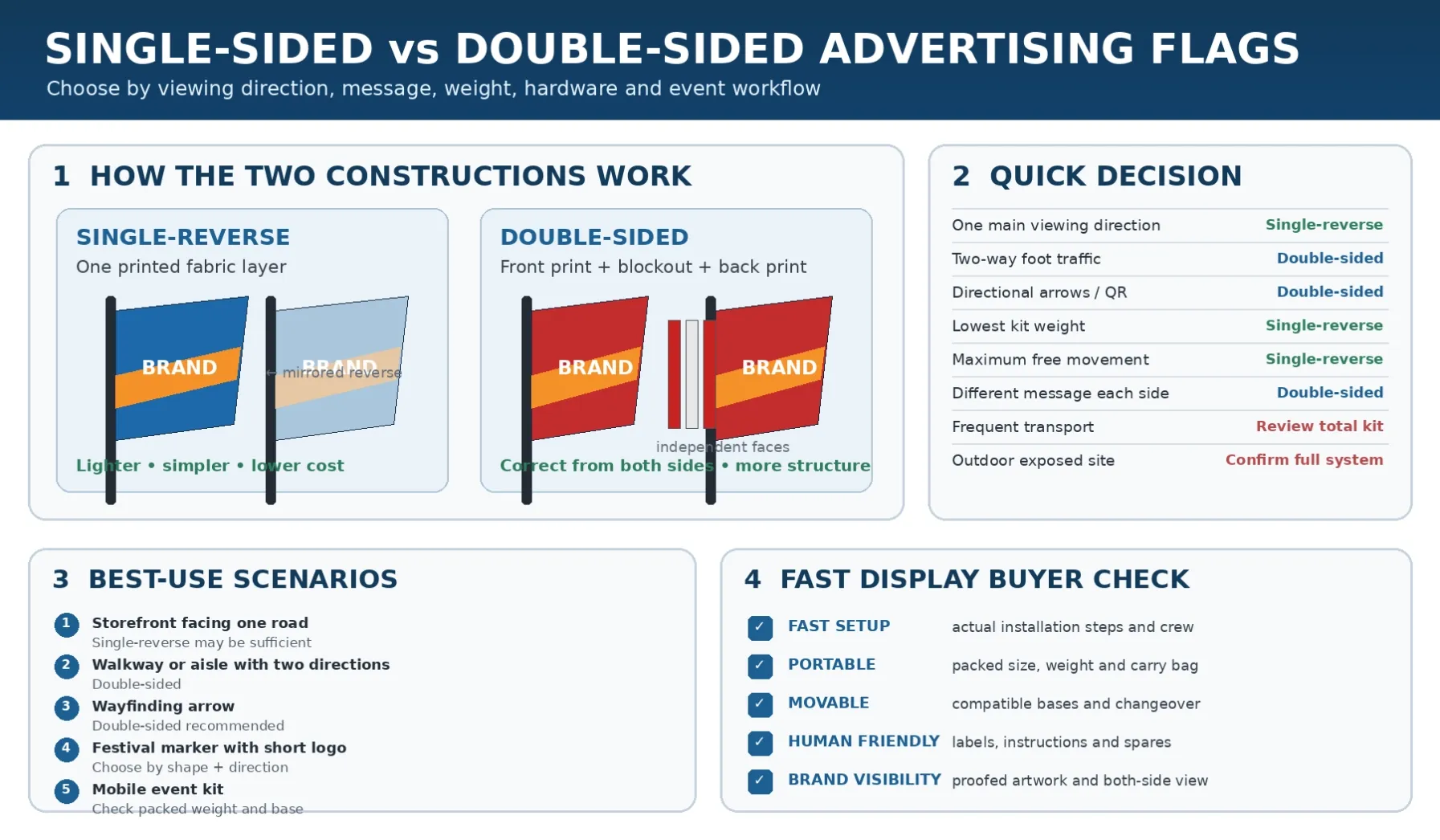
A single-sided feather flag is commonly printed on one piece of fabric. The design is visible from the reverse side as a mirrored image, with color appearance affected by the material and print process. This can be efficient when the message works in both viewing directions.
A double-sided flag uses separate printed faces with a blocker between them so that each side can read correctly. It is normally heavier and may behave differently from a single-layer flag. Ask for the finished construction, not only the phrase “double sided,” and confirm whether both sides can carry different artwork.
Choose based on reading direction. If visitors approach from both sides and the text must read correctly, double-sided construction may be worth considering. If the flag is mainly viewed from one direction, a single-sided option may meet the campaign goal with a simpler structure.
6. Check fabric, stitching and pole compatibility
Product names alone do not describe the complete quality level. Request the proposed fabric type, finishing method and pole specification in writing. Key details include the pole sleeve, reinforced stress points, edge stitching, graphic orientation and the way the pole sections connect.
For repeat programs, ask whether replacement flags will remain compatible with the same hardware. This matters to distributors and multi-location buyers who want to reuse poles and bases across campaigns. Keep the approved template and order reference for future graphics.
7. Prepare artwork for fast reading
Outdoor flag artwork is read quickly and often from a distance. Keep the main message short, use strong contrast and avoid placing important elements too close to the pole sleeve or stitched edges. A vertical logo lockup often performs better than shrinking a horizontal layout until it becomes unreadable.
- Use the manufacturer's final template for the selected size and shape.
- Convert or package fonts according to the artwork requirements.
- Provide suitable vector logos or sufficiently high-resolution images.
- Check the proof at realistic viewing size, not only at full zoom on a monitor.
- Confirm front, reverse and reading direction before production.
A pre-production proof should show the exact shape, safe area and orientation. Approval should be based on that proof, not on a generic mockup. Buyers can also review thequality control processwhen checking print, finishing and packing expectations.
8. Compare quotations as complete systems
Two quotations can look similar while including different components. Ask for a line-by-line description of the graphic, pole set, base, optional weight, carry bag, packing method and any replacement parts. Also confirm sample options, artwork proofing, packaging, shipment terms and the information required before production scheduling can be confirmed.
Do not assume an unverified MOQ, lead time or certification applies to every configuration. These details should be confirmed for the actual size, quantity, print construction and destination.
Questions to send a feather flag manufacturer
- Which size do you recommend for the stated viewing distance and venue limits?
- Does the quoted height include the base?
- Which base is included, and what surface is it intended for?
- Is the graphic single sided or double sided, and how will the reverse read?
- What fabric and finishing construction are proposed?
- Can replacement graphics fit the same pole system?
- What artwork template and proof will be supplied?
- What exactly is included in the packed set?
- Which production and shipment details must be confirmed for this order?
Common ordering mistakes
- Choosing only by total height without checking the graphic size.
- Ordering a base before confirming the ground surface.
- Expecting single-sided fabric to read normally from both sides.
- Using long sentences or low-contrast artwork on a narrow flag.
- Comparing a graphic-only price with a complete hardware set.
- Assuming replacement graphics fit poles from another system.
- Relying on generic wind claims instead of site-specific guidance.
FAQ
What size feather flag should I choose?
Choose by viewing distance, available height, graphic area and site footprint. Ask for an overall dimensional drawing because size labels can differ between suppliers.
Can a feather flag be used on concrete?
Yes, when it is paired with a base intended for hard surfaces and used within appropriate conditions. Confirm the complete base and weight configuration for the selected flag size.
Is a double-sided feather flag always better?
No. It is useful when both approaches require correctly reading artwork, but it has a different construction and weight. The better option depends on viewing direction, budget and site conditions.
Can I reorder only the printed flag?
Often, but compatibility must be confirmed against the exact pole system and graphic template. Keep the approved dimensions and order reference.
Prepare a clearer request for quotation
Send the event location, indoor or outdoor use, ground surface, preferred size, quantity, print direction, artwork status, destination and required date. BESDA is a direct manufacturer of custom flags and coordinated display products.Contact BESDAfor a configuration review and a factory quotation based on your actual application.