News & Insights
How Much Weight Does a Feather Flag Base Need?
A 2.8 m feather flag needs 10–15 kg of ballast on hard ground, a 3.3 m flag needs 15–20 kg, and a 4.5 m flag needs 25–30 kg. On grass, a 1 kg ground spike can hold more than any weight you can carry —
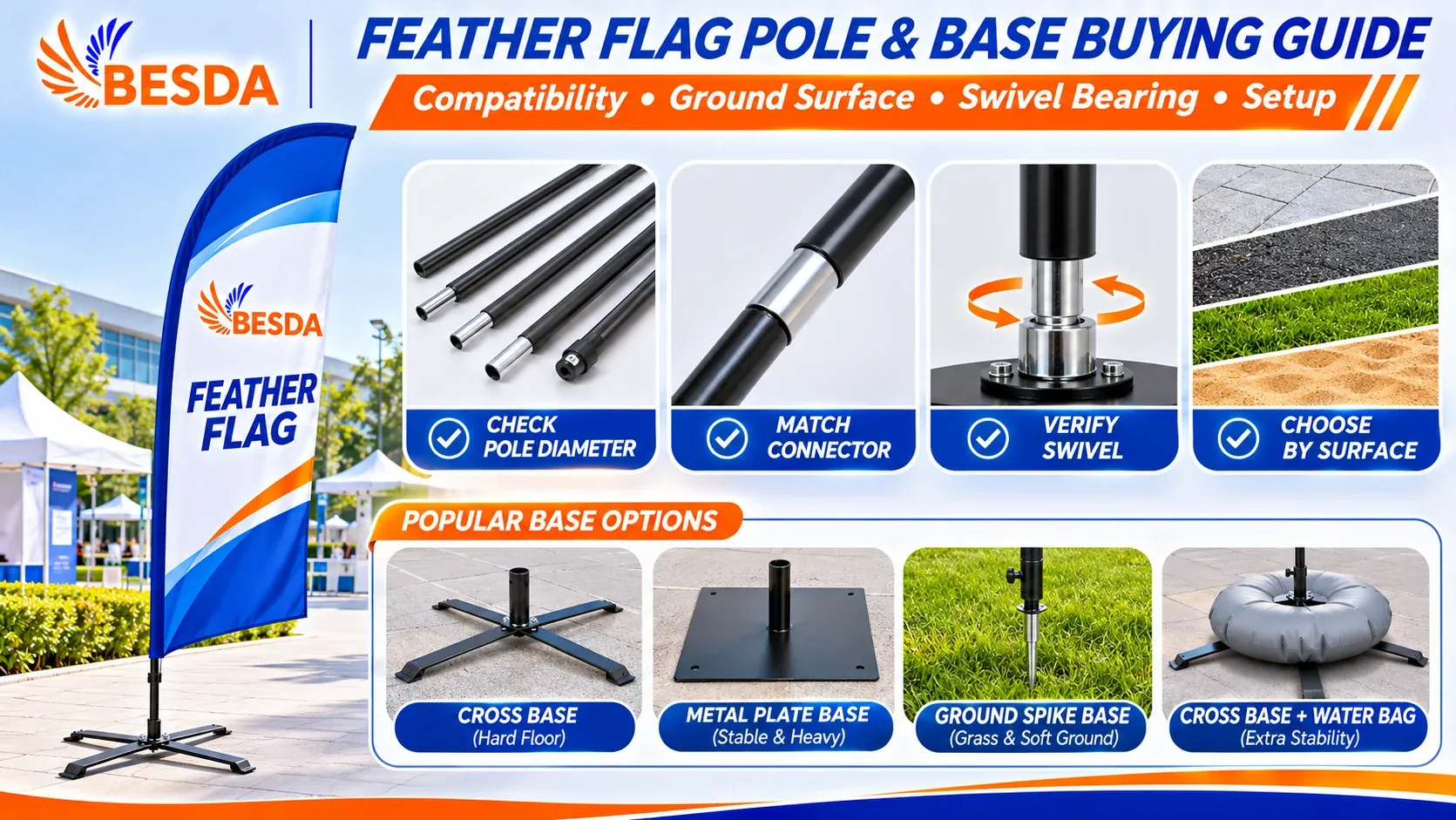
At a glance
2.8 m flag, hard ground: 10–15 kg of ballast.
3.3 m flag, hard ground: 15–20 kg.
4.5 m flag, hard ground: 25–30 kg.
Teardrop flag, same pole height: add 3–5 kg — it carries about 27% more cloth.
Grass: a 40–60 cm ground spike (about 1–2 kg) often beats any weight you can carry.
Take the flag down when sustained wind reaches 15–20 mph (24–32 km/h). No base makes a flag a permanent structure.
What a flag base actually does
A feather flag is a sail. The cloth catches the wind, the pole turns that into leverage, and the base is the only thing stopping the whole kit from tipping over. There are only two ways a base can do that job, and everything sold as a base — from a 1 kg spike to a 20-litre water tank — is one of those two ideas in different packaging.
The first way is anchoring: push a steel pin into the ground and let the soil hold the load. The second way is ballast: put mass on top of the surface and let gravity hold the load. That distinction explains most buying mistakes. On soft ground, a spike beats any weight you can carry, because the soil is doing the work instead of the base. On pavement, where nothing can be pushed into the ground, weight is the only option — and the question becomes how much.
How much weight, by flag height
The number that matters is not the base's name. It is the mass in kilograms, matched to the flag's sail area. A taller flag carries more cloth, and more cloth means more wind load. The table below is supplier guidance from BESDA's sister-site buying guides (brandingtent.com), not a BESDA factory test — ask BESDA for the tested wind speed behind any base you order.
Pole height | Sail area (feather) | Ballast on hard ground | Anchor on grass |
2.8 m | about 1.1 sq m | 10–15 kg | 40 cm spike |
3.3 m | about 1.5 sq m | 15–20 kg | 50 cm spike |
4.5 m | about 3.2 sq m | 25–30 kg | 60 cm ground screw |
A 4.5 m flag carries close to three times the cloth of a 2.8 m flag, so the base mass has to rise with it. The most common bad pairing in the field is a 4.5 m flag on a 2.8 m base. It leans at 15 mph and falls at 20 mph. If your quote lists a base by name only — "cross base included" — ask for the mass in kilograms and the wind speed it was tested to, and the surface that test assumed.
Why a teardrop flag needs more weight
A teardrop flag and a feather flag share the same pole, base and print method. The outline is the difference, and it changes the wind load. At 3.3 m, a teardrop carries about 1.9 sq m of cloth against the feather's 1.5 sq m — about 27% more sail area. That is why the teardrop needs a heavier base, and why it holds a steadier shape in a light breeze.
At a wind speed of 10 m/s (about 22 mph), the air pressure is about 61 Pa. With a drag coefficient of 1.2, a 3.3 m teardrop sees about 139 N of horizontal force — roughly 14 kg — while the feather sees about 110 N, roughly 11 kg. At 15 m/s the figures rise to about 32 kg and 25 kg; at 20 m/s they reach about 57 kg and 45 kg. The force is only half the story: the base resists a turning moment, so the plate mass on a quotation is higher than the force figure. A 3.3 m teardrop with an 18–22 kg plate is a typical pairing on pavement. The same pole with a 12 kg plate will lift at the edge in a 20 mph gust.
The practical rule: add 3–5 kg to the teardrop at the same pole height. And take the teardrop down first — it reaches the wind limit with more cloth, so it goes down first.
The four base types, weighed honestly
Ground spike (40–60 cm, about 1–2 kg). A steel pin with a rotating collar that accepts pole feet in the 12–16 mm range. You stamp it in with your foot, drop the pole in, and the collar lets the flag swing with the wind instead of loading the pole sideways. Best on grass and soil. Watch-out: it pulls out in wet ground, and it is useless on pavement.
Cross base with water bag (dry 2.5–3 kg, plus a 10 L bag — about 10 kg filled). A welded steel X with four folding legs. On its own it is a footprint, not a base. The 10-litre water bag drapes over the hub and adds about 10 kg once filled from a tap. This is the street answer for pavement and exhibition halls: light to carry, heavy on site. Watch-out: a bag can split, and you need a tap on site to refill it.
Steel plate (5 kg at 385×385 mm, 7 kg at 400×400 mm, 10 kg at 495×495 mm). Flat steel, welded or cast, with a low trip edge. The choice where a bag would be moved or stolen, and the right answer for forecourts. Watch-out: the plate edge can lift in a gust, and plates are the heaviest thing to carry.
Water tank base (12–32 litres, over 30 kg when a 32-litre tank is full). A moulded tank you fill on site — the heaviest option in the range, and the one recommended for moderately windy conditions, promenades and seafront promotions. It ships empty, so freight stays reasonable. Watch-out: a full 32-litre tank is over 30 kg, so check the surface underneath — lightweight decks and glass canopies are not the right surface. A tyre base (12–20 kg, driven over by a car wheel) plays the same role on forecourts where cars are already parked.
Wind ratings: what the numbers actually mean
One retailer's published wind ratings for a 10 ft feather flag show the pattern clearly: a small flag is rated 35 km/h on a cross base and 71 km/h with a water ballast or sand bag; a medium flag 27 km/h rising to 56 km/h; a large flag 22 km/h rising to 48 km/h. The ballast roughly doubles the rating. Treat those figures as guidance, not a guarantee — they are a retailer's approximate guide, and wind ratings for stakes depend on ground density and how well the stake was pushed in.
The rule that matters on site is simpler than any table: lower the flag at 15–20 mph sustained wind (24–32 km/h). A flag is not a wind-rated structure. Coastal sites, tower-shadow plazas and gaps between buildings get the heavier option regardless of the forecast average, because gusts there arrive faster than the forecast.
Indoors, the base solves a different problem
Inside a mall, a showroom or an exhibition hall there is no wind load, no rain and no ground spike option. The base is chosen for foot traffic, not for wind. In still air a light cross base holds a 3.4 m flag without help. Near moving crowds the maths changes: a trolley nudge, a child pulling a hem, or a cleaning machine clipping the pole all act like a small wind load.
The working rule for managed venues: a bare cross base (1.25–1.45 kg of steel) is for 2.8–3.4 m flags in quiet zones. Add weight, or step up to a heavy cross base or a steel plate, whenever the flag stands within reach of through traffic — and always for 4 m and above. Keep at least 15 cm between the pole top and the ceiling or any light fixture, keep fabric at least 45 cm below sprinkler heads, and keep the base 1.2 m or more clear of the walking line, out of door swings, and never blocking an exit, a fire point or an accessible route.
The mistakes that cost a flag
- Buying the base by price, not by mass. A 4.5 m flag on a 10 kg plate will lean at 15 mph and fall at 20 mph. Ask for kilograms.
- Forgetting the water. A cross base without its bag is a footprint. The crew arrives, the tap is locked, the flag goes up unballasted.
- Using a spike on hard ground, or a plate on soft ground. The wrong principle in the wrong place fails either way.
- Leaving the flag up in a storm. No base makes a flag permanent. Take it down at 15–20 mph sustained wind, and take the teardrop down first.
- Indoors, trusting a light base near a crowd. A flag that tips into a person is a safety incident, not a display problem.
What to ask your supplier before you order
- What is the base mass in kilograms — not the base name?
- What wind speed was it tested to, and on what surface?
- Does the kit include the water bag, or is it sold separately?
- What is the pole foot diameter, and does the base collar fit it (12–16 mm is the common range)?
- How does the kit pack for transport — dry weight, and what needs filling on site?
Send BESDA the flag height, the ground type, and the wind conditions at the site, and the base can be matched to the flag instead of guessed.
Frequently asked questions
How much weight does a feather flag base need?
On hard ground, plan 10–15 kg for a 2.8 m flag, 15–20 kg for a 3.3 m flag, and 25–30 kg for a 4.5 m flag. On grass, a 40–60 cm ground spike does the job with about 1–2 kg of steel, because the soil holds the load.
Does a water bag really make a difference?
Yes — one retailer's ratings show a water ballast or sand bag roughly doubling the wind rating of a cross base (for example, a small flag from 35 km/h to 71 km/h). The bag adds about 9–10 kg once filled.
Is a steel plate better than a cross base with a water bag?
A plate is better where a bag could be moved, stolen or punctured, and on forecourts. A cross base with a bag is better when the crew has to carry the kit — it travels at 3–4 kg dry and fills on site.
Can I use a ground spike on concrete?
No. A spike needs soil to grip. On concrete or indoors, use ballast: a cross base with a water bag, a steel plate, or a water tank base.
When should I take the flag down?
When sustained wind reaches 15–20 mph (24–32 km/h). Take a teardrop flag down first — it carries about 27% more cloth than a feather flag on the same pole.
Get the base matched to your flag
Tell us the flag height, the ground at the site, and the wind you expect, and we will match the base to the flag — spike, cross base with water bag, steel plate, water tank or tyre base — with the mass in kilograms on the quotation, not just a base name.
WhatsApp: Chat with us on WhatsApp at +86 135 1661 0926 — send the flag size and a photo of the ground, and we will confirm the base.
Email: Write to info@we-display.net with the flag height, ground type and event date, and we will reply with a matched base and a factory quote.
Ask for Quote form: Use the Ask for Quote form on this site and choose "Advertising Flags" under Product of Interest.
Key facts
- A 2.8 m feather flag needs 10–15 kg of ballast on hard ground; a 3.3 m flag needs 15–20 kg; a 4.5 m flag needs 25–30 kg (supplier guidance, brandingtent.com).
- A teardrop flag carries about 27% more cloth than a feather flag on the same pole, so it needs 3–5 kg more base weight.
- Lower a feather flag when sustained wind reaches 15–20 mph (24–32 km/h); a flag is not a wind-rated structure.
- BESDA flag fabric options: 100D, 110G Polyester, 130G, 250G. BESDA is a manufacturer and wholesaler, not a retailer; prices are by quotation only.