News & Insights
Best Feather Flag Base by Ground Type
Choose the right feather flag base for concrete, grass, sand, indoor exhibitions and vehicle promotions. Compare cross, plate, spike, water and car bases.
A feather flag is only as practical as the base holding it upright. The same base that works on an exhibition floor may be unsuitable for grass, sand or a windy forecourt. Choosing by appearance or price alone can lead to an unstable display, slow setup or unnecessary shipping weight. Start with the surface, then match the base to the flag and the real operating environment.
How to Choose a Feather Flag Base
Identify the surface: indoor exhibition flooring, concrete, asphalt, compacted soil, grass, loose sand or a vehicle display area. Then consider flag height, exposed area, wind, pedestrian traffic, setup frequency and whether the venue allows stakes or water ballast. Ask the supplier to confirm the base model, pole socket, compatible flag sizes, ballast method, packed dimensions and any operating limitations. A base should be selected as part of the flag kit—not treated as a generic accessory.
Cross Base: Portable Support for Flat Surfaces
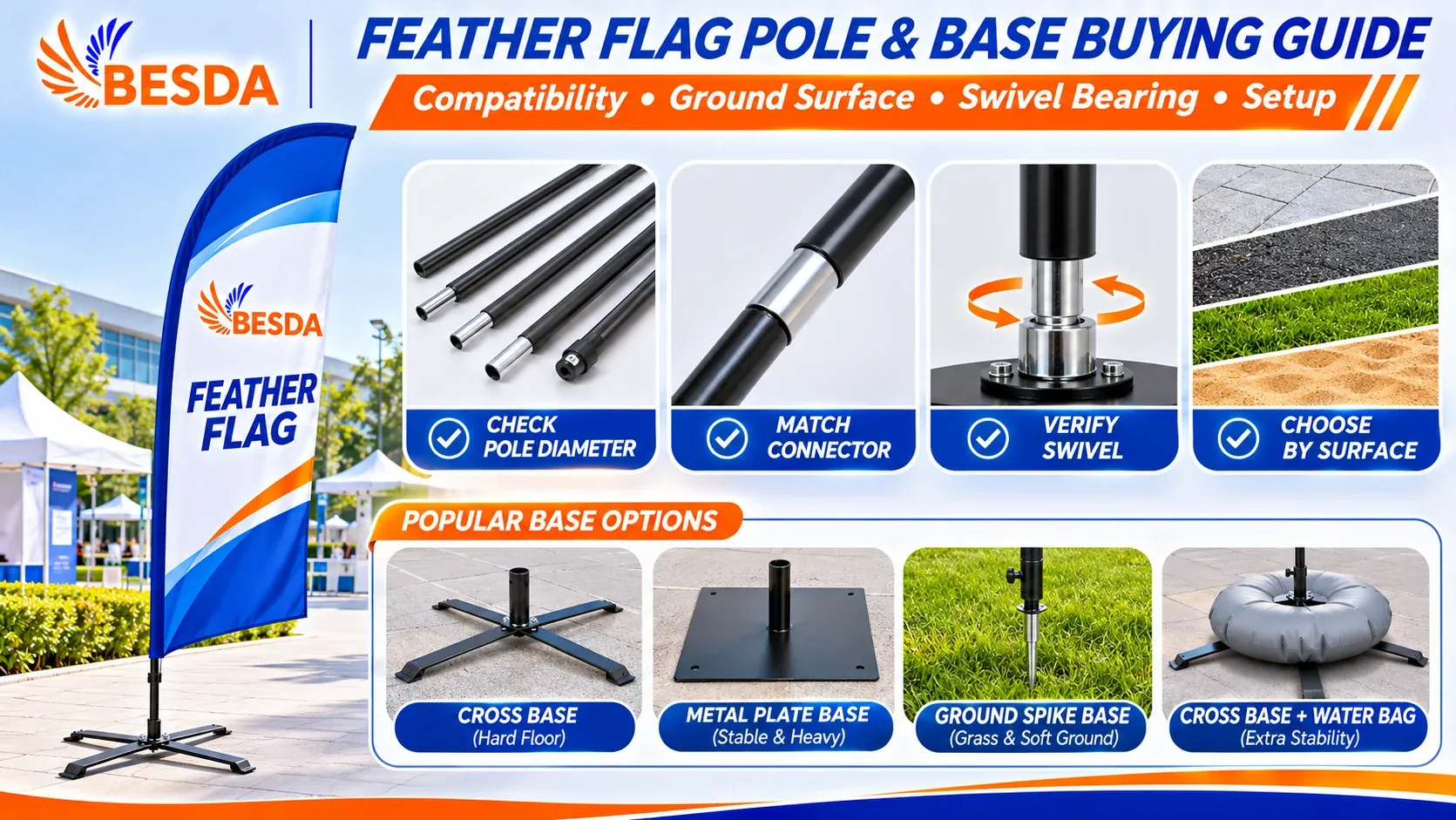
A cross base uses folding or fixed legs to create a footprint around the pole socket. It is commonly used for indoor trade shows, retail floors and other flat surfaces. Its advantages are portability, relatively quick setup and a low packed profile. Outdoors, a cross base may require a compatible water bag or other approved ballast. The correct ballast depends on the exact base and flag configuration. Do not infer stability from the shape of the metal legs alone, and do not use an unweighted cross base in exposed conditions unless the manufacturer specifically approves it.
Metal Plate Base: A Compact Indoor Option
A weighted metal plate places mass directly in the base. It can be suitable for showrooms, malls and exhibition floors where drilling or staking is not permitted. It avoids filling and emptying a water container and can present a neat footprint. Confirm the plate's actual weight, dimensions, pole socket and floor-protection details. A compact plate is not automatically the best outdoor choice: its fixed mass may be inadequate for an exposed site or a larger flag.
Ground Spike: For Suitable Soft Ground
A ground spike is driven into suitable soil, grass or sand and holds the flag pole through a compatible socket. It is light to transport and does not require water ballast. It is not suitable for concrete, asphalt, exhibition floors or locations where penetrating the ground is prohibited. Ground conditions matter. Firm compacted soil, loose dry sand and saturated ground do not provide identical holding performance. Confirm spike length, insertion depth, soil conditions and safe placement before use.
Water-Fillable Base: Ballast for Hard Ground
Water-fillable bases are portable when empty and gain weight when filled on site. They can be useful for outdoor promotions on paved surfaces where stakes cannot be used. Some models can also be filled with sand, which may be preferable where water could freeze or is unavailable—subject to the manufacturer's instructions. Check capacity, filled weight, shell construction, socket material, drainage, filling access and compatibility. A litre rating is not a complete stability specification; flag size, wind exposure and base geometry still matter.
Car Base and Other Specialist Options
A drive-on car base is designed to be secured beneath a vehicle tyre and is often used at dealerships or automotive promotions. It is not a universal substitute for a weighted base. Confirm vehicle position, tyre contact, pole socket and site safety. Heavy cross bases, rotating sockets and other specialist fittings may be available for particular use cases. The important point is to match the product code and connection dimensions to the pole kit.
Base Comparison for Buyers
Use the table as an initial selection guide, not as an engineering rating. Final suitability depends on the manufacturer's approved model, flag size and site conditions.
What to Include in a Base RFQ
Send the flag shape and finished height, quantity, indoor or outdoor location, surface type, expected exposure, pole model if known, and whether the display will be moved frequently. For a mixed order, list each flag size and base quantity separately. Ask for product photographs, dimensions, empty and filled weight where applicable, material, socket dimensions, packing method and compatibility confirmation. This avoids receiving a base that looks similar but does not fit the pole.
Quick Comparison
Cross base — Best starting point: Indoor floors and flat hard surfaces; Confirm before ordering: Leg span, socket, ballast compatibility.
Metal plate — Best starting point: Indoor showroom and exhibition use; Confirm before ordering: Actual weight, plate size, floor protection.
Ground spike — Best starting point: Suitable grass, soil or sand; Confirm before ordering: Spike length, ground condition, pole fitting.
Water-fillable base — Best starting point: Outdoor hard surfaces where ballast is permitted; Confirm before ordering: Capacity, filled weight, shell and socket.
Car base — Best starting point: Vehicle forecourts and auto promotions; Confirm before ordering: Tyre positioning, socket and site safety.
Frequently Asked Questions
Which feather flag base is best for concrete?
A cross base with compatible ballast or a weighted plate may be appropriate. Choose according to flag size, exposure, pedestrian traffic and the manufacturer's approved configuration.
What base should I use for grass?
A ground spike is a common starting point for suitable firm ground. Check soil condition, spike depth and local restrictions before installation.
Can I use a cross base outdoors?
It may be used outdoors when the exact model is designed for that use and the required ballast is installed. An unweighted cross base should not be assumed safe in exposed conditions.
Is a water base better than a metal plate?
Neither is universally better. A water base is portable when empty and can add ballast on site; a metal plate carries its weight at all times and may be convenient indoors.
Why Work With BESDA?
BESDA supplies custom flags, advertising tents, LED light boxes and portable trade show displays for B2B projects. The most useful supplier discussion starts with the real application, dimensions, artwork, hardware, installation environment, packing and delivery requirements. Product-specific specifications and compatibility should be confirmed in the approved quotation and production documents. Send BESDA your flag height, surface type, venue, quantity and destination. We will help identify compatible base options and the details that should be confirmed in the quotation.
Related BESDA resources
Deeper reading on this site: Custom Feather Flags, Water Base Systems, BESDA FAQ and BESDA Quality Control.
Next step
Send us your application, sizes, quantity, artwork status and destination, and we will reply with a specification-led quotation and a confirmed production schedule.
You can reach us on WhatsApp or by email, or use the form on the contact page for a recommendation within one working day.