News & Insights
LED SEG Light Box: A Complete B2B Buying Guide
Learn how an LED SEG light box works and compare aluminum profiles, silicone edge graphics, LED layout, brightness uniformity, power, mounting and replacement graphics.
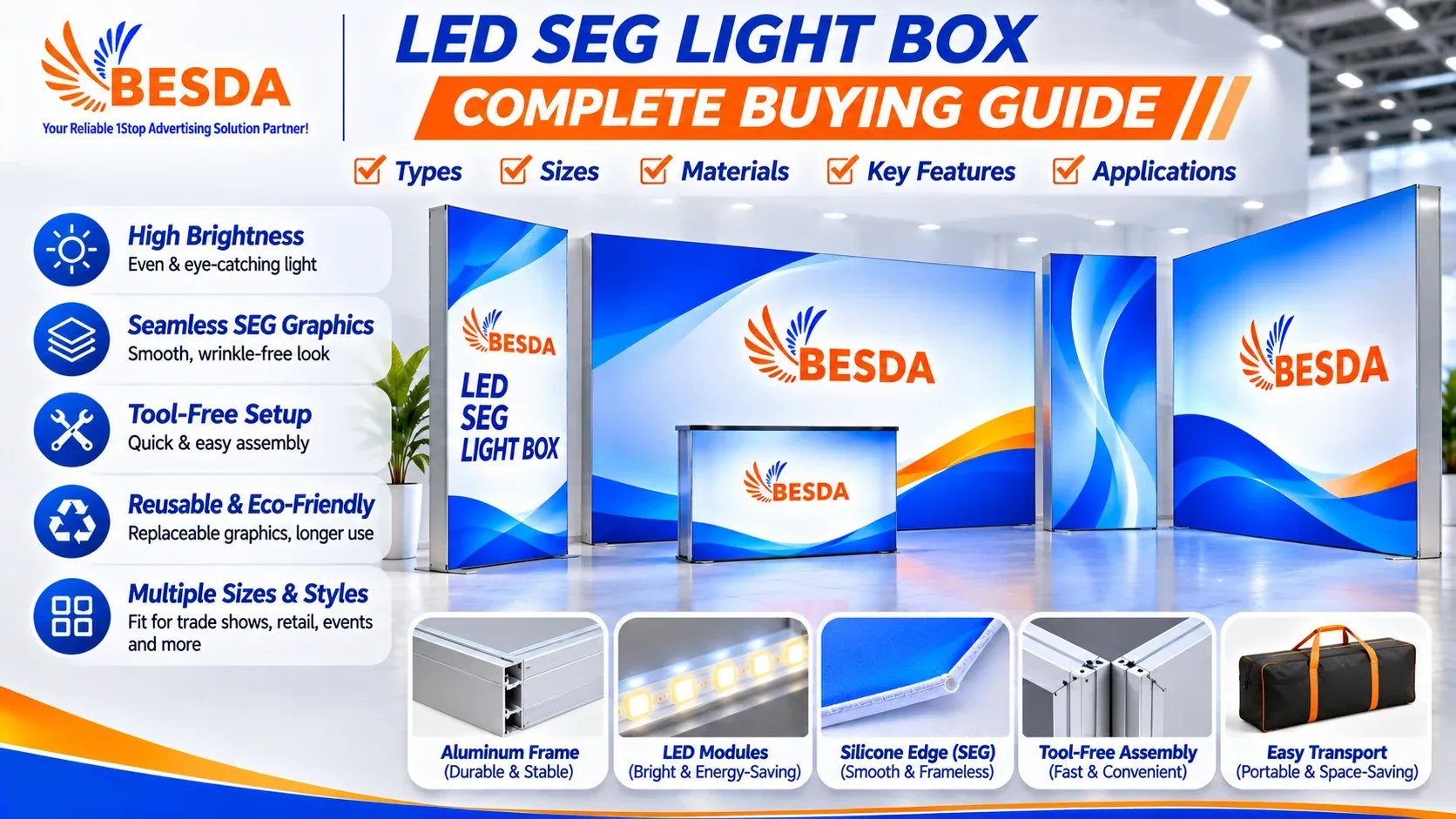
An LED SEG light box combines three systems that must work together: the aluminum frame, the illuminated LED assembly and the fabric graphic with a silicone edge. A display may look similar from the front while differing substantially in frame depth, lighting method, service access and graphic replacement. This guide explains the components and the questions B2B buyers should ask before ordering.
What Is an LED SEG Light Box?
SEG stands for Silicone Edge Graphic. A fabric graphic has a narrow silicone bead sewn around its edge. The bead is pressed into a groove in the aluminum frame, stretching the fabric across the opening. In an LED SEG light box, an LED system illuminates the graphic from behind or through an engineered edge-lighting arrangement. The result is a fabric-faced illuminated display used in retail, exhibitions, showrooms, airports and brand environments. The exact lighting layout depends on frame design and size.
How the Frame and Silicone Edge Work
The aluminum extrusion provides the perimeter structure and a channel that accepts the silicone bead. Correct graphic dimensions and bead size are important: a graphic that is too large may be difficult to install, while one that is too small may not tension evenly. Request a frame cross-section, finished graphic dimensions, silicone bead specification and installation instructions. Confirm whether the graphic is single-sided or double-sided and whether a rear fabric or rigid panel is included.
Backlit vs Edge-Lit SEG Systems
A backlit system places LEDs behind the graphic, often using modules or panels distributed across the back. An edge-lit system directs light from the frame perimeter into an optical light guide or purpose-designed structure. These layouts are not interchangeable and require different frame and graphic specifications. Ask the supplier to identify the light path, LED position, optical components and maintenance access. Do not compare wattage alone: finished brightness and uniformity depend on the complete assembly.
Frame Depth, Size and Mounting
Frame depth affects the available space for LEDs, wiring, power components and diffusion. A slim frame may be suitable for certain edge-lit designs, while a deeper cabinet may be needed for a particular backlit layout or large format. Confirm outer dimensions, visible graphic size, profile width and mounting clearance. Choose wall-mounted, freestanding, ceiling-suspended or modular construction according to the application. Confirm feet, brackets, joining hardware and access to the power supply.
Graphic Fabric, Printing and Tension
Backlit fabric needs to be selected for the intended illumination and print process. Confirm fabric composition, print method, light transmission, color profile, finished size and silicone bead dimensions. The graphic should be tensioned evenly without twisting or visible slack. Approve a sample or full-size proof under illumination where possible. Check color appearance, hotspots, wrinkles, seams, corner fit and whether the printed face is intended for front or rear viewing.
Brightness and Uniformity: What to Test
A high wattage does not automatically create a better display. Uneven LED spacing, insufficient diffusion, incorrect frame depth or unsuitable fabric can produce hotspots, dark corners or visible bands. Ask for a photograph or video of the exact configuration illuminated in a controlled environment. For a project specification, define the measurement method, viewing conditions, brightness target and acceptable uniformity. Require evidence from the finished assembly rather than relying on a component data sheet alone.
Power Supply and Electrical Compatibility
Confirm LED input voltage, total power, current, driver type, dimming method, cable exit and connector. The power supply must match the LED system's electrical requirements and the destination market. Ask whether the driver is accessible for service and whether it is included in the quotation. Check plug type, input voltage range, frequency, applicable certifications and installation instructions. Electrical requirements should be reviewed by a qualified person for the destination and installation.
Graphic Replacement and Maintenance
A key benefit of SEG is the ability to replace the fabric graphic while retaining compatible frame hardware. Record the frame model, visible opening, finished graphic size, silicone bead profile and orientation. For larger displays, ask whether replacement graphics can be shipped separately and how they should be installed. Plan access to LEDs, drivers and wiring. Ask which components are replaceable and how the frame opens for maintenance.
What to Include in an SEG Light Box RFQ
Provide overall size, visible graphic size, single- or double-sided requirement, frame depth, backlit or edge-lit preference, mounting method, LED voltage, dimming needs, destination, quantity, artwork and deadline. Request a drawing, electrical specification, graphic template, packing details and test evidence.
Comparison Table
Frame — What to confirm: Profile, depth, channel and finish; Why it matters: Determines structure and graphic fit.
Graphic — What to confirm: Fabric, print, bead size and finished dimensions; Why it matters: Controls tension and image quality.
Lighting — What to confirm: Backlit or edge-lit; LED layout; Why it matters: Determines optical design.
Uniformity — What to confirm: Finished-unit test method and evidence; Why it matters: Avoids hotspots and dark areas.
Electrical — What to confirm: Voltage, watts, current, driver and plug; Why it matters: Ensures compatible power.
Service — What to confirm: LED and driver access; Why it matters: Simplifies maintenance.
Packing — What to confirm: Frame length, gross weight and protection; Why it matters: Reduces shipping damage.
Frequently Asked Questions
What does SEG mean in a light box?
SEG means Silicone Edge Graphic. A silicone bead is sewn to the graphic edge and pressed into a groove in the frame.
Can SEG graphics be replaced?
Yes, many SEG systems are designed for replaceable graphics. The replacement must match the frame opening, bead profile and finished dimensions.
Are all SEG light boxes backlit?
No. SEG describes the graphic attachment system. The lighting may be backlit or use a specified edge-lit optical arrangement.
How do I prevent hotspots in an LED SEG light box?
Use a lighting layout, frame depth, diffuser and fabric designed together. Request an illuminated sample or finished-unit test evidence.
Can an SEG light box be double-sided?
Some frames are designed for double-sided use. Confirm the structure, lighting, graphic layers, stability and viewing requirements.
Why Choose BESDA?
BESDA supports B2B projects across custom flags, event tents, portable trade show displays, counters and illuminated signage. We approach each enquiry by confirming the actual application, dimensions, materials, frame or hardware compatibility, artwork, packaging and destination requirements. Product specifications, test evidence and delivery details should be confirmed in the approved quotation and production documents. Send BESDA your display size, single- or double-sided requirement, mounting method, lighting preference, artwork and destination market. We can help define the frame, fabric, LED and power specifications as one system.
Related BESDA resources
Deeper reading on this site: Trade Show Branding, Quality Control and Factory Tour.
Next step
Send us your application, sizes, quantity, artwork status and destination, and we will reply with a specification-led quotation and a confirmed production schedule.
You can reach us on WhatsApp or by email, or use the form on the contact page for a recommendation within one working day.