News & Insights
Why Do Feather Flags Tear in the Wind?
Learn why feather flags tear or fail outdoors. Compare fabric, stitching, pole flexibility, base stability and practical wind-safety checks before ordering custom flags.
A feather flag is designed to move in the breeze, but repeated flapping, sharp gusts, poor anchoring and incorrect assembly can turn normal movement into premature wear. If a flag tears at the sleeve, a pole section cracks, or the complete display tips over, replacing the fabric alone may not solve the underlying problem. Buyers should assess the fabric, stitching, pole, connector, base and site conditions as one system.
What Actually Causes Feather Flags to Tear?
Wind loads are dynamic. The flag fabric accelerates, changes direction and repeatedly transfers force to the sleeve, seams and pole. A loose or poorly fitted sleeve can rub against the pole; a weak seam concentrates stress; a damaged pole section can create a sharp contact point. Prolonged UV exposure, abrasion, moisture, dirt and repeated folding can also weaken textile over time. Common failure patterns point to different causes. A tear along the pole sleeve suggests friction, seam or fit issues. A split at the outer edge may indicate repeated fluttering or worn stitching. A pole that fractures near a joint may indicate impact, incorrect assembly, fatigue or exposure beyond the system's intended conditions. A toppled flag points first to the base, ballast, ground or site exposure—not necessarily the fabric.
Does Heavier Fabric Always Last Longer?
Not automatically. Fabric weight is only one part of performance. Buyers should compare textile construction, yarn, weave or knit, tear behaviour, print process, finishing, sleeve construction and the way the material flexes in use. A heavier fabric can feel substantial but may not be the best match for every pole system or wind condition. For promotional flags, the right fabric is the one tested and approved for the intended display system. Ask for a physical sample or a finished sample kit where practical. Check print clarity, colour appearance, edge finishing, sleeve dimensions and how the fabric sits on the pole. Do not select solely from a GSM number.
How Pole Design and Assembly Affect Durability
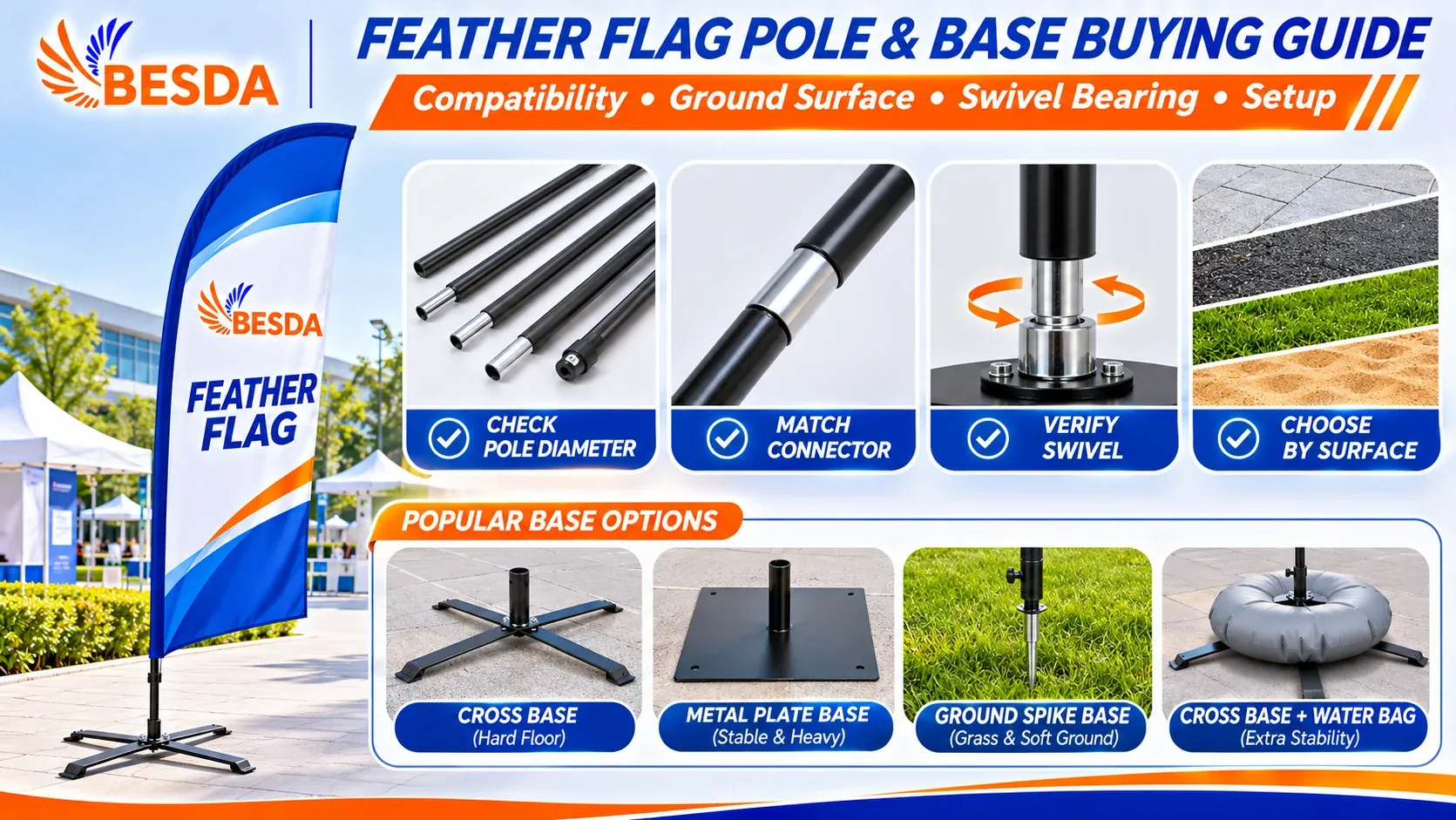
Feather flag poles commonly combine rigid and flexible sections so the assembly can support the flag shape while allowing controlled movement. The material, diameter, section joints, ferrules, connectors and assembly sequence all matter. A pole kit must be compatible with the flag size and sleeve pattern. Before deployment, check every section for cracks, deformation, loose joints or missing retaining parts. Insert sections fully and follow the supplier's assembly instructions. Do not force an incompatible section or substitute a connector because it appears to fit. For repeat campaigns, keep a record of pole model, section count and replacement-part codes.
Why the Base Matters as Much as the Flag
A flag can be well made and still become unsafe if the base does not suit the surface. A ground spike is intended for suitable soft ground; a cross base or weighted plate is used on hard, flat surfaces; a water-fillable base can add ballast where the model and site permit. A vehicle base is a specialist option for suitable vehicle display settings. Base choice must consider flag height and area, exposure, surface, pedestrian traffic, venue rules and the manufacturer's instructions. A cross base without the required ballast may slide or tip. A spike in loose sand may not hold as it would in firm soil. Never assume one base is suitable for every size or weather condition.
A Practical Pre-Event Inspection
Inspect the fabric for cuts, loose threads, seam separation, fading and contamination. Check the sleeve for abrasion and confirm the flag is not twisted around the pole. Inspect pole sections and connectors, then verify the base is the specified model and is fully assembled. Confirm the site surface and surrounding pedestrian route. Review the weather forecast and the product manufacturer's operating guidance before use. Take the flag down when conditions exceed the system's stated limits or when the site becomes unsafe. A temporary advertising flag is not a substitute for an engineered permanent structure, and no generic wind-speed claim should override site-specific safety instructions.
How to Specify a More Reliable Custom Feather Flag Order
Give the manufacturer the finished flag dimensions, shape, intended location, indoor or outdoor use, expected frequency of setup, surface type, artwork, quantity and destination. Ask the supplier to identify the compatible pole and base models in the quotation. Request evidence that relates to your exact configuration: approved artwork, fabric and finishing sample, pole-section details, connector fit, base model, packing list and final inspection photographs where available. For repeat orders, retain the approved specification and product codes so the next batch can be compared against the same standard.
When Should You Replace the Fabric, Pole or Complete Kit?
If the graphic is worn but the frame and pole remain serviceable, a replacement flag may be economical—provided the new sleeve and dimensions match the existing hardware. If the pole is cracked, joints are loose, or base compatibility is uncertain, replacing only the fabric leaves the main risk unresolved. Before ordering replacement parts, photograph the pole joints, base socket, label and full flag. Record the flag height and sleeve construction. Ask the supplier to confirm compatibility in writing rather than relying on visual similarity.
Quick Comparison
Tear along sleeve — Likely area to inspect: Sleeve fit, stitching, pole abrasion; Buyer action: Check sleeve dimensions and seam finishing.
Outer-edge tear — Likely area to inspect: Fabric wear, repeated fluttering, exposure; Buyer action: Review fabric construction and operating conditions.
Pole fracture — Likely area to inspect: Section joint, material, assembly, impact; Buyer action: Confirm pole model and replacement section.
Flag tips over — Likely area to inspect: Base, ballast, surface, exposure; Buyer action: Re-specify base for the actual site.
Frequently Asked Questions
Why do feather flags tear at the pole sleeve?
Repeated rubbing, incorrect sleeve fit, weak or damaged stitching, and pole-joint contact can contribute. Inspect the sleeve and pole together; do not assume the fabric material alone is responsible.
Are feather flags suitable for strong wind?
They are temporary promotional displays, not all-weather structures. Follow the exact manufacturer's wind and operating instructions, assess gusts and exposure, and take the display down when conditions exceed its stated limits.
Does thicker flag fabric prevent tearing?
Not by itself. Textile construction, tear behaviour, stitching, sleeve design, pole compatibility, UV exposure and use conditions all affect service life.
Can I replace only the feather flag fabric?
Often yes, if the existing pole and base are serviceable and the replacement dimensions, sleeve and attachment design match the hardware. Confirm compatibility before ordering.
Why Work With BESDA?
BESDA supplies custom flags, advertising tents, LED light boxes and portable trade show displays for B2B projects. The most useful supplier discussion starts with the real application, dimensions, artwork, hardware, installation environment, packing and delivery requirements. Product-specific specifications and compatibility should be confirmed in the approved quotation and production documents. Planning a wholesale feather flag order? Send BESDA your flag size, shape, quantity, artwork, display surface, destination and event date. We can review the flag, pole and base as one configuration before quotation.
Related BESDA resources
Deeper reading on this site: Custom Feather Flags, Water Base Systems for Flag Displays, BESDA Quality Control and BESDA Factory Tour.
Next step
Send us your application, sizes, quantity, artwork status and destination, and we will reply with a specification-led quotation and a confirmed production schedule.
You can reach us on WhatsApp or by email, or use the form on the contact page for a recommendation within one working day.