Feather Flags Buying Guide: Size, Fabric & Bases
Choose feather flags by size, fabric, pole, printing and base. Compare complete kit options and order the right setup for your event or storefront.
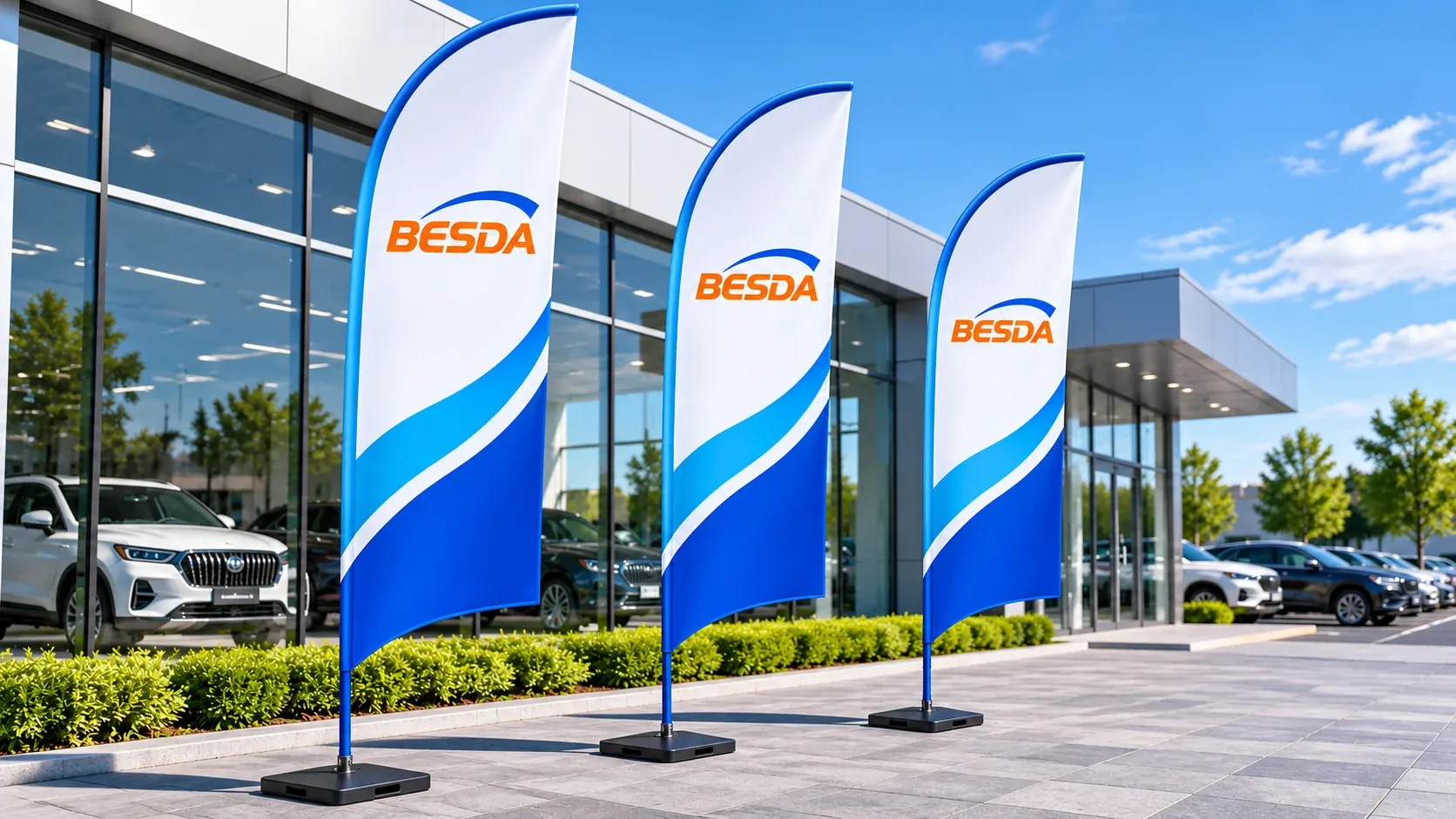
Quick answer: Choose a feather flag as a complete system—flag shape and size, fabric, pole set, print construction, base and carry bag. The correct combination depends on viewing distance, venue surface, wind exposure, message length, transport and how often the flag will be reused.
A feather flag gives a brand a tall, moving message without the footprint of a rigid sign. But buyers often compare only the printed flag price. That leaves important questions unanswered: Is the pole compatible? Does the base fit the venue? Will the message read correctly from both directions? Does the kit include the bag and hardware needed by the installation team?
What Is a Feather Flag?
A feather flag is a vertical fabric advertising banner held by a sectional flexible pole. Its long curved top and free outer edge create the familiar feather or blade-like silhouette. The fabric can move in light air, helping the display attract attention at storefronts, roadside locations, dealerships, festivals, sports events and exhibition entrances.
A complete kit normally consists of a printed flag, pole sections, a base selected for the surface and a carry bag. Depending on the supplier and configuration, the kit may also include a water bag, ground spike, pole bag or replacement hardware. Ask for an itemised list rather than assuming every accessory is included.
What Does a Feather Flag Solve?
• Creates a vertical brand marker where a full-size sign or rigid structure is impractical.
• Adds movement and height to a storefront, vehicle forecourt, event entrance or outdoor promotion.
• Provides a portable display that can be moved between locations when the base and packing system are suitable.
• Allows campaign graphics to be refreshed without replacing the entire hardware kit when pole and flag sleeve remain compatible.
• Supports consistent branding across multiple locations when sizes, print files and kit components are standardised.
When and Where Should You Use Feather Flags?
Use feather flags when the message needs to be seen from a distance or above parked vehicles, low displays or a busy pedestrian approach. Common applications include car dealerships, retail promotions, real-estate launches, sports events, races, festivals, food outlets, trade show entrances and temporary roadshows.
A feather flag is not a substitute for a regulated traffic sign, permanent sign structure or engineered wind-rated installation. Do not place it where it blocks accessible routes, creates a trip hazard or conflicts with venue rules.
Feather Flag Size Guide
BESDA's existing feather-flag catalogue lists a six-size example range. These dimensions are a reference for planning; confirm the actual graphic size, assembled pole height and base height on the final specification.
Catalogue size: XS · Flag graphic (W × H): 60 × 200 cm · Approx. pole height: 280 cm
Catalogue size: S · Flag graphic (W × H): 60 × 240 cm · Approx. pole height: 340 cm
Catalogue size: M · Flag graphic (W × H): 70 × 290 cm · Approx. pole height: 400 cm
Catalogue size: L · Flag graphic (W × H): 70 × 325 cm · Approx. pole height: 460 cm
Catalogue size: XL · Flag graphic (W × H): 75 × 360 cm · Approx. pole height: 500 cm
Catalogue size: XXL · Flag graphic (W × H): 75 × 410 cm · Approx. pole height: 560 cm
Choose graphic height and total assembled height separately. The base, pole profile and top section affect total display height. For a roadside site, check visibility over parked vehicles and landscaping. For a trade show, confirm ceiling clearance and event rules.
Flag Fabric: 100D, 110gsm and 130gsm Are Not the Same Unit
Common options include knitted polyester around 110gsm, other fabric weights such as 115gsm or 130gsm, 100D constructions and mesh. GSM is fabric mass per square metre. Denier (D) describes yarn linear density. A 100D label does not tell you the finished fabric's gsm, weave, coating or durability.
Fabric option: Knitted polyester around 110gsm · What to confirm: Finished gsm, knit construction, print method and edge finishing · Buyer implication: A common lightweight option for portable printed flags
Fabric option: Heavier polyester options · What to confirm: Actual gsm, stiffness, colour saturation and packed weight · Buyer implication: May change how the flag moves and handles
Fabric option: Mesh fabric · What to confirm: Mesh opening, print coverage, edge strength and intended exposure · Buyer implication: Can be considered where airflow is part of the design requirement
Fabric option: 100D reference · What to confirm: Yarn denier plus finished fabric gsm and construction · Buyer implication: Do not compare a denier value directly with gsm
Do not select fabric by the number alone. Ask for a physical sample or finished flag made from the proposed fabric, especially when the order will be repeated across multiple designs.
Pole Construction: Aluminium, Fibreglass or a Combination
Pole construction: Aluminium + fibreglass top · Potential use: Lower-section support with a flexible top section · Questions to ask: Which sections are aluminium or fibreglass? What are the diameters and replacement codes?
Pole construction: Full aluminium · Potential use: Consistent metal pole system · Questions to ask: What are wall thickness, finish, section connection and compatibility?
Pole construction: Full fibreglass · Potential use: Flexible pole option for selected designs · Questions to ask: What are rod diameter, section strength and replacement availability?
The sleeve must match the pole shape and diameter. Check the number of pole sections, top profile, elastic cord or connector arrangement, and whether a replacement section can be purchased separately.
How to Choose the Right Base
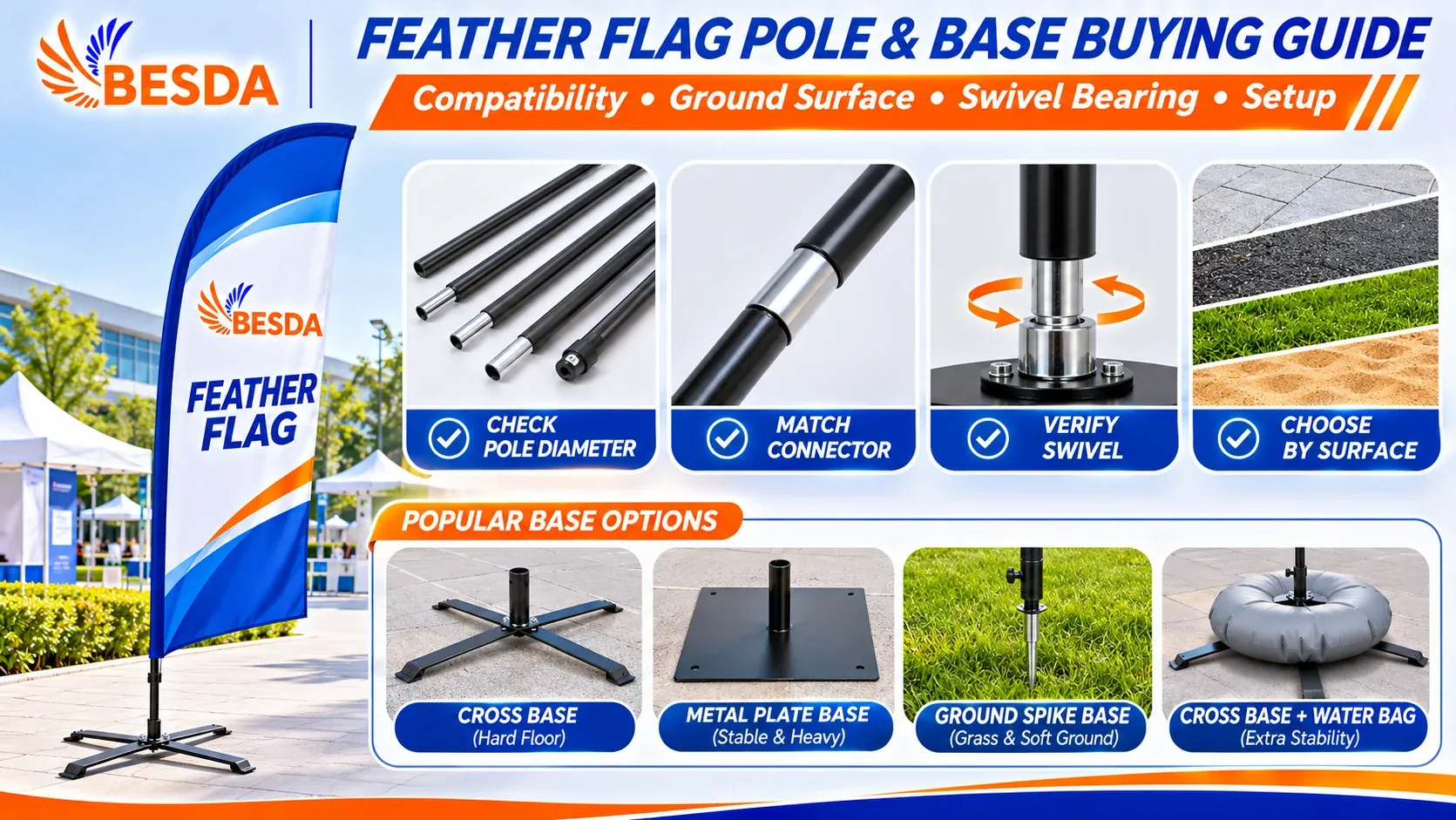
Venue surface: Grass or soft soil · Base options to discuss: Ground spike or compatible stake · What to confirm: Insertion depth, soil condition, pole spindle and removal method
Venue surface: Concrete or paving · Base options to discuss: Cross base, weighted plate or water-fill system with suitable ballast · What to confirm: Base footprint, ballast weight, trip risk and wind exposure
Venue surface: Indoor hard floor · Base options to discuss: Metal plate or cross base with protective feet · What to confirm: Floor protection, stability, display height and visitor circulation
Venue surface: Vehicle forecourt · Base options to discuss: Vehicle/tire base where the design supports it · What to confirm: Vehicle compatibility, safe placement and access clearance
Venue surface: High-exposure outdoor site · Base options to discuss: Approved anchoring and ballast arrangement · What to confirm: Model-specific operating limits and venue weather plan
A base is not a decorative accessory. It is part of the stability system. A lightweight cross base may be convenient on a trade show floor but may need additional ballast outdoors. Never infer a safe wind speed from the base name.
Single-Sided vs Double-Sided Feather Flags
Option: Single-sided print-through · Construction: Artwork is printed on one face; reverse usually appears mirrored and less saturated · Best fit: Cost-conscious campaigns where reverse readability is not critical
Option: Double-sided with blockout · Construction: Two printed faces separated by a blockout layer and sewn into one graphic · Best fit: Two-way viewing where both sides must read correctly
Double-sided construction can increase fabric weight, sewing complexity, cost and sometimes the demands on the pole system. Confirm whether the two faces can carry different artwork, how the blockout is constructed and whether the pole set is rated for that graphic.
How to Choose a Feather Flag: Six Steps
1. Map the viewing direction: one direction or both?
2. Measure the venue: footprint, height clearance, viewing distance and nearby obstructions.
3. Choose the flag size; keep the main logo or message large enough to read.
4. Select fabric by finished gsm, weave, print quality and intended use—not just a marketing label.
5. Match pole and base to the surface; confirm section compatibility and ballast requirements.
6. Confirm the complete kit and artwork proof, including all parts, packing and replacement components.
How to Install and Care for Feather Flags
Assemble the pole sections in the sequence supplied with the model, insert the pole through the flag sleeve, connect the top section and secure the lower end to the selected base. Keep fabric clear of sharp edges and check that the base is fully seated. Follow the supplier's instructions for the specific base and any rotating spindle.
After an event, remove the flag before packing, allow it to dry fully if wet, clean it with a mild method suitable for the fabric and store it away from sharp hardware. Inspect stitching, sleeve wear, pole joints, elastic connectors and base fittings before the next campaign.
Printing, Production and Quality Checks
• Check logo orientation, safe area, text size and pole-pocket position.
• Compare printed colour with the approved Pantone reference under agreed viewing conditions; a digital screen preview is not a physical colour guarantee.
• Inspect stitching, sleeve reinforcement, hems and fabric alignment.
• Verify the correct pole sections, base, bag and spare parts are packed for each kit.
• Request pre-shipment photographs or inspection records for the actual order.
Features, Advantages and Buyer Benefits
Feature: Tall curved silhouette · Advantage: Creates a visible vertical marker · Buyer benefit: Helps a site or promotion stand out
Feature: Lightweight fabric and sectional pole · Advantage: Can be packed and moved between locations · Buyer benefit: Supports mobile campaigns and repeat events
Feature: Choice of pole and base · Advantage: Hardware can be matched to the venue · Buyer benefit: Reduces setup and compatibility problems
Feature: Single- or double-sided print · Advantage: Graphic construction can match viewing direction · Buyer benefit: Balances readability, weight and budget
Feature: Replaceable flag skin where compatible · Advantage: Graphics may be refreshed without replacing all hardware · Buyer benefit: Can improve repeat-program economics
Common Buying Mistakes
• Choosing a base before confirming the site surface and flag height.
• Comparing 100D and 110gsm as if they were equivalent measurements.
• Assuming single-sided print will read correctly from both directions.
• Ordering a replacement flag without checking sleeve dimensions and pole compatibility.
• Putting long paragraphs or small contact details on a narrow vertical flag.
• Accepting a generic 'windproof' claim without the full setup and operating conditions.
Why Consider BESDA for a Feather Flag Program?
BESDA's product range includes advertising flags, tents, portable displays and signage. For distributors and event agencies, the useful question is whether the supplier can standardise flag size, print specification, pole/base combination, carry bag and carton labelling across repeat orders. Ask for the written specification and sample approval process before committing to a program.
Order SOP: What to Send in Your Feather Flag RFQ
1. Flag shape, graphic size and assembled pole height.
2. Quantity by design, destination country and required delivery date.
3. Fabric type and finished gsm; note if a sample is required.
4. Single-sided or double-sided printing, with artwork for each face if applicable.
5. Pole construction and replacement-pole requirements.
6. Base type matched to the actual venue surface and exposure.
7. Carry bag, water bag, spare parts, carton labels and packing requirements.
8. Vector artwork, colour references and final proof approval contact.
Frequently Asked Questions
What size feather flag should I choose?
Choose by viewing distance, surrounding obstacles, available footprint and transport. Use the supplier's graphic size and total pole height chart, then confirm the actual dimensions on the quotation.
Does a feather flag need wind to be visible?
The fabric can move in air, but visibility also depends on shape, print contrast, installation and viewing direction. Do not assume the flag will remain fully readable in every wind condition.
Can I use one base for every flag size?
Not necessarily. Base compatibility and ballast requirements depend on flag height, pole system, surface and exposure. Ask for the approved combination.
Should I order single-sided or double-sided printing?
Choose single-sided when a mirrored reverse is acceptable. Choose double-sided when the message must read correctly from both directions.
Can I reorder only the printed flag?
Often yes, if the replacement graphic matches the original pole and sleeve specification. Keep the model code and dimensions with the artwork file.
Request a Feather Flag Kit Recommendation
Send BESDA the venue surface, flag height, viewing direction, quantity, artwork and delivery destination. We can review the complete kit requirements before quotation.