Teardrop Flag Buying Guide: Size, Pole & Base
Compare teardrop flag sizes, fabrics, pole sets, bases and print options. Learn how to specify a custom teardrop beach flag for events, retail and outdoor promotion.
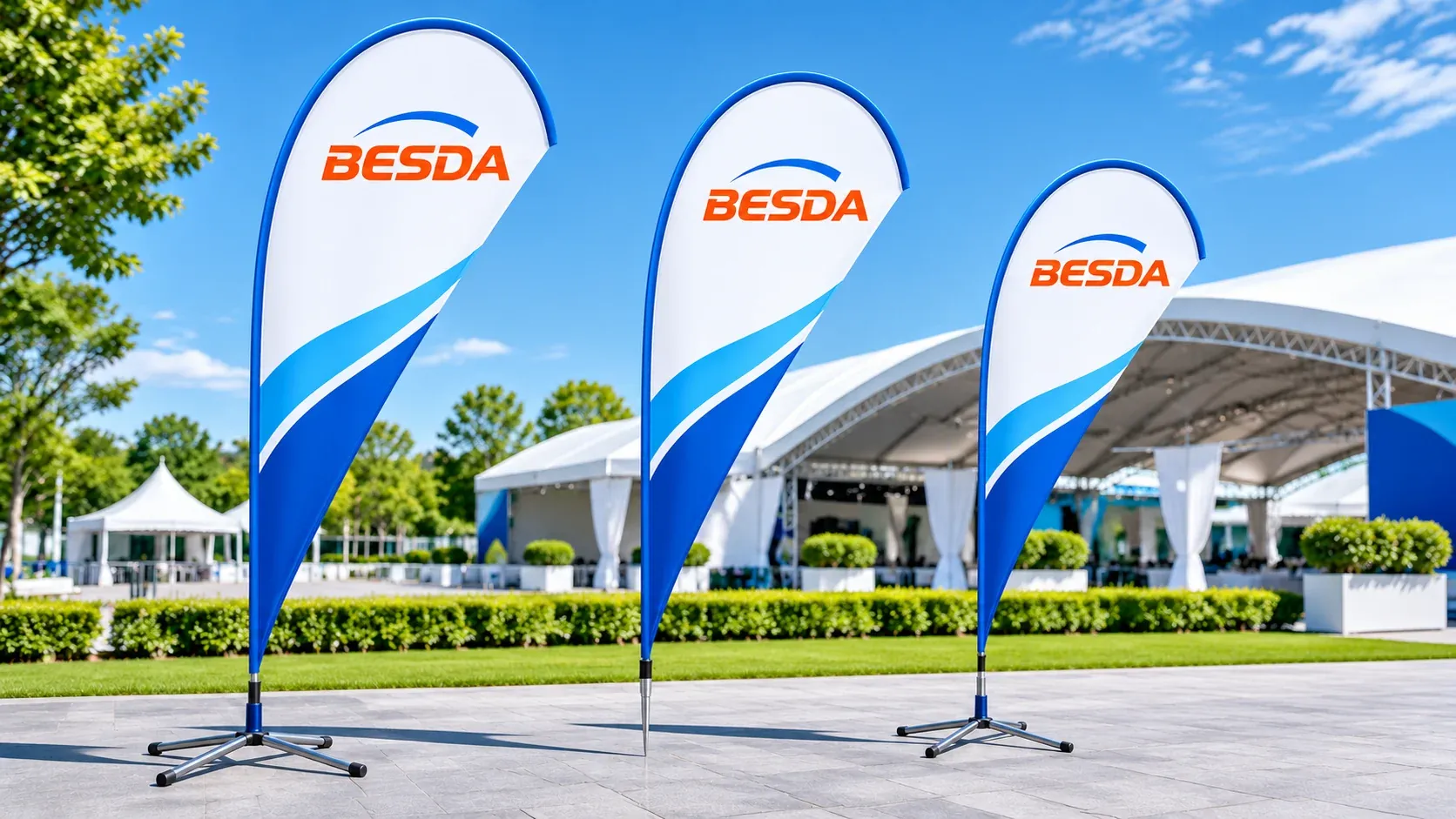
Quick answer: A teardrop flag is a shaped fabric banner supported by a curved sectional pole. Choose it when the compact waterdrop silhouette suits your brand layout. The correct purchase depends on graphic dimensions, pole height, fabric, print construction, base, venue surface and the way the message must read.
A teardrop flag and a feather flag may appear similar in a supplier catalogue, but they are not interchangeable graphics. The pole path, sleeve, top curve and printable area differ. If you approve a design using the wrong template, important text can move too close to a seam or become distorted when the fabric is tensioned.
What Is a Teardrop Flag?
A teardrop flag is a vertical advertising flag with a rounded, waterdrop-like outline. A flexible pole follows the curved upper profile and supports the fabric in a defined shape. The complete display normally includes the printed flag, pole sections, a base and a carry bag, with exact kit contents depending on the quotation.
The product is also described as a teardrop beach flag, flying flag or advertising flag. These names can overlap with other flag shapes in marketplace listings. Ask the supplier to confirm the actual silhouette using a dimensioned drawing or finished product photograph—not only a text label.
What Does a Teardrop Flag Solve?
• Creates a compact, recognisable flag shape for storefronts, events and promotional sites.
• Provides a vertical brand message where a rigid sign would take more floor space.
• Supports a repeatable hardware program when replacement graphics use the same pole and sleeve specification.
• Offers single- or double-sided print options to suit the viewing direction.
• Can be combined with feather flags, tents and other portable displays for a coordinated campaign.
When and Where Should You Use Teardrop Flags?
Teardrop flags are useful at retail entrances, real-estate launches, car dealerships, sports events, exhibition areas, food outlets, festivals and temporary brand activations. Their compact profile can work well where a buyer wants a shaped vertical message but does not need the longer free-edge layout of a feather flag.
Teardrop Flag Size Guide
The existing BESDA teardrop catalogue shows the following example combinations. Confirm the latest production template, graphic dimensions and assembled height before approving artwork.
Example graphic size (W × H): 75 × 165 cm · Approx. pole height: 280 cm
Example graphic size (W × H): 85 × 190 cm · Approx. pole height: 340 cm
Example graphic size (W × H): 95 × 230 cm · Approx. pole height: 400 cm
Example graphic size (W × H): 110 × 260 cm · Approx. pole height: 460 cm
Example graphic size (W × H): 110 × 300 cm · Approx. pole height: 500 cm
Example graphic size (W × H): 130 × 330 cm · Approx. pole height: 560 cm
The size decision should consider more than total height. Check how much graphic is visible after the pole sleeve and curved seams are taken into account. The message should remain legible at the expected viewing distance, and top clearance should suit the venue.
Fabric and Printing Options
Common flag fabrics include knitted polyester, other polyester constructions and mesh. BESDA's published teardrop information lists polyester options such as 90g, 100D and 110g references, plus mesh. Ask for the finished gsm and fabric construction because denier and gsm measure different things.
Print configuration: Single-sided print-through · What the buyer sees: Reverse is usually mirrored and less saturated · Best-fit decision: One main viewing direction or cost-sensitive campaigns
Print configuration: Single-sided reverse orientation · What the buyer sees: Pole pocket can be positioned to suit viewing direction · Best-fit decision: When the flag is approached from a specific side
Print configuration: Double-sided with blockout · What the buyer sees: Two separately printed faces with a blocking layer between them · Best-fit decision: Two-way visibility where both sides need correct reading direction
For double-sided flags, ask how the faces are joined, what blockout material is used and how the extra weight affects the pole system. Do not assume the two faces can use different artwork unless the order specification confirms it.
Pole Options and Compatibility
Pole type: Aluminium with fibreglass top section · Buyer checks: Confirm which sections are aluminium or fibreglass, joint design and replacement codes.
Pole type: Full aluminium · Buyer checks: Confirm alloy, section diameter, wall thickness, finish and compatibility with the sleeve.
Pole type: Full fibreglass · Buyer checks: Confirm rod diameter, flexibility, section connection and spare-part availability.
The pole must follow the correct teardrop curve. A pole set made for a feather shape may not create the same tension or outline. Confirm model code, section count, assembled length and sleeve dimensions before purchasing replacement graphics.
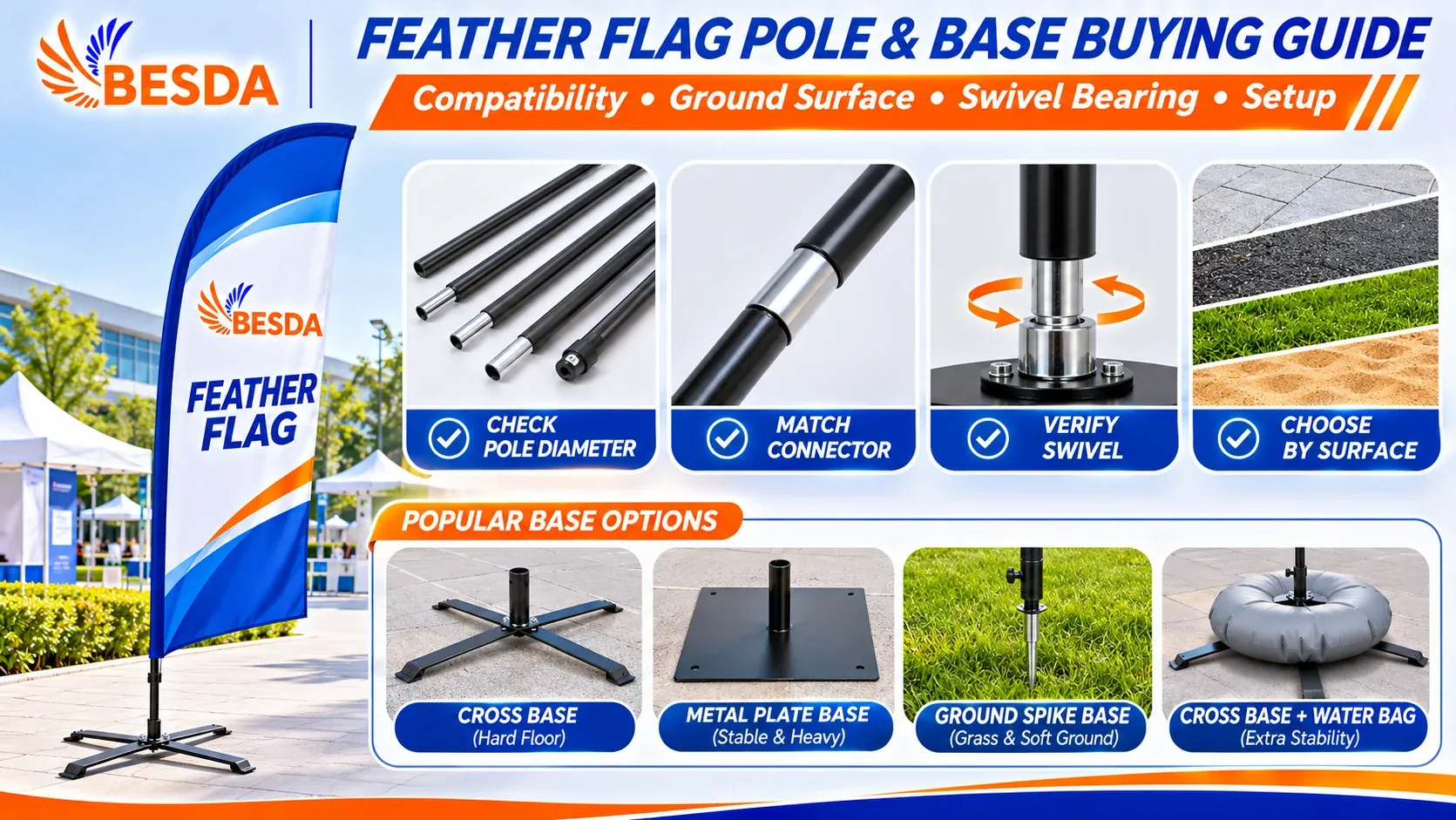
Choose a Base for the Actual Surface
Installation surface: Grass or soil · Possible base choice: Ground spike · Buyer checks: Ground condition, insertion depth, pole connection and removal method
Installation surface: Concrete or paved floor · Possible base choice: Cross base or metal plate · Buyer checks: Footprint, ballast, floor protection and trip risk
Installation surface: Indoor exhibition floor · Possible base choice: Cross base or weighted plate with protective feet · Buyer checks: Venue rules, circulation and floor finish
Installation surface: Vehicle promotion · Possible base choice: Compatible car/tire base · Buyer checks: Safe positioning around vehicles and correct pole connection
Installation surface: Outdoor exposed location · Possible base choice: Approved ballast or anchoring system · Buyer checks: Model-specific operating limits and weather procedure
Water bags or water-fill bases can add ballast where the product is designed for them. Confirm fill volume, closure, drainage and base compatibility. A base that fits the pole is not automatically sufficient for every surface or exposure.
Teardrop vs Feather Flag: Which Should You Choose?
Decision: Shape · Teardrop flag: Rounded, waterdrop-like outline · Feather flag: Longer blade/feather-like outline with a free edge
Decision: Graphic planning · Teardrop flag: Compact layout; text must respect curved top and sleeve · Feather flag: More elongated message area; layout follows blade profile
Decision: Brand impression · Teardrop flag: Distinct, compact silhouette · Feather flag: More flowing shape and visible fabric movement
Decision: Main selection issue · Teardrop flag: Correct pole curve, sleeve and printable area · Feather flag: Flag width, curved edge and message hierarchy
Decision: Best next step · Teardrop flag: Approve teardrop-specific template · Feather flag: Approve feather-specific template
Neither shape is universally better. If the design contains a short logo and one message, either may work. If the message needs a longer vertical hierarchy, compare the actual print area. For a program with both shapes, ask whether the same base family can be standardised without assuming the poles are interchangeable.
Artwork Rules for Teardrop Flags
• Use the supplier's exact teardrop template, not a feather-flag file resized to fit.
• Keep essential logos, phone numbers and small text away from curved seams and pole sleeves.
• Check whether the pole pocket sits on the left or right when viewed from the front.
• Use a high-resolution vector logo and convert fonts to outlines before final production where required.
• Confirm bleed, safe area, finished graphic size and whether each side has separate artwork.
• Approve a realistic mock-up showing the front, reverse, sleeve and curved top.
How to Choose and Order a Teardrop Flag
1. Choose the teardrop shape and identify the intended application.
2. Select graphic size and assembled pole height using the current size chart.
3. Choose fabric by construction, finished gsm and print requirements.
4. Decide between single-sided print-through and double-sided blockout construction.
5. Select a compatible pole set and base for the venue surface.
6. Approve the artwork template, pocket direction, colour references and proof.
7. Confirm kit contents, packing, quantity, delivery destination and required date.
Installation, Care and Quality Control
Follow the model-specific installation sheet. Assemble the pole sections in order, insert the pole into the correct sleeve, connect the base and check fabric tension. Do not force a section or pull fabric against a sharp edge. Confirm the base is fully seated before opening the display to visitors.
After use, remove and dry the flag before packing. Check the sleeve, curved top seam, pole joints, connector cord and base. Store the fabric clean and dry, and keep the model code with the artwork so replacement flags can be ordered to the correct dimensions.
• Artwork: check shape, pocket direction, safe area and print orientation.
• Fabric: check material identification, colour, edge stitching and sleeve reinforcement.
• Pole: check section count, fit, connection and replacement-part identification.
• Base: check type, finish, connection and ballast components.
• Packing: check one complete kit per agreed carton or bag configuration.
Features, Advantages and Buyer Benefits
Feature: Waterdrop-like outline · Advantage: Recognisable compact flag profile · Buyer benefit: Distinct visual identity at entrances and retail sites
Feature: Curved supporting pole · Advantage: Maintains intended silhouette when correctly assembled · Buyer benefit: More consistent shape than a loose rectangular banner
Feature: Single- or double-sided options · Advantage: Matches graphic construction to viewing direction · Buyer benefit: Better control over readability and cost
Feature: Multiple pole and base options · Advantage: Can be matched to surface and use case · Buyer benefit: Fewer compatibility surprises at installation
Feature: Replaceable flag graphic where compatible · Advantage: Campaign graphics can be refreshed separately · Buyer benefit: Supports repeat orders and multi-season programs
Why Consider BESDA for Teardrop Flags?
BESDA supplies a broader range of advertising flags, tents, portable displays and signage. For distributors and agencies, a useful sourcing partner should keep the flag template, pole specification, base selection, artwork revision and packing details consistent across repeat orders. Ask for the model-specific drawing and written kit list before approving bulk production.
Order SOP: What to Include in Your Teardrop Flag RFQ
1. Flag shape and graphic dimensions.
2. Pole height, material and section count.
3. Fabric type and finished gsm.
4. Single-sided or double-sided print construction.
5. Base type and installation surface.
6. Artwork template, pocket direction and colour reference.
7. Quantity, carry bag, packing, destination and required delivery date.
8. Sample or pre-production approval requirement.
Frequently Asked Questions
What makes a teardrop flag different from a feather flag?
A teardrop flag has a compact waterdrop-like outline held by a curved pole path. A feather flag has a longer blade-like silhouette and a different message area. Choose by artwork, viewing distance and desired shape.
What size teardrop flag should I order?
Match graphic dimensions and assembled pole height to viewing distance, site clearance and message length. The published BESDA range is a reference; confirm the current model chart.
Can a teardrop flag be printed double-sided?
Yes, configurations may include two separately printed faces with a blockout layer. Confirm construction, thickness, weight and pole compatibility.
Which base should I use on concrete?
A cross base or weighted plate may be suitable, depending on flag size and exposure. Confirm ballast requirements and pole compatibility.
Can I reorder only the teardrop flag graphic?
This is possible when replacement sleeve, pole profile, dimensions and attachment details match the original kit. Keep the specification and model code.
Request a Teardrop Flag Quote
Send BESDA the flag size, venue surface, viewing direction, print-side requirement, quantity, artwork and delivery destination. We can review the kit configuration before quotation.