News & Insights
Star Tent vs Double Star Tent Guide
Compare star tents and double star tents by roof geometry, footprint, support structure, branding area, anchoring, transport and event application.
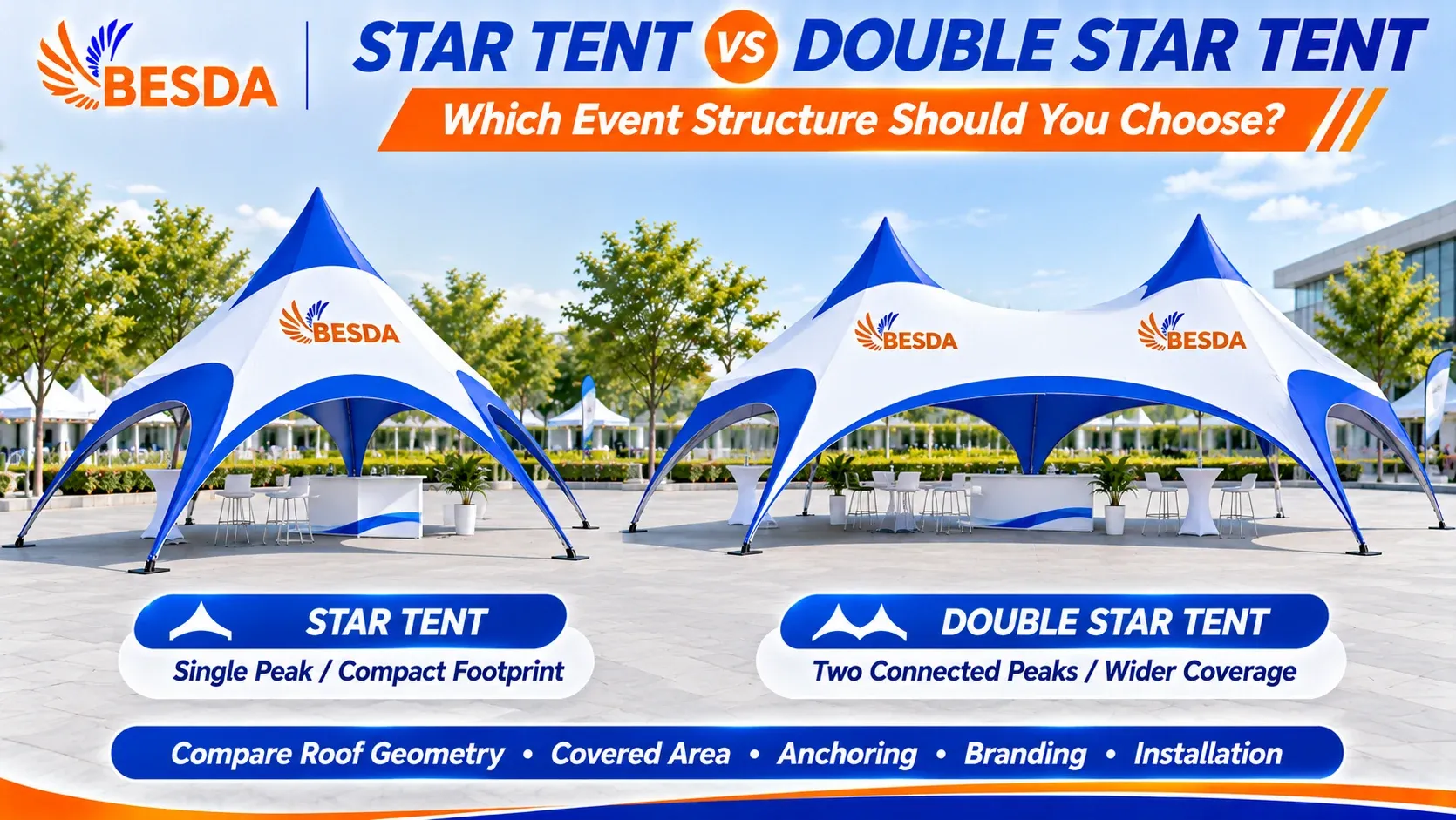
Star tents are chosen for their dramatic silhouette and large overhead branding area. Double star tents extend that visual concept into a broader or more complex event footprint. The names alone do not tell you the usable covered area, support arrangement or installation requirements. Before comparing quotations, review the actual plan, elevation drawing and anchoring layout.
What Is a Star Tent?
A star tent is a fabric canopy supported by one or more masts and tensioned through perimeter anchor points. The raised center and radiating fabric panels create a recognizable star-like roof profile. It is often used for festivals, outdoor hospitality, brand activations and gathering spaces. The number of peaks, mast positions, perimeter points and fabric panels vary by design. Request a dimensioned drawing rather than estimating the covered area from a promotional photograph.
What Is a Double Star Tent?
A double star tent generally refers to a larger arrangement that combines two star-shaped canopy sections or two prominent peaks into one connected shelter. The exact configuration may use shared support points, separate masts or a purpose-designed connecting structure. Because the term is not a universal engineering standard, ask the manufacturer to define the exact model: number of masts, peak heights, connection method, overall footprint and perimeter anchor count.
Roof Geometry and Covered Area
A high central peak can create an open, dramatic interior, but the usable sheltered area depends on the roof profile, mast positions, fabric tension and weather exposure. Measure the clear area at the height where people, counters or equipment will be placed. For a double arrangement, identify whether the central connection creates a valley, overlap or continuous canopy. Ask how rainwater is managed and whether the connection requires additional supports.
Support Structure and Installation
Confirm mast material, mast height, base plate or ground fixing, perimeter hardware, tensioning method and installation sequence. Large tensile structures may require specialist installation and a defined site plan. Ask for the complete installation manual, crew requirements, lifting equipment if applicable and inspection points. Do not assume a large star tent can be erected like a small pop-up canopy.
Anchoring and Site Conditions
Star-shaped canopies rely on tension and perimeter anchoring. The required anchor type depends on soil, concrete, asphalt, paving, buried services and site permissions. Ask for model-specific anchor loads and approved ground-fixing details. Wind creates uplift and lateral loads. Follow the manufacturer's operating limits and event engineer's instructions. Do not use improvised weights as a substitute for an engineered anchoring plan.
Branding and Fabric Options
The large fabric roof can provide a strong overhead branding surface. Ask which panels can be printed, whether the artwork is visible from below and above, and how seams, mast sleeves and tension points affect the design. Approve a panel-by-panel artwork template. Keep logos and critical text away from seams, high-tension areas and locations that may fold during packing.
Weather, Water Runoff and Safety
Ask whether the design includes a drainage plan, rainwater collection points or specific orientation requirements. A roof that looks symmetrical in a render may behave differently when installed on uneven ground or exposed to wind. Confirm the permitted weather conditions, inspection frequency and evacuation or dismantling procedure. A decorative canopy is not automatically rated for severe weather.
Transport, Storage and Reuse
Compare fabric panel dimensions, mast length, hardware cases, total package count and gross weight. A double arrangement may require more transport volume and more installation hardware than a single star tent. For touring use, label each fabric panel and hardware component, record the assembly sequence and inspect seams, webbing, ropes and connectors after each event.
How to Choose Between the Two
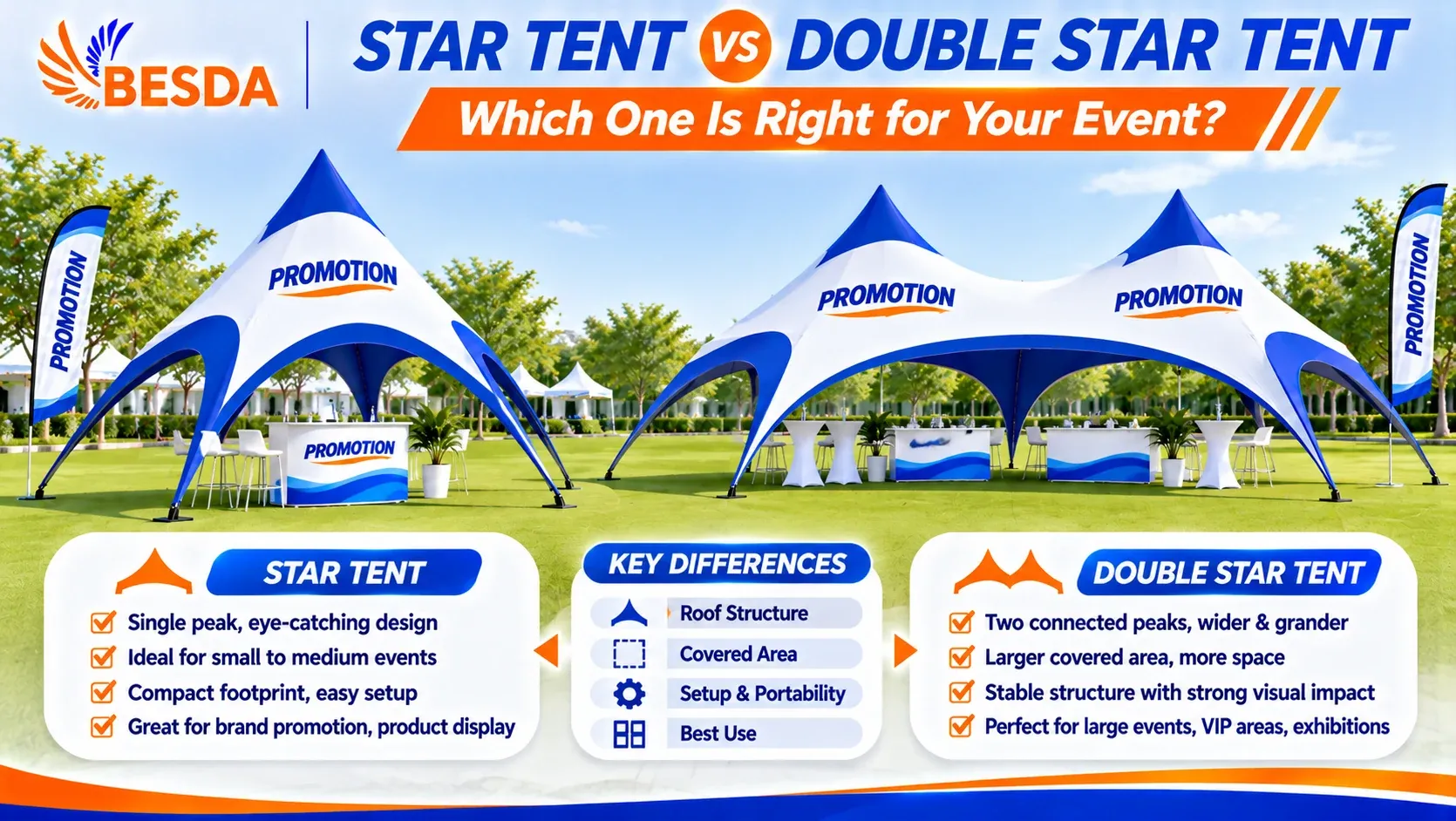
Choose a single star tent when its footprint and visual profile meet the event brief with a manageable installation plan. Consider a double star configuration when the project needs a broader covered zone or a more prominent architectural presence and the site can accommodate its supports and anchors. Base the decision on the dimensioned layout, usable area, wind plan, installation budget, access routes, branding and logistics—not the product name alone.
Star Tent RFQ Checklist
Provide overall footprint, peak heights, number of peaks, clear covered area, mast locations, ground type, anchor method, print coverage, weather exposure, installation crew, packed dimensions, destination and quantity. Request plan and elevation drawings, material specifications and installation documentation.
Comparison Table
Key check — Single star tent: Anchor layout and clear area; Double star tent: Connection detail, drainage and combined wind plan.
Factor — Single star tent: Single star tent; Double star tent: Double star tent.
Roof layout — Single star tent: One star canopy arrangement; Double star tent: Two connected or coordinated peak sections.
Footprint — Single star tent: Usually simpler to plan; Double star tent: May need more space and anchor points.
Installation — Single star tent: Model-specific mast and perimeter setup; Double star tent: Potentially more complex support and connection sequence.
Branding — Single star tent: Large overhead fabric panels; Double star tent: More panel area, more artwork coordination.
Logistics — Single star tent: Fewer components in many configurations; Double star tent: Potentially more masts, panels and hardware.
Frequently Asked Questions
Is a double star tent simply twice the size of a star tent?
Not necessarily. Dimensions and covered area depend on the specific geometry and connection design. Request drawings.
How many anchor points does a star tent need?
The number and loads are model-specific. Use the manufacturer's installation drawing and site engineering requirements.
Can star tents be printed with custom logos?
Many designs offer custom fabric printing. Confirm printable panels, artwork templates and viewing direction.
Can a star tent be used in strong wind?
Only within the manufacturer's approved conditions and with the specified anchoring. Stop use when limits are exceeded.
Why Choose BESDA?
BESDA supports B2B projects across custom flags, event tents, portable trade show displays, counters and illuminated signage. We approach each enquiry by confirming the actual application, dimensions, materials, frame or hardware compatibility, artwork, packaging and destination requirements. Product specifications, test evidence and delivery details should be confirmed in the approved quotation and production documents. Send BESDA your event footprint, desired peak arrangement, ground surface, branding coverage and installation location. We can help review whether a single or double star configuration fits the project.
Related BESDA resources
Deeper reading on this site: Outdoor Event Branding, Factory Tour and Quality Control.
Next step
Send us your application, sizes, quantity, artwork status and destination, and we will reply with a specification-led quotation and a confirmed production schedule.
You can reach us on WhatsApp or by email, or use the form on the contact page for a recommendation within one working day.