News & Insights
Single vs Double-Sided Feather Flags | BESDA
Compare single-sided and double-sided feather flags by print construction, reverse visibility, weight, cost, wind movement and the best use for each.
The choice between single-sided and double-sided feather flags is not simply a matter of paying for more printing. It changes how the message reads from the reverse, how the fabric is constructed, how much the finished flag weighs and what pole-and-base combination may be appropriate. Start with the direction of visitor traffic and the importance of readable text on both faces.
What Is a Single-Sided Feather Flag?
A typical single-sided flag is printed on one layer of polyester. The ink shows through the textile, so the reverse is visible as a mirror image and may appear less saturated. This construction is lighter and is often a cost-effective choice when most viewers approach from one direction or when the reverse does not need to read correctly. A mirrored reverse can work for simple graphics, large symbols or a logo that remains recognizable when reversed. It is less suitable for phone numbers, URLs, directional arrows or text that must be read correctly from both sides. Always review a front-and-back mock-up before approving artwork.
What Is a Double-Sided Feather Flag?
A common double-sided construction uses two separately printed fabric panels with an opaque blockout layer between them. The panels are sewn together so each face can display the artwork in the correct reading direction. Some systems allow different designs on the two faces; others repeat the same design. The blockout layer reduces show-through, but it adds material and weight. That extra weight can influence the pole system and base requirements. Confirm the complete flag kit, not just the graphic, when comparing supplier quotations.
Single-Sided vs Double-Sided: Main Differences
Single-sided is generally lighter and less expensive, with a mirrored reverse. Double-sided is generally heavier and costs more, but offers correct-reading artwork on both sides. Neither construction is universally better: the right option depends on viewing direction, message complexity, budget, wind exposure and the approved pole-and-base system.
When Should You Choose Single-Sided?
Choose single-sided when the flag is positioned against a building, fence or boundary and most people see the printed face. It can also suit simple artwork where a mirrored reverse is acceptable. Its lower weight can help the flag move freely, but the full system must still be used within its operating instructions.
When Is Double-Sided Worth the Extra Cost?
Choose double-sided when visitors approach from both directions, such as a car-park entrance, open walkway, road junction, exhibition aisle or event perimeter. It is particularly useful when text, a phone number, QR code or directional message must read correctly from either side. If the two sides carry different messages, label the artwork clearly as Face A and Face B. Confirm pole orientation and the viewing direction in the proof.
How the Construction Affects Poles and Bases
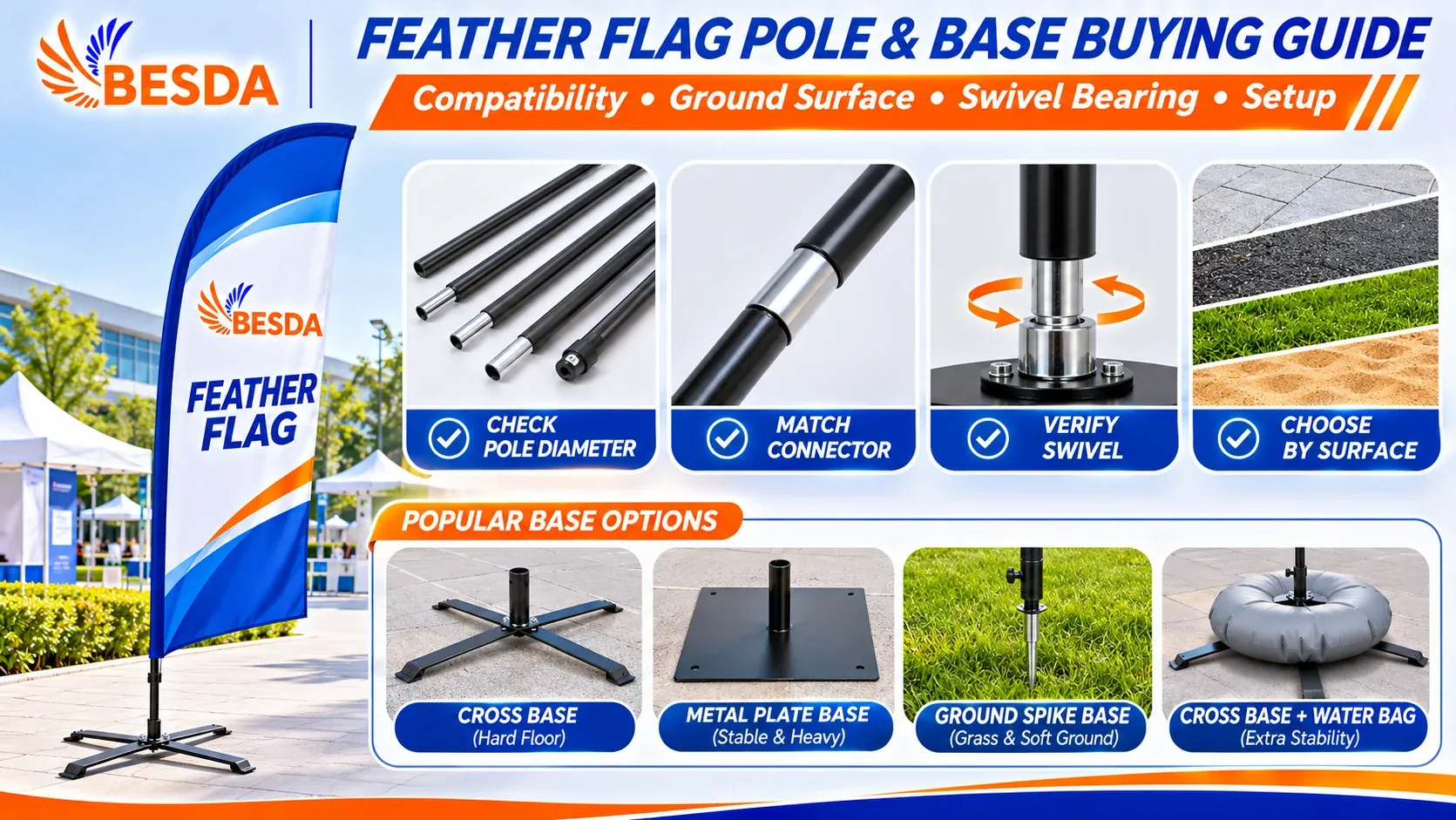
Because a double-sided graphic can be heavier, ask the manufacturer to confirm the compatible pole sections, connectors, base and size range. Do not assume the base supplied for a single-sided flag is automatically suitable for a heavier double-sided version. Site exposure and flag dimensions also matter. Request the assembled kit weight, recommended base model and any product-specific operating limitations. A larger or heavier base does not by itself establish a safe wind rating.
Artwork and Quality Checks Before Production
For single-sided artwork, verify whether the reverse mirror image is acceptable. For double-sided artwork, check that both faces are correctly oriented and that the blockout construction prevents unwanted show-through. Review color, seam placement, pole sleeve, bottom finish and any reinforcement details. Approve a physical sample when color, fabric hand-feel, opacity or two-face alignment is commercially important. Retain the approved proof and construction specification for repeat orders.
Quick Comparison
Graphic layers — Single-sided: Usually one printed fabric layer; Double-sided: Two printed faces with blockout layer in common constructions.
Reverse view — Single-sided: Mirrored; may be less saturated; Double-sided: Correct-reading artwork on both faces.
Weight — Single-sided: Usually lighter; Double-sided: Usually heavier.
Cost — Single-sided: Usually lower; Double-sided: Usually higher.
Best use — Single-sided: One-direction viewing; simple graphics; Double-sided: Two-way traffic; text readable from both directions.
Frequently Asked Questions
Does the back of a single-sided feather flag read backwards?
Usually yes. The ink shows through the fabric, so the reverse appears mirrored. Confirm the exact fabric and print construction with the supplier.
Does double-sided mean two printed fabrics?
A common construction uses two printed panels with a blockout layer between them. Suppliers may use different constructions, so request a cross-section or written specification.
Are double-sided feather flags heavier?
Generally yes, because they contain additional material. Confirm the total graphic weight and compatible pole and base for the chosen size.
Can each side have a different design?
Many double-sided constructions allow different artwork on each face. Confirm this option, face orientation and proofing requirements before production.
Why Choose BESDA?
BESDA supports B2B projects involving custom advertising flags, event tents, LED light boxes and portable display systems. A reliable quotation begins with the actual application, dimensions, materials, artwork, hardware, installation environment, packing and delivery requirements. Product-specific specifications and compatibility should be confirmed in the approved quotation and production documents. Send BESDA your flag size, viewing directions, artwork, quantity, display surface and event location. We can help confirm whether single-sided or double-sided construction and which matched pole/base kit should be quoted.
Related BESDA resources
Deeper reading on this site: Custom Feather Flags, BESDA Quality Control and Feather Flag vs Teardrop Flag Guide.
Next step
Send us your application, sizes, quantity, artwork status and destination, and we will reply with a specification-led quotation and a confirmed production schedule.
You can reach us on WhatsApp or by email, or use the form on the contact page for a recommendation within one working day.