Pagoda Tent Buying Guide: Size, Frame & Fabric
Compare pagoda tent sizes, frames, canopy fabrics, sidewalls, anchoring and packing. Use this B2B buyer guide to specify an event tent for your venue and project.
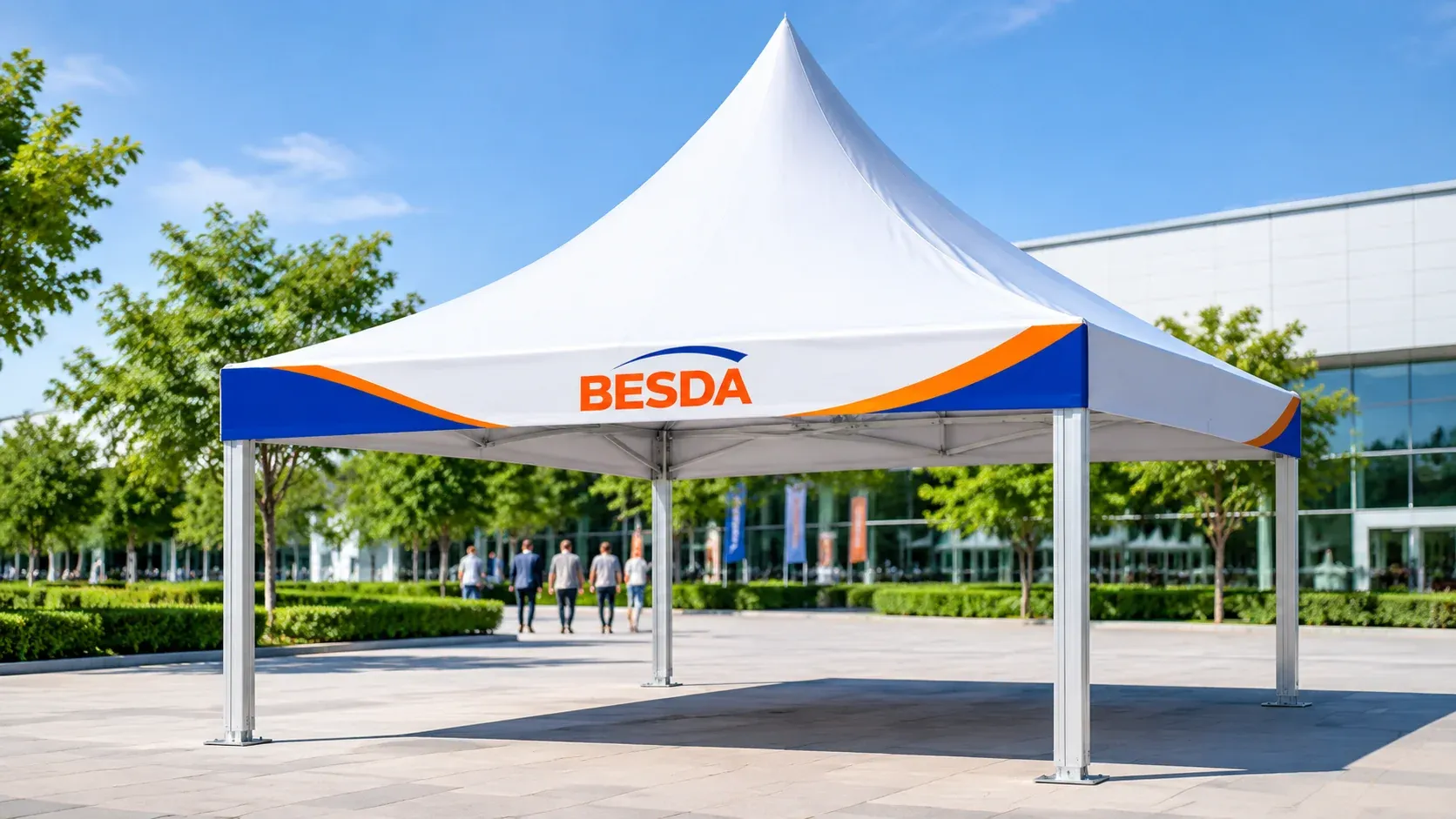
Quick answer: A pagoda tent is a high-peak event tent chosen for a distinctive roof profile and branded shelter. Before ordering, confirm whether you need a folding portable high-peak canopy or a modular framed marquee; then match size, frame, fabric, sidewalls, anchoring and packing to the actual site.
What Is a Pagoda Tent?
A pagoda tent is an event shelter with a raised central peak and sloping roof panels. The high roof creates a recognisable silhouette that can carry a brand message above a crowd. Depending on the product family, the frame may be a folding pop-up structure or a modular aluminium-frame system. Sidewalls, doors, rain gutters, weights, anchors and transport bags may be optional or model-specific.
The terms pagoda tent, canopy tent, gazebo and marquee are not used consistently in every market. Canopy tent is a broad description; pagoda describes the roof profile. Gazebo is often used for smaller portable shelters, while marquee commonly describes a larger event tent in some markets. Request a drawing and component list so the product name does not hide a structural difference.
What Problems Does a Pagoda Tent Solve?
• A high-peak roof helps a booth or entrance stand out from rows of flat-roof canopies.
• An enclosed footprint creates a defined space for registration, sampling, catering, product display or hospitality.
• Printed roof panels and sidewalls turn the shelter into a visible brand asset.
• Compatible gutters and linked units can help create a larger footprint when the structure is designed for that purpose.
• A coordinated kit can reduce sourcing friction when tents, flags, table covers and displays are purchased together.
When and Where Should You Use One?
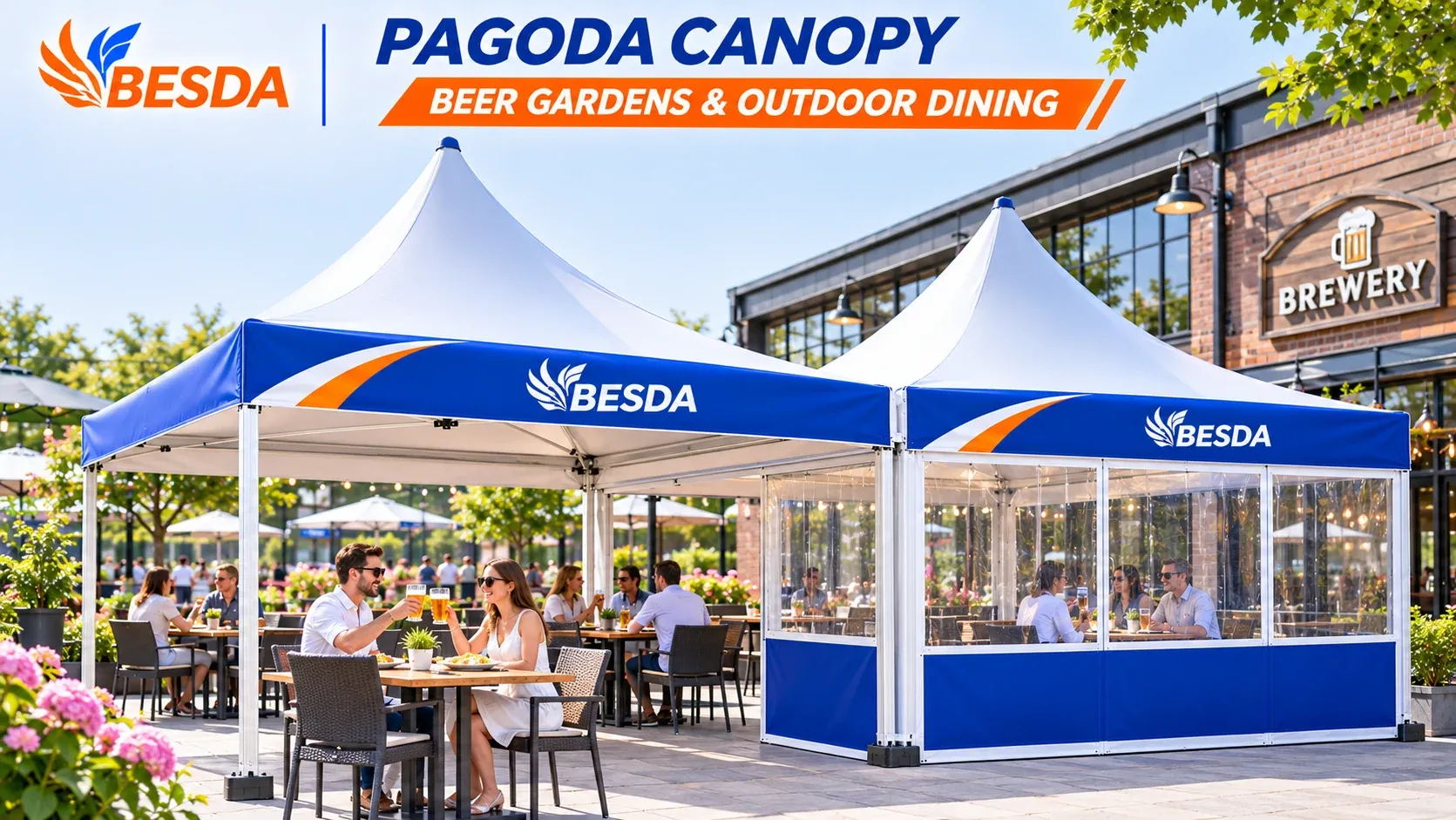
Pagoda tents are commonly considered for outdoor brand activations, food and community festivals, sports events, temporary retail, exhibition entrances, ticketing, information points, catering and VIP hospitality. They are useful when a defined footprint and a distinctive roofline matter more than a completely open floor plan.
Do not select a portable promotional tent as a substitute for an engineered long-duration structure. If the site is exposed, the event is large, units will be joined, or local wind and snow conditions are demanding, request model-specific structural information and an anchoring plan before purchase.
First Decision: Folding High-Peak or Modular Pagoda Structure?
Decision factor: Main priority · Folding high-peak canopy: Portability, repeated setup and compact storage · Modular pagoda marquee: Larger footprint, modular expansion and event infrastructure
Decision factor: Frame · Folding high-peak canopy: Folding members and locking points · Modular pagoda marquee: Extruded profiles, connectors and engineered joints
Decision factor: Transport · Folding high-peak canopy: Designed around manageable packed components · Modular pagoda marquee: Longer/heavier components; handling needs planning
Decision factor: Best fit · Folding high-peak canopy: Brand roadshows, pop-up promotions and smaller event footprints · Modular pagoda marquee: Larger events, connected units and demanding temporary installations
Decision factor: Must verify · Folding high-peak canopy: Locking system, frame profile, packed size and setup instructions · Modular pagoda marquee: Profile dimensions, connector details, structural calculations and anchoring
Do not assume every pagoda tent has a central pole or that every model is clear-span. Some folding high-peak designs use a telescoping mast; other modular systems use perimeter frames and a different roof-support arrangement. Ask for a frame drawing and confirm how much clear interior space remains.
How to Choose the Right Size
Common catalogue footprints include 3 × 3 m, 4 × 4 m, 5 × 5 m and 6 × 6 m, although the available range depends on the structure. Treat these as planning examples, not universal standards. Measure the usable footprint and include entrance clearance, queue space, counter depth, equipment, staff movement and accessible routes.
Example footprint: 3 × 3 m · Approx. floor area: 9 m² · Planning question: Is this a single registration, sampling or information point?
Example footprint: 4 × 4 m · Approx. floor area: 16 m² · Planning question: Do staff and visitors need to move around a counter or product display?
Example footprint: 5 × 5 m · Approx. floor area: 25 m² · Planning question: Will the space include hospitality, multiple counters or sidewall zones?
Example footprint: 6 × 6 m · Approx. floor area: 36 m² · Planning question: Does the larger structure require a modular system, additional crew or engineered anchoring?
Frame Materials: Aluminium or Steel?
Frame option: Aluminium alloy · Potential advantage: Often lighter to handle and naturally corrosion resistant · What to verify: Alloy/temper if specified, profile shape, dimensions, wall thickness and joint design
Frame option: Powder-coated steel · Potential advantage: Can offer a cost-conscious frame option and robust sections · What to verify: Steel thickness, coating quality, rust protection at joints, total weight and handling
Do not compare frames by material name alone. A well-designed frame depends on section geometry, wall thickness, joint reinforcement, locking details and quality control. Ask the supplier to put actual profile dimensions and frame weight on the quotation.
Canopy Fabrics: Oxford, PU Coating and PVC
BESDA's existing Pagoda product information lists 300D, 420D, 500D and 600D Oxford options with PU coating, plus a heavy-duty PVC option for projects needing a different construction. These are not interchangeable descriptions. Denier (D) describes yarn linear density; gsm describes fabric mass per square metre. A denier value cannot be converted directly into gsm without knowing the yarn and fabric construction.
Fabric family: 300D–600D Oxford with PU coating · Where it may fit: Portable promotional canopies where packed weight and handling matter · Questions to ask: Finished fabric weight, coating, water-resistance test and seam construction?
Fabric family: PVC-coated polyester · Where it may fit: Heavier-duty or larger temporary structures, depending on design · Questions to ask: Fabric weight in g/m², base textile, coating, fire test, seam method and repair procedure?
Fabric family: Printed sidewall fabric · Where it may fit: Branding, privacy, screening or weather protection depending on configuration · Questions to ask: Plain or printed? How does it attach? Can it be removed or replaced?
Do not assume a heavier fabric automatically makes the entire tent safer. The frame, seams, roof tension, anchors, ground conditions and weather procedure all matter. Fire-retardant claims should identify the exact fabric, test standard, certificate holder and destination-market relevance.
Sidewalls, Doors, Gutters and Other Configurations
• Open-sided: better access and airflow for sampling or visitor interaction.
• Half-height or partial walls: useful for defining a counter zone while retaining visibility.
• Full sidewalls: can provide more branding or screening, subject to site conditions.
• Windows and doors: confirm panel material, opening direction, zips and replacement options.
• Rain gutters: use only compatible components designed for the specific connected tent system.
• Weight plates, water barrels or ground anchors: choose according to the surface, tent design and approved installation plan.
How to Choose a Pagoda Tent: Seven Buyer Steps
1. Define the job: event type, visitors, equipment, operating hours and expected reuse frequency.
2. Measure the site: footprint, surface, overhead clearance, nearby structures and delivery access.
3. Choose the structure: folding high-peak canopy or modular pagoda marquee.
4. Confirm the frame: profile dimensions, wall thickness, connectors, locking details and total packed weight.
5. Choose roof and wall fabric: construction, coating, print method and test evidence.
6. Plan anchoring and weather procedures: obtain the model-specific plan and operating limits.
7. Approve the complete specification: artwork, dimensions, accessories, packing list, sample/proof and delivery date.
Installation, Use and Maintenance
Use the instruction manual for the exact model; this is a planning checklist, not a substitute for the manufacturer's instructions. Inspect the ground and mark the footprint, identify frame members, assemble and lock the frame as instructed, attach the canopy without forcing seams, tension the roof evenly, install compatible sidewalls and secure approved anchors or ballast. Before opening to visitors, inspect locks, joints, fabric tension, trip hazards and circulation routes.
Follow the manufacturer's operating limits and the event organiser's weather plan. Do not improvise anchors. After use, dry the fabric fully before storage, clean it with a suitable mild method, inspect seams and joints, and store poles and fabric as directed.
Production and Quality Checks Buyers Should Request
• Frame: profile dimensions, joint fit, locking operation and coating condition.
• Fabric: material identification, coating, print alignment, seam strength and roof-panel fit.
• Artwork: colour approval, panel orientation, logo safe area and repeat alignment.
• Accessories: sidewall compatibility, gutter fit, anchors/weights and carry-bag dimensions.
• Packing: component count, protective wrapping, carton/bag dimensions, gross weight and spare-parts list.
Features, Advantages and Buyer Benefits
Feature: High-peak roof profile · Practical advantage: More recognisable silhouette than a flat roof · Buyer benefit: A clearer visual landmark at crowded events
Feature: Custom printed canopy and walls · Practical advantage: Branding can be applied to the shelter itself · Buyer benefit: A more consistent event identity
Feature: Choice of frame and fabric systems · Practical advantage: Configuration can match transport and use frequency · Buyer benefit: Less risk of buying a structure that is unsuitable for the job
Feature: Compatible accessories · Practical advantage: Walls, gutters and anchoring can be planned as one kit · Buyer benefit: Fewer last-minute sourcing gaps
Feature: Replaceable textile options where supported · Practical advantage: Graphics or textile components may be refreshed separately · Buyer benefit: Better planning for repeat campaigns
Common Buying Mistakes
• Choosing by roof shape without identifying the actual frame architecture.
• Comparing 600D Oxford with 850g/m² PVC as if the numbers measured the same thing.
• Accepting a wind-load number without the model drawing, anchor configuration and test/calculation basis.
• Ordering sidewalls or gutters before confirming compatibility.
• Approving a logo mock-up without checking real panel seams, orientation and safe areas.
• Comparing quotations that do not include the same frame, fabric, accessories, packing and delivery terms.
Why Consider BESDA for Your Pagoda Tent Program?
BESDA works across custom flags, event tents, portable displays and signage. For buyers coordinating an outdoor promotion or a multi-product event package, that breadth can simplify artwork coordination, product matching and shipment planning. The right supplier relationship should be built around a written specification—not a broad promise of 'premium quality'.
• Request one itemised specification covering frame, canopy, walls, anchors, accessories and packing.
• Ask for a design proof and confirm which colours are matched by Pantone reference and which are printed from CMYK artwork.
• Request product-specific QC photographs or video for the actual order.
• Discuss replacement canopy panels, sidewalls and hardware compatibility before placing a repeat-order program.
• Review the Quality Control and Warehouse & Logistics pages for evidence relevant to the order.
Order SOP: What to Include in Your RFQ
1. Send event type, installation country, event date and expected use duration.
2. Specify footprint, required entrance clearance and folding or modular structure.
3. Select frame material and provide any required profile or engineering specification.
4. Choose Oxford or PVC fabric, roof colour, printing coverage and sidewalls.
5. List doors, windows, gutters, weights, anchors, carry bags and spare parts.
6. Attach vector artwork and identify brand colour references.
7. Confirm quantity, sample requirement, packing preference, shipping destination and required date.
8. Review quotation, drawing, proof, sample or pre-production approval before authorising bulk production.
Frequently Asked Questions
What is the difference between a pagoda tent and a canopy tent?
Canopy tent is a broad product category. Pagoda describes a high-peak roof style. The frame may be folding or modular, so compare structure, packed size and installation requirements.
Is Oxford fabric or PVC better for a pagoda tent?
Oxford is often considered for portable promotional canopies; PVC-coated polyester is common in heavier temporary structures. Compare construction, weight basis, coating, seams and test documents.
Can a pagoda tent be printed with a full-colour logo?
Custom printing is available on many models. Confirm whether artwork covers roof panels, valance and sidewalls, and approve a proof showing seams and panel orientation.
Can I connect several pagoda tents together?
Some modular systems offer compatible gutters or linking components. Confirm the exact tent series supports connection and obtain installation and anchoring details.
Can you guarantee a wind speed?
A generic guarantee is not appropriate. Ask for the specific model's engineering basis, anchor arrangement, site assumptions and operating procedure. Local event rules and weather decisions still apply.
Request a Pagoda Tent Recommendation
Send BESDA your site dimensions, event type, surface, quantity, artwork and required delivery date. We can review the information and help identify which pagoda structure and accessory package should be quoted.