News & Insights
LED Rotating Signage Motor & Installation
Understand rotating sign motor selection, bearings, alignment, vibration, wiring, mounting, commissioning and maintenance checks.
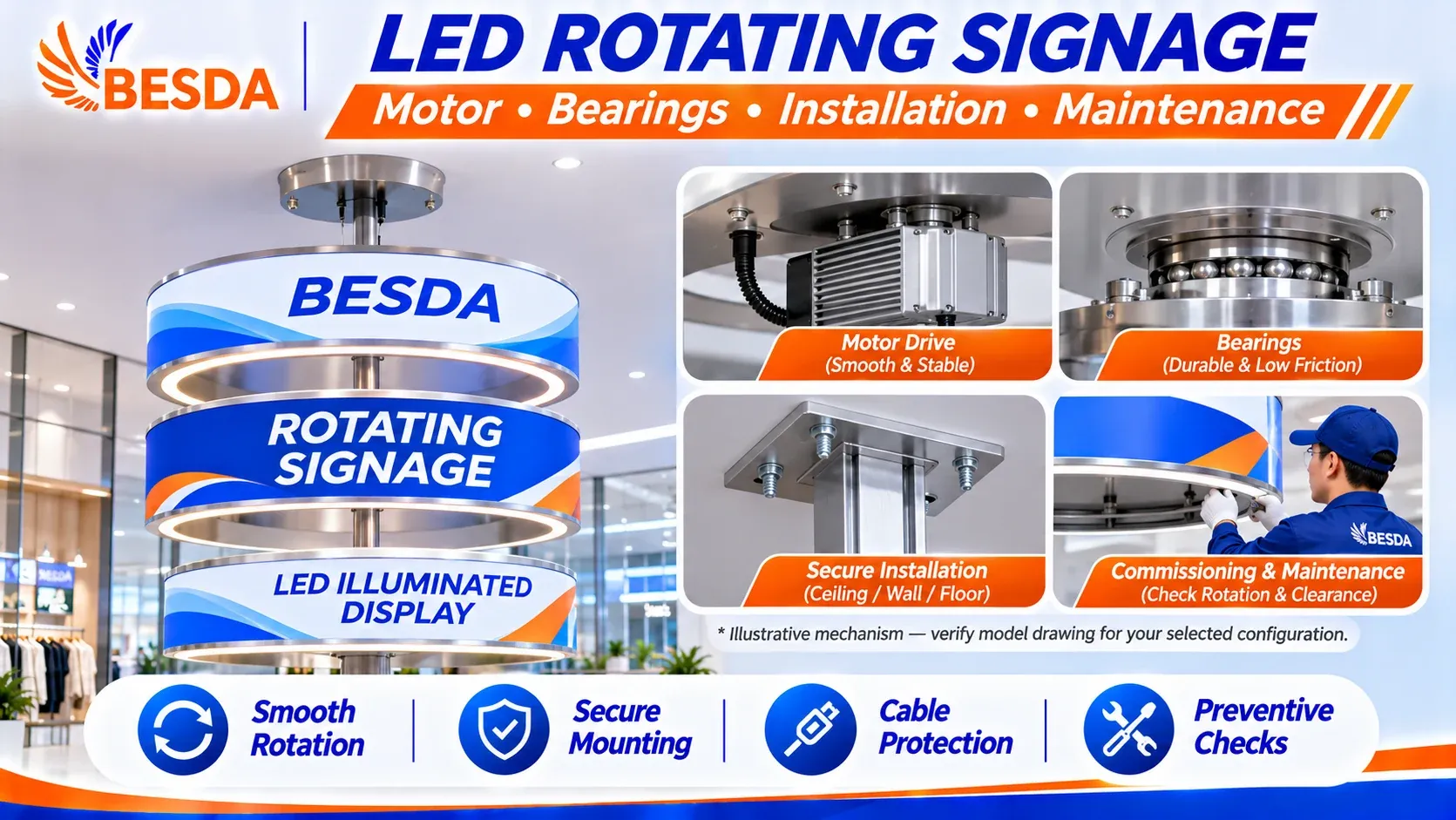
When an LED rotating sign runs smoothly, viewers notice the message—not the mechanism. When it wobbles, scrapes or becomes noisy, the display quickly looks unreliable and may become unsafe. Understanding the motor, bearings, shaft alignment and mounting system helps buyers specify a better product and helps installers plan commissioning and maintenance.
How a Motorized Rotating Sign Works
A fixed support holds the sign assembly while a motor drives a shaft or transmission connected to the rotating display. Bearings support the rotating parts and help control friction and alignment. LEDs illuminate the sign faces or graphic panels. The design may use direct drive, gears, belts or another transmission. Ask the supplier for a mechanical drawing rather than assuming all rotating signage uses the same mechanism.
Motor Selection: Torque, Speed and Duty Cycle
Motor selection depends on the mass and geometry of the rotating assembly, friction, acceleration, desired speed and operating schedule. A motor's rated power alone does not fully describe its ability to start and rotate a specific load. Request rated voltage, power, torque or load information where available, speed range, duty cycle, starting behavior, noise and thermal limits. Avoid substituting a motor based only on physical size.
Bearings and Rotating Support
Bearings support the shaft or rotating platform and help maintain smooth motion. Their selection depends on load direction, radial and axial forces, speed, environment and maintenance requirements. Ask which bearing assembly is used, whether it is sealed or protected, how it is lubricated if applicable, and whether it can be replaced as a service part.
Shaft Alignment and Balance
Misalignment can increase friction, noise, vibration and wear. An unevenly distributed graphic or panel mass can also create imbalance as the sign rotates. The mounting surface must be level and structurally suitable for the unit. During inspection, look for visible wobble, changing gaps, scraping, loose fasteners and vibration transmitted to the mounting surface. Do not continue operation if abnormal movement is observed.
Mounting and Structural Support
Ceiling, wall and floor installations have different load paths and fixing requirements. Confirm the total weight, center of gravity, fixing pattern, substrate, fastener specification and clearance around the rotating parts. For overhead installation, use a qualified installer and the approved structural fixing method. The sign's housing or decorative cover must not be treated as an anchor point unless the design specifically allows it.
Electrical Routing to Fixed and Rotating Parts
The motor and LEDs may have separate circuits. Some designs route power through fixed wiring, while others may require a rotating electrical interface. Ask how cables are protected from twisting, abrasion and interference with moving components. Request a wiring diagram, connector details, input ratings and service isolation procedure. Do not improvise cable loops around a rotating shaft.
LED and Graphic Maintenance
The illuminated panels should be accessible for inspection and replacement. Confirm whether LED modules, drivers, diffusers and graphics can be serviced independently. Check that the rotating mechanism does not obstruct access to fasteners or cable connections. Use the specified graphic material and mounting method to maintain balance. A replacement panel that is heavier or differently positioned can affect the rotating assembly.
Commissioning: What to Test Before Handover
Test the mounting, fasteners, rotation direction, start and stop behavior, speed, noise, vibration, clearance, illumination and cable routing. Run the unit for the manufacturer's specified test period and record any abnormal behavior. For multi-layer units, verify alignment and spacing at every level. Check that no rotating component can contact nearby walls, ceilings, signs or people.
Preventive Maintenance and Troubleshooting
Follow the manufacturer's maintenance schedule. Inspect fasteners, bearing noise, motor temperature, cable condition, panel security, dust buildup and rotation clearance. Record operating hours and service events where appropriate. If the sign wobbles, scrapes, stalls or smells hot, stop power and arrange inspection by qualified service personnel. Do not lubricate sealed bearings or open electrical assemblies unless the manufacturer instructs it.
Technical RFQ and Handover Documents
Request motor datasheet, bearing and shaft information, assembly drawing, mounting detail, wiring diagram, rated load, operating schedule, service access instructions, spare-parts list, test report and warranty terms.
Comparison Table
Motor — Key parameter: Torque, speed, duty cycle, voltage; Failure symptom to watch: Stall, overheating, irregular speed.
Bearing — Key parameter: Load, sealing, service method; Failure symptom to watch: Noise, friction, wobble.
Shaft / hub — Key parameter: Alignment, concentricity, retention; Failure symptom to watch: Runout, scraping, vibration.
Mount — Key parameter: Substrate, fasteners, load path; Failure symptom to watch: Loosening or movement.
Wiring — Key parameter: Routing, strain relief, isolation; Failure symptom to watch: Twisting, abrasion, intermittent power.
Panels — Key parameter: Mass, balance, fastening; Failure symptom to watch: Uneven rotation or detachment.
Frequently Asked Questions
Why does an LED rotating sign wobble?
Possible causes include an uneven mount, shaft misalignment, bearing wear, loose fasteners or an unbalanced rotating panel. Stop operation and inspect safely.
Can I use a higher-power motor to fix slow rotation?
Not without checking torque, speed, load, transmission and control compatibility. A higher power rating alone may not solve the problem.
How often should rotating signage be maintained?
Follow the manufacturer's schedule and inspect after installation, relocation or abnormal operation. Frequency depends on duty cycle and environment.
Can I replace the bearing myself?
Only if the manufacturer provides a service procedure and the work can be done safely by qualified personnel.
What should be tested before installation handover?
Mounting, fasteners, rotation, clearance, noise, vibration, lighting, wiring and emergency isolation should be checked and documented.
Why Choose BESDA?
BESDA supports B2B projects across custom flags, event tents, portable trade show displays, counters and illuminated signage. We approach each enquiry by confirming the actual application, dimensions, materials, frame or hardware compatibility, artwork, packaging and destination requirements. Product specifications, test evidence and delivery details should be confirmed in the approved quotation and production documents. Send BESDA the rotating sign model, installation location, number of layers, operating hours and a short video of any abnormal movement. We can help identify which mechanical and electrical specifications need review.
Related BESDA resources
Deeper reading on this site: Quality Control, Factory Tour and FAQ.
Next step
Send us your application, sizes, quantity, artwork status and destination, and we will reply with a specification-led quotation and a confirmed production schedule.
You can reach us on WhatsApp or by email, or use the form on the contact page for a recommendation within one working day.