News & Insights
LED Rotating Signage Buying Guide: Motor & Slip Ring
Compare rotating light box formats, slip ring and motor choices, panel materials, rotation speed and the spec fields that decide whether a moving sign survives daily use.
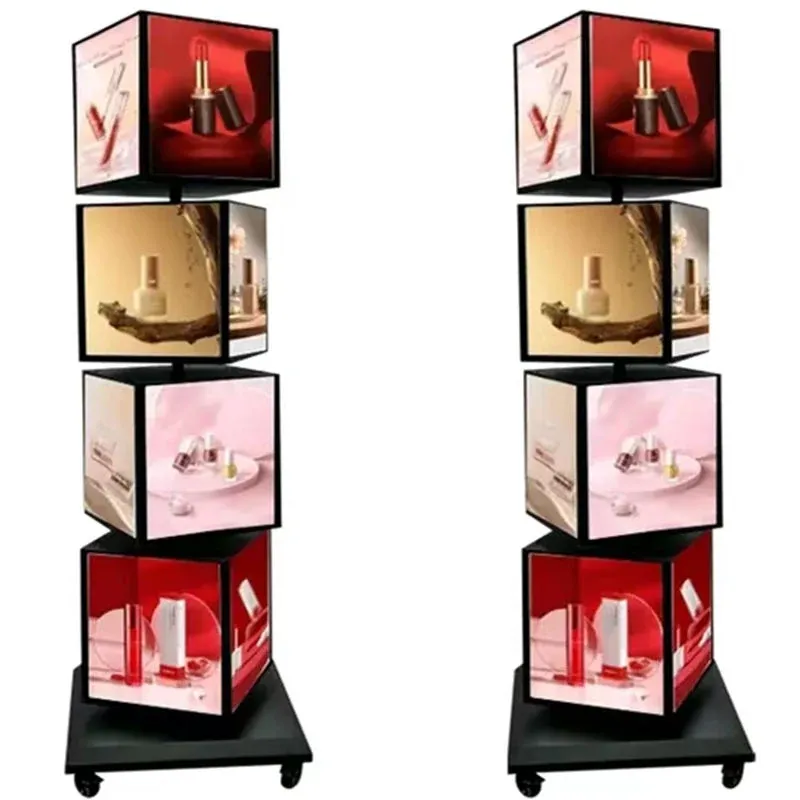
If you are comparing quotes for a moving light box, the number that decides whether the unit survives daily use is not watts or panel size. It is how power reaches the rotating head. A unit that turns through a slip ring can run continuously for years; a unit that turns through a cable with a limit switch is sweeping back and forth and will eventually wear through its conductors. Ask that question before you look at the print.
This guide is written for distributors, retail chains, exhibition contractors and brand owners who buy rotating signage in quantity. It covers the three formats sold under the same name, the mechanics that fail first, the specification fields that are usually missing from a quotation, and the checks to run before you place a repeat order.
What LED rotating signage actually means
LED rotating signage is a light box whose display head turns around a vertical axis, driven by an electric motor inside the base or the wall bracket. The light source is LED strip behind a diffused panel, so the graphic is backlit while it moves. The movement is mechanical and continuous or indexed; it is not a video effect.
Three different products are sold under this name, and they are not interchangeable. Worth knowing before you send an enquiry: a holographic fan is not a light box (it uses spinning blades and persistence of vision, produces no backlit print, and cannot be read from the side). A digital signage screen is not a light box either (it plays video, costs several times more, and needs content management). And a static double-sided light box with a rotating wall bracket is a bracket accessory, not a rotating display.
The three formats you will be quoted
Multi-layer tower
Two to four backlit cubes stacked on one shaft, usually 300, 400 or 500 mm square, standing roughly 1.4 to 1.9 m with the base. Each layer can carry a different campaign, which is why cosmetics, food and travel retail like it. The tower is the hardest format to keep stable, because a 4-layer head is tall and top-heavy; balance and base weight matter more here than on any other type.
Double-sided wall or pole unit
Two backlit faces on a rotating bracket, 400 to 800 mm across, mounted on a wall, a pole or a shopfront frame. Outdoor versions add a sealed housing and a heavier bearing set. This format is the most exposed to wind and rain, so the shaft seal and the IP rating of the joint decide its service life, not the LED.
Foldable totem
A scissor lattice frame inside a printed fabric or film skin, folded flat for transport and opened on site. The rotation is usually a slow motorised base. It travels well and sets up without tools, which suits roadshows and dealer networks, but the lattice is a wear item and the skin has to be tensioned evenly or the panels look wavy in motion.
Where motion earns its place, and where it does not
Movement buys attention in three situations: a crowded aisle where a static poster is lost among neighbours; a window or lobby where the same graphic has to hold attention for weeks; and a product launch where the rotation itself signals that something is new. In those cases the mechanical premium is easy to justify against the cost of a campaign refresh.
It does not pay in three others. If the message needs more than three seconds to read, rotation fights the reader. If the site has no reliable power or no access for maintenance, a moving part becomes a liability. And if the environment is dusty, greasy or coastal, a cheap rotating joint will seize long before the LED reaches its rated hours.
In those cases a static LED SEG light box or a slim light box usually delivers more readable advertising per unit of maintenance.
Who buys it, and what each buyer checks first
A distributor checks spare-part availability and whether the same base accepts 300 and 400 mm heads, because one SKU that covers three panel sizes reduces stock. A retail chain checks colour consistency across a hundred units and whether the graphic can be replaced by store staff without tools. An exhibition contractor checks packed volume against the van, setup time per unit, and whether the tower can be locked for transport.
A hospitality or venue buyer checks noise and light spill, because the unit sits in a lobby where guests stand next to it. A brand owner checks the print: whether the campaign colour survives backlighting, and whether the panels can be swapped mid-campaign without replacing hardware. Those five checklists rarely overlap, and a supplier who only quotes wattage is answering none of them.
Anatomy of a rotating light box, top to bottom
The head is a stack: printed panel, diffuser, LED strip on an aluminium carrier, back panel, frame. The frame carries the shaft coupling. Below it sits the bearing block, then the slip ring, then the gearbox and motor, then the base plate and the control board. On a tower, each layer repeats the panel-diffuser-LED stack and shares one shaft.
Two details separate a good build from a cosmetic one. The LED carrier should be aluminium, not plastic, because it spreads heat away from the diodes; a plastic carrier traps heat in a sealed box and shortens LED life. And the shaft coupling should be machined with a flat or a keyway rather than relying on a grub screw on a round shaft, which slips under load and makes the head wobble after a few months.
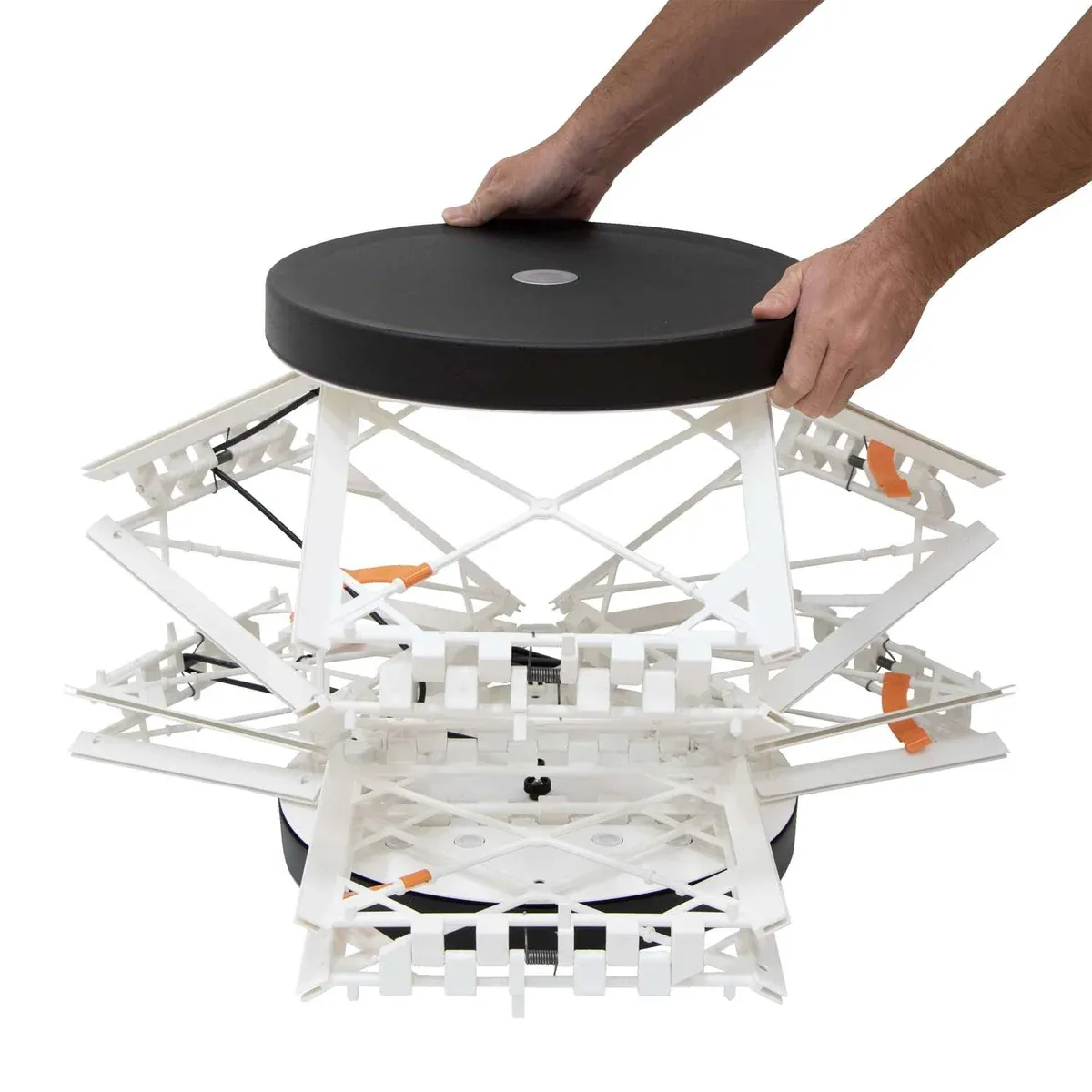
A foldable totem base opened for inspection. The scissor lattice, the numbered pole ends and the central hub are the parts that wear; they are also the parts a buyer never sees in a product photo.
The slip ring decides whether it lasts years or months
A slip ring, also called a rotary electrical joint, transfers power from the fixed base to the turning head through sliding contacts. Without it, continuous rotation is impossible: any fixed cable would twist and break within a few hundred turns. A unit that claims 360-degree rotation but has no slip ring is either oscillating through a limited arc or using a coiled cable with a return spring.
Ask three questions. How many circuits does the ring carry, and does that number cover the LED load plus the motor plus any signal line with spare capacity? What is the contact material, precious metal or carbon brush, and what is the rated rotational life? And is the ring a hollow-bore type, so wiring passes through the centre of the shaft instead of being routed around it? Hollow-bore rings are the standard solution for light boxes because they keep the wiring on the axis and avoid chafing.
The contact material matters more than the price difference suggests. Precious-metal contacts suit low-current LED loads and run quietly for long periods. Carbon brushes handle higher current but shed dust inside a sealed head, and the dust eventually films the diffuser. If a supplier cannot name the ring's rated life in revolutions, treat the rotation as a feature you will be maintaining, not a spec you can rely on.
Motor, gearbox and bearings
A brushless DC motor is the right choice for units that run more than eight hours a day, because there are no brushes to wear and the controller can hold a constant speed as the load changes. A brushed gear motor is acceptable for intermittent retail hours, but ask for the brush life at rated load instead of accepting a generic statement about long service.
Sealed ball bearings, not sleeve bearings. Sleeve bearings develop play, the head tilts, the gap between panel and frame goes uneven, and light leaks out of one side. On a multi-layer tower that play is visible as a wobble, which is the first thing a retail client complains about. Ask for the bearing type and for a runout figure measured at the top panel.
Noise is a specification too. Request a sound pressure reading at one metre with the unit running at its normal speed. A lobby or a clinic needs a quiet drive; a trade show aisle does not. If the supplier has no number, the unit was probably never measured outside a workshop.
Frame, panel and print materials
Frames are usually aluminium profile, anodised or powder coated. Wall thickness and joint design determine rigidity: a thin profile flexes when the head turns, and the flex shows up as a flicker in the panel gap. For outdoor units the coating matters as much as the alloy, because a coastal site will pit a poor finish within a season.
Panels are normally acrylic (PMMA) at 2 to 3 mm, chosen for clarity and light transmission. Acrylic is brittle under impact; PET and PETG resist impact better with a small loss of clarity, and polycarbonate is the toughest option but yellows under UV. For a shopfront that takes knocks, PETG is often the better compromise. For a lamination or a printed face, the ink system and the white backing layer decide whether the colour looks flat or washed out when lit.
Print method follows the panel. Direct UV printing on acrylic needs a white ink layer behind the colour, otherwise the backlight bleeds through and the image greys out. Backlit film behind a diffuser gives a softer, more even result and is easier to replace. For edge-lit crystal panels the pattern is laser-engraved, not printed, and the dot density controls the evenness.
Light quality: lux, CRI and the hotspot test
Three numbers describe the light, and they are usually quoted badly. Luminous flux tells you how much light the strip produces, not how bright the panel looks. Illuminance in lux, measured at the panel surface and again at one metre, tells you what the viewer sees. Colour rendering index tells you whether skin tones and product colours look right; CRI 80 is acceptable for general retail, CRI 90 or above is what cosmetics and fashion expect.
Evenness is the number buyers feel but rarely specify. Measure the brightest and dimmest points on the lit panel and compare them. A ratio above roughly 0.7 minimum-to-maximum reads as even; below that, hotspots appear as bright bands behind the LED rows. Hotspots come from three causes: strip pitch too wide for the box depth, diffuser too close to the LEDs, or a diffuser grade that scatters unevenly. If you can see the individual diodes from 300 mm away, the optical stack is under-designed.
Heat belongs in the same conversation. LEDs lose output and shift colour as junction temperature rises. In a sealed rotating head there is no convection, so the aluminium carrier and the back panel are the only heat path. Ask what temperature the head reaches after four hours at rated power, and whether the driver is mounted outside the heated zone.
Size, viewing distance and the three-second read
Panel size follows viewing distance more than floor space. As a working rule for backlit retail graphics, a capital letter height of about 25 mm is readable at 10 m in good light; at 30 m you need roughly 75 mm, and at 50 m about 125 mm. That arithmetic usually decides the panel size before the interior designer does.
The three-second read is the other constraint. A rotating face that carries a headline, a product shot and a legal line will be read as a blur. One idea per face, five to seven words of headline, and the rotating motion supplies the rest. If the campaign needs a paragraph, the tower format is wrong; a static backlit wall is better.
Rotation speed: fast spin versus slow dwell
Two speed families exist and they serve different jobs. Slim single-face spinners run fast, in the range of tens of revolutions per minute, and are used where the motion itself is the message. Multi-layer towers run slowly, typically a few revolutions per minute, and often pause for several seconds at each face so a passer-by can finish reading before the next panel arrives.
Ask for the control logic, not just the speed. Continuous rotation at a fixed rate is the cheapest drive. Indexed rotation with an adjustable dwell needs a controller with position feedback, which costs more but converts far better in a shopping aisle. Also ask about direction reversal and a manual override, because a store manager will want to stop the unit during a promotion without unplugging it.
Power, control and outdoor safety
Indoor units normally run from a 12 V or 24 V DC driver fed by a mains adapter, which keeps the rotating head at a safe voltage. Outdoor units often take mains directly into a sealed housing, and that changes the safety requirements: earth bonding on the metal frame, a residual current device upstream, cable glands rated for the enclosure, and a joint design that keeps water out of the bearing and the slip ring.
For outdoor mounting, wind load is the load case that breaks brackets. A 1.8 m tower with a 500 mm head presents a large sail area, and the moment at the base is what pulls fixings out of a wall. Specify the fixing pattern and the anchor type for the actual substrate, not a generic bracket, and check that the rotation does not loosen the fixings over time by adding a thread-locking method.
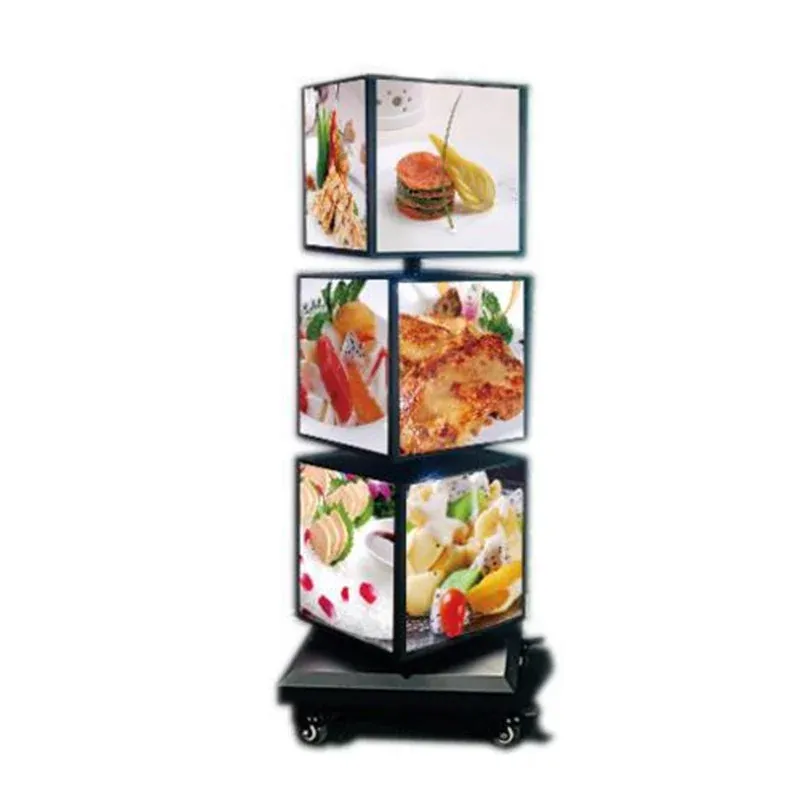
Three-layer and four-layer towers share one shaft and one base. Layer count changes the centre of gravity, so the same base is not automatically correct for both.
Specification fields to confirm per model
Before you compare quotations, put these fields side by side. Panel size and layer count. Overall height and base footprint. Rotation type (continuous or indexed), speed range and dwell time. Motor type, gearbox ratio and rated life. Slip ring circuits, contact material and rated revolutions. Bearing type. LED type, quantity per layer, colour temperature and CRI. Driver input voltage, output voltage and rated power. Panel material and thickness. Frame profile and finish. IP rating for outdoor models. Packed dimensions, gross weight and carton quantity. Spare parts included.
Any field left blank in a quotation is a field you will be guessing about at the repeat order. Marking them as to-be-confirmed is acceptable; inventing a number is not.
Customisation that actually changes the quote
Layer count, panel size and print method are the three variables that move the price most, because they change the frame, the shaft length and the number of LEDs. Surface finish, base colour, logo on the base cap and a wheel set are cosmetic and cheap to change. Adding a shelf or a product cavity inside one layer turns the unit into a display case and requires a different frame, so it belongs in the first conversation, not the last.
If you need the same campaign on several formats, ask for a shared panel size across the tower, the wall unit and the counter unit. Standardising one print size across three products reduces artwork work and lets you move stock between channels.
Feature, advantage, benefit
Continuous rotation through a slip ring means the head never reverses, so there is no cable fatigue and no visible sweep back. For the buyer, that is one less failure mode in a fleet of units.
Indexed rotation with dwell means each face stops long enough to be read, which raises the share of passers-by who actually absorb the message. For a retail chain, that is the difference between motion as decoration and motion as media.
A hollow-bore ring keeps wiring on the axis, which removes chafing and makes reassembly after transport predictable. For a contractor, that is a shorter setup and fewer callbacks.
Aluminium LED carriers and an external driver keep heat away from the diodes, which protects colour consistency across a long campaign. For a brand owner, that is fewer complaints about panels that no longer match each other.
Sealed ball bearings and a machined coupling hold the panel gap steady, so the head does not wobble after months of use. For a venue, that is a unit that still looks new at the end of the season.
How to choose in six steps
First, define the message: one idea per face, and the number of faces you need. Second, measure the viewing distance and pick the panel size from the letter-height rule. Third, choose the format: tower for depth of range, wall or pole unit for a single sightline, totem where transport dominates. Fourth, decide the rotation logic: continuous for attention, indexed with dwell for readability. Fifth, fix the environment: indoor, outdoor, coastal, dusty, and the power available. Sixth, write the specification fields into the RFQ so every quote answers the same questions.
If two quotes differ by a wide margin, the difference is almost always in the slip ring, the bearing set or the driver. Ask for those three part specifications in writing and the comparison becomes honest.
Installation and first-run checks
Site preparation is short but not optional. The floor or wall must be flat and able to take the point load plus the overturning moment. For a tower, check the base is level to within a couple of millimetres across its footprint; a base that rocks will transmit movement into the bearing. For a wall unit, confirm the substrate is solid masonry or a steel frame, not plasterboard.
Assembly order for a tower: base plate, then the rotating assembly, then the layers from the bottom up, then the top cap. Route the cable before the head is lowered into place, and confirm the ring turns freely by hand through a full revolution before power is applied. On first run, check three things: the head turns at a constant speed with no scraping, the panel gap stays even through the revolution, and the unit is quiet at one metre. Let it run for an hour and check the head temperature by hand before you sign off.
The most common installation error is fixing the base to a surface that flexes. The second is forgetting to lock the head for transport, which lets the assembly hammer the bearing during the drive to the site.
Production, QC and the evidence to request
A rotating unit is assembled, not printed, and the assembly is where defects appear. Ask for the aging record: units run continuously for a stated number of hours before packing, with speed and noise checked at the end. Ask for a balance check on towers, ideally a runout reading at the top panel. Ask for an insulation resistance and high-pot test on the driver circuit for outdoor models, and an IP test report if the unit is sold for exterior use.
Then ask for the boring evidence: a photo of the packing method, the carton drop test record, and the spare-parts kit list. A supplier who can produce those three without a week of delay is a supplier who has shipped this product before.
Packing, transport and reassembly
Towers ship as a base carton plus a head carton, or as one carton with the layers nested. Foam should separate the panels from the frame; a panel that touches a frame edge in transit arrives with a chipped corner. The rotating assembly should be locked or removed, and the shaft protected by a sleeve. For export, add corner boards and a moisture barrier, because a container that sweats will leave water marks on printed acrylic.
On arrival, check the panel faces before assembly. A crack that starts at a fixing hole is easy to miss under protective film and becomes a customer complaint after the first week.
Care and maintenance
Clean panels with lukewarm water and a drop of mild detergent, using a microfibre cloth. Never use alcohol, acetone or glass cleaner on a printed face; solvents attack the ink and cloud acrylic. Dust the diffuser with a soft brush, not a cloth, because grit dragged across the surface leaves scratches that show up when the light is on.
Once a year, listen to the bearing and check the panel gap at four points around the revolution. If the gap has opened on one side, the bearing or the coupling needs attention. On units that run all day, ask for the slip ring to be inspected at the interval the supplier states, and keep one spare ring and one spare driver per site if the units are business-critical.
Order process and RFQ checklist
Send the following and the first quotation will be close to final: quantity and layer count, panel size, indoor or outdoor, mounting surface, viewing distance, rotation type and speed, print files or the number of faces, power available on site, packed size limit if you ship by air, and the destination country for certification and plug type. Add the spare-parts expectation and the warranty terms you need.
We review the artwork against the panel proportions before quoting, because a design that was made for a static poster rarely fits a rotating face without rework. If the campaign has a fixed colour, send a physical reference or a Pantone number and we will confirm how it reads under backlight before production.
Questions buyers ask before ordering
Does the unit rotate continuously or sweep back and forth?
Both exist. Continuous rotation needs a slip ring. A unit that sweeps uses a cable with a limit switch and reverses at the end of its arc. Ask which one you are being quoted, because the maintenance profile is completely different.
How long does the motor last?
It depends on duty cycle and load. Ask for the rated life in hours at the actual load, and for the brush or bearing service interval. A supplier who answers in hours is easier to hold to a warranty than one who answers in years.
Can I change the graphic without changing the frame?
Yes on magnetic, SEG and film-based faces. On direct-printed acrylic the panel is the graphic, so a campaign change means a new panel. Decide how often the message changes before you choose the print method.
Is it safe to leave running overnight?
That is a question about the driver and the thermal design, not about the motor alone. Ask for the surface temperature after four hours and confirm the driver is rated for continuous duty. For unattended retail use, a timer is worth specifying.
Can it be used outdoors?
Only the versions built for it, with a sealed housing, a protected shaft and an IP rating stated for the exact model. The rotating joint is the weakest point against water, so ask how the seal is arranged and whether the bearing is in a separate chamber.
How is it shipped, and can it be reassembled on site?
Normally as separate base and head cartons with the head locked. Reassembly is a matter of minutes with the right sequence. Ask for the assembly sheet and a short video before the units leave the factory.
What spare parts should I stock?
One driver, one slip ring and one set of panel fixings per ten units is a sensible starting point for a fleet. Distributors usually add a spare motor for the most common model.
Can the panels be double-sided?
On wall and pole units, yes: two printed faces back to back with an opaque layer between them so the image does not show through. On towers each face is already a separate panel, so double-sided printing applies to the flat formats.
How do I clean the printed panel?
Mild soap and water with a microfibre cloth. No solvents, no abrasive pads, and no glass cleaner on the printed side.
What information do you need to quote?
Quantity, layer count, panel size, indoor or outdoor, mounting surface, rotation type, artwork status and destination. With those six items we can quote a specification that will not change after the sample.
Why buyers work with BESDA
We build rotating units as a mechanical product first. The slip ring, bearing set, coupling and driver are named parts in our quotation, not hidden inside a headline wattage. Our towers are balanced and run before packing, and we keep the test record for the batch.
We also build the static side of the same range, so we will tell you when a rotating unit is the wrong answer. If your campaign has a long message or the site has no maintenance access, we will quote a magnetic light box or a double-sided outdoor light box sign instead and explain why.
For retail rollouts, the rotating range is usually specified alongside custom-shaped LED light boxes and the retail display campaign set. For exhibition work it pairs with trade show displays.
Next step
Send us the viewing distance, the number of faces, the mounting surface and the quantity. We will come back with a specification that names the slip ring, the bearing and the driver, plus a packing plan that matches how you ship. If you already have a quotation, send it and we will mark the three fields that decide the unit's life.
You can reach us on WhatsApp or by email, or use the form on the contact page. If you are still comparing light box types, start with the LED SEG light box buying guide and the explainer on how a SEG box works.