News & Insights
LED Magnetic Light Box Buying Guide
A magnetic light box is bought for its poster-exchange workflow. Compare magnet systems, lighting, poster media and the specification fields to confirm before ordering.
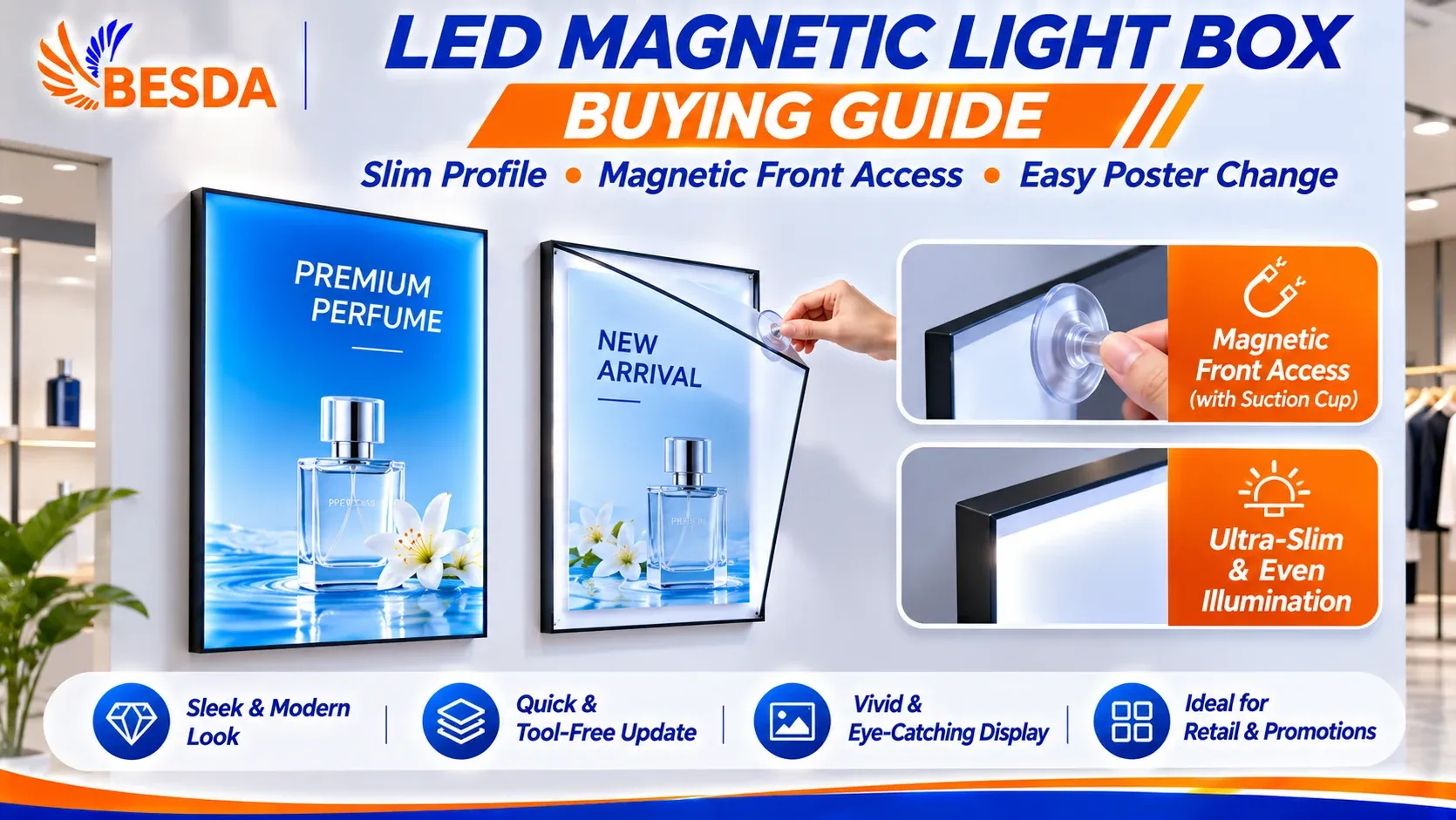
The question that decides whether a magnetic light box is the right purchase is not brightness or price. It is how often the message changes. A magnetic light box exists so that a shop assistant can swap a printed poster in under a minute, without tools, without a fitter and without touching a single screw. If your campaign changes weekly or monthly, that workflow is the whole point of the product. If the graphic is permanent, you are paying for a mechanism you will never use.
This guide is written for retail groups, distributors, franchise networks, restaurants and estate agencies that buy light boxes in quantity. It separates the products sold under the magnetic name, explains the magnet and lighting systems that decide long-term reliability, lists the specification fields most quotations leave out, and finishes with an RFQ checklist that makes quotes comparable.
What a magnetic light box actually is
A magnetic light box is an illuminated poster display in which the front face is held in place by magnet strips rather than by a snap frame, screws or a silicone gasket. The frame is a shallow aluminium tray that carries the LED lighting and the light-spreading layers; the printed poster sits in front of those layers, and a thin steel or magnetic front plate closes the box and holds the graphic flat. To change the message, you lift a corner of the front plate, take out the old poster, drop in the new one and let the magnets pull the plate back into position.
Three products get sold under names that sound similar, and they are not the same purchase. A snap frame light box holds the graphic under spring-edged profiles that you fold open with your fingers; it is a different edge system with its own wear pattern, and usually a deeper profile. A SEG fabric light box stretches a printed textile with a silicone edge into a groove, which suits large seamless walls rather than poster exchange. A slim or crystal light box may also open at the front, but the panel construction and the way light reaches the graphic differ. Ask the supplier which front-opening system the quotation actually describes.
The formats you will be quoted
Format: Wall-mounted slim magnetic · Industry-common frame widths: 19 to 40 mm, with 21, 25, 28 and 36 mm frequent increments · Where it fits: corridors, shop entrances, menu walls, estate agent windows · Check first: wall substrate and fixing pattern, single or double sided
Format: Freestanding double-sided magnetic · Typical depth: deeper frames to carry two faces and a foot or pole · Where it fits: showroom floors, mall walkways, salon and clinic interiors · Check first: base weight and footprint, whether both faces accept different graphics
Format: Hanging magnetic light box · Suspended by cables or rods from the ceiling · Where it fits: retail windows and mall atriums where floor space is committed · Check first: suspension kit rating and ceiling anchor type
Format: Table-top magnetic display · Small formats from A4 upward · Where it fits: counters, reception desks, restaurant tables · Check first: stand angle, cable exit and driver placement
Format: Outdoor or waterproof magnetic · Sealed frames with drainage and IP-rated construction · Where it fits: forecourts, transit shelters, building fronts · Check first: the exact IP rating for the whole unit, not the LED module alone
One size does not fill every role. Distributors usually standardise on one or two formats and keep the poster size identical across a chain, because a shared poster size means one artwork template and interchangeable stock between sites.
Who buys magnetic light boxes, and what each checks first
A retail chain buyer checks whether store staff can complete the poster exchange without maintenance visits, and whether the frame finish matches the shopfit across seasons. A distributor checks packed volume, spare-part availability and whether one frame size accepts posters from several artwork templates. A franchise operator checks colour consistency between units delivered months apart, because a mismatched campaign looks like neglect to customers.
A restaurant or café owner checks cleaning: grease and steam demand a front plate that wipes down and a poster that can be replaced cheaply. An estate agency checks the same thing from the other side, replacing property cards weekly and caring mostly about how flat the poster sits under the magnetic plate, because a lifted corner reads as sloppy at the window. Those checklists share one requirement: the exchange must stay easy for the whole service life, not just the first month.
The magnet system is the part that decides the service life
The magnetic front is a system of three parts: the magnet strips fixed to the frame, the steel or magnetic front plate, and the adhesive or mechanical fixing that binds the strips to the frame. Failures almost always start in the third part. Adhesive-backed magnet strips that are applied to an unsuitable finish can creep, and the first symptom is a corner that no longer pulls in cleanly. Ask how the strips are fixed: taped, glued with a primer, or mechanically retained in a channel. Mechanically retained strips outlast tape in commercial service.
Magnet layout matters more than magnet strength. A frame with continuous magnetic surround holds the plate evenly; a frame with four corner magnets and long unsupported spans lets the middle of the plate bow outward on large formats, which shows as a shadow down the poster. On formats above roughly A1, ask for the magnet pitch or for a continuous strip, and ask whether the front plate is a steel sheet or a magnetic-laminated panel, because the two behave differently at the corners when you lift them.
There is also a structural ceiling worth knowing before you fall in love with a very large magnetic format. The front is one plate held at its edges, so as the format grows past the A0 and 120-centimetre class, the plate's own weight works against the magnet surround and the middle can dome or sag. Suppliers handle this with stiffer plates or intermediate retention, and beyond that point a stretched-fabric SEG system is usually the more honest construction. Ask the supplier to state the largest format their magnetic front is designed for, rather than discovering the limit at your largest site.
One naming trap to clear up in the first email: magnetic describes the front plate, not the mounting. A magnetic light box still screws to the wall like any other cabinet; only the graphic face opens without tools. Sites that assumed otherwise have drilled nothing, leaned the unit against the wall and waited for it to stick. Put the mounting method in the specification.
The exchange itself should need no tool. On a well-designed unit, a finger notch or a small suction pull at the lower corner lifts the plate. On a poorly designed one, the plate sits flush with no gripping point, and staff will jam a knife blade under it, scratching the frame in the first week. Put the exchange method in writing in the order: which corner lifts, whether a suction cup is supplied, and how the poster is held so it cannot slide when the plate opens.
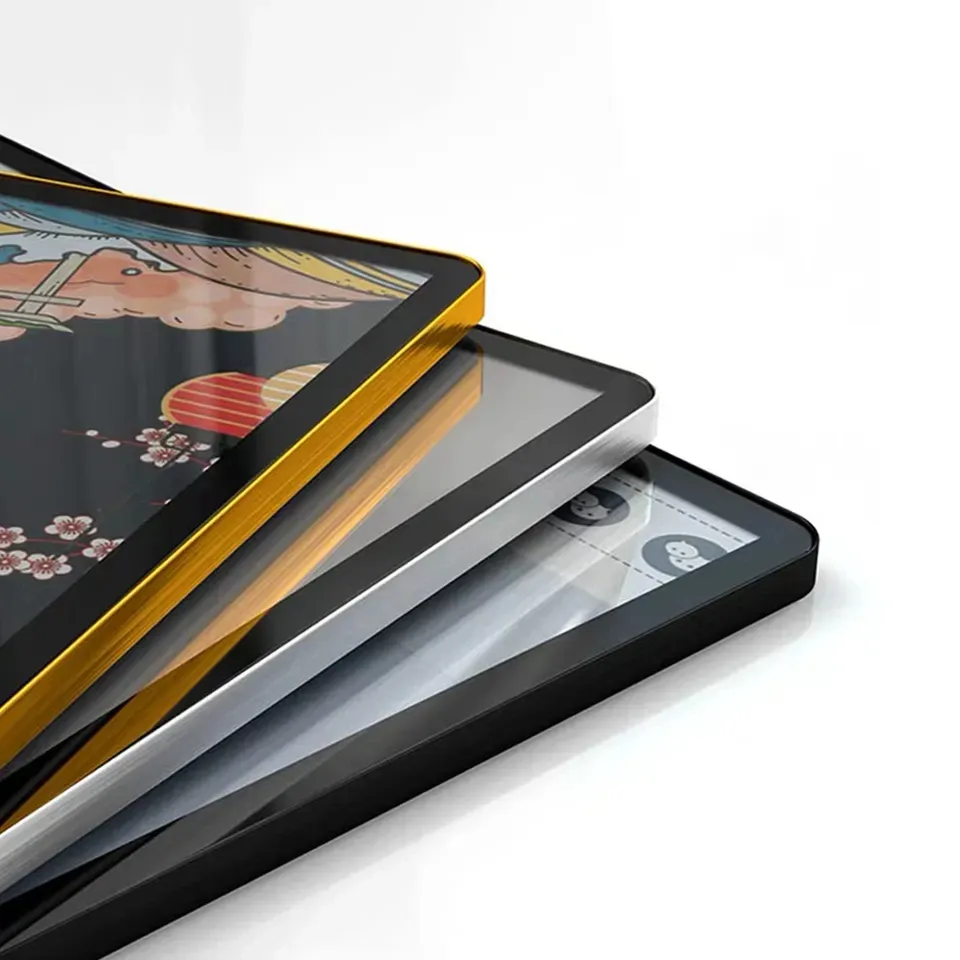
Frame finish is a real choice, not a catalogue detail: gold, silver and black anodised frames serve different shopfit schemes. Confirm the finish and the magnet fixing method on the quotation, not in the delivery bay.
Lighting: edge-lit versus back-lit in a magnetic frame
Two lighting architectures share the magnetic name. Edge-lit units run LED bars along the inner edges of a light guide plate, which spreads the light across the face behind the poster; this is what makes very slim depths possible. Back-lit units place LED rows behind a diffuser across the full area, which needs more depth but can deliver higher, more uniform brightness on large faces. Neither is universally better: edge-lit wins where depth and elegance matter, back-lit wins where the poster must fight a bright shop window.
Judge the light with three checks. First, evenness: look at the lit face at an angle and from straight on; a visible bright band near the LED edges or dull zones in the middle means the light guide or diffuser is mismatched to the depth. Second, colour: the LED strip should have a stated colour temperature, and a chain that mixes batches will show it across the window. Third, hotspot test: hold a plain white test poster on the face; if individual diodes project as spots from normal viewing distance, the diffusion stack is under-designed for that poster stock.
Ask for the LED specification in writing: strip type such as SMD 2835 or 3014, colour temperature within the common 3000 to 6500 K range, colour rendering index, rated hours and the driver's rated power. CRI 80 suits general retail; cosmetics and fashion counters do better with CRI 90 or above. For units that run all day in a shopfront, an external driver mounted away from the frame runs cooler and is easier to replace than one buried in the tray, and across this category the external adapter is statistically the first part to fail, so treat its protection features and replacement availability as part of the purchase decision, not an accessory.
Graphics: what you print on decides how the display looks
The poster is half of the product, and the most common defect in the field starts with its material. Ordinary paper is opaque and fibrous: under edge lighting it shows grey, and its edges drink moisture and curl, which lifts the front plate and casts a ripple shadow down the display. The stock the category is built around is a semi-translucent backlit PET film, which lets light pass evenly and stays flat. If a quotation prices posters without naming the medium, that is the first thing to clarify.
Backlit poster paper is the economical option for short campaigns and needs a good diffuser beneath it. Backlit film is thicker and gives richer colour under edge lighting, which is why most photographic and estate work uses it. LED film, a newer printed medium designed for edge-lit boxes, spreads light well at very slim depths. Each material sits differently behind a magnetic plate, so confirm the intended poster stock with the supplier before approving artwork.
Print questions worth asking: resolution expected at final size, whether the supplier prints from your files or supplies printed posters as an ongoing item, and whether spare posters for a whole franchise run can be supplied against one approved proof. A supplier who controls the poster supply chain keeps colour consistent across reorders; a buyer who mixes print shops will not.
Size, viewing distance and poster logistics
Common catalogue formats run from A4 table-top units through A3, A2, A1 and A0, and onward to cinema and mall sizes such as 50 by 70, 70 by 100, 85 by 120 and 100 by 140 centimetres, with 27 by 40 inches common for cinema lobbies. Treat every size as a planning example and confirm the actual numbers before approving artwork.
The size trap catches experienced buyers too, because three different numbers hide behind the word size. The outer frame size is the aluminium dimension on the wall. The graphic size is the poster that goes inside it. The visible area is what the audience actually sees after the magnetic surround and frame edges cover part of the poster. The three can differ by tens of millimetres on each side, enough to crop a headline or a legal line. Insist that the quotation states all three in millimetres, and build the artwork to the visible area, not to the poster.
Poster logistics decide the size as much as viewing distance does. A chain that prints posters in one country and ships them to sites needs a size that ships flat without rolling creases; a single site with a local print shop can use any size. When a rollout spans both, standardising on the shippable size avoids running two artwork templates for the same campaign.
Comparison: magnetic light box against the alternatives
Versus snap frame light box: the snap frame's folded edges open wider and accept thicker stocks, but the corner springs lose tension with rough use and the profile is deeper. Magnetic fronts close flush, exchange faster and suit frequent changes.
Versus SEG fabric light box: SEG suits large seamless walls and premium backlit graphics, but the exchange needs a silicone-edged print and some practice. Magnetic suits poster-sized media and non-specialist staff.
Versus static slim or crystal panels: a crystal panel is a fixed-face acrylic display whose graphic is part of the construction. If the message rarely changes, a static unit can be the calmer choice; the LED crystal light box buying guide covers that family in detail.
The honest way to choose is to count exchanges per year. Weekly or monthly changes favour magnetic. Quarterly changes can go either way. Permanent graphics do not need an opening face at all.
Specification fields to confirm per model
Before comparing quotations, put these fields side by side: outer frame size, graphic size and visible area, all in millimetres; frame depth and front-plate construction; magnet fixing method and layout; edge-lit or back-lit; LED strip type, colour temperature, CRI and rated hours; driver power, placement, protection features and replaceability; single or double sided; finish and colour options; poster stock the unit is designed for; IP rating where relevant; certifications for the destination market; packed dimensions, gross weight and units per carton; spare parts included.
Power figures deserve a note of caution. Marketplace listings quote anything from single-digit watts on small formats to three-digit claims on large double-sided units, sometimes with lifetime figures to match. Treat power and lifetime as model facts that the supplier must state with test conditions, and judge brightness by the lit face in front of you, not by the wattage on the label.
Any supplier who fills in every field without being asked has shipped this product before. Any field returned blank is a field you will be arguing about at the repeat order; ask for it marked as to-be-confirmed rather than invented.
Feature, advantage, benefit
Tool-free magnetic exchange means any staff member can change a campaign without a maintenance visit; for a chain, that is the difference between a poster that changes on schedule and a poster that waits for a fitter.
A flush front plate with no snap edges presents the graphic without the shadow lines that spring frames cast; for estate and photo display, that is a cleaner window.
Edge-lit construction keeps depth low, so the display reads as part of the shopfit rather than as an appliance; for corridors and lifts, that is the difference between fitting and not fitting.
Standardised poster sizes across a chain mean one artwork template and interchangeable stock; for a distributor, that is fewer SKUs and fewer misprints.
A replaceable driver and named LED strips turn an end-of-life event into a maintenance item; for a franchise operator, that is a longer service life for the same capital.
How to choose in six steps
First, count the exchanges per month per site; that decides whether an opening face is needed at all. Second, measure the wall or counter and the viewing distance, and pick the visible poster area from that arithmetic. Third, choose the format: wall, freestanding, hanging, table-top or outdoor. Fourth, decide the lighting architecture: edge-lit for slim elegance, back-lit for brightness in a difficult window. Fifth, fix the poster stock and artwork template before quoting. Sixth, send the specification field list with the RFQ so every quote answers the same questions.
If two quotations differ by a wide margin, the difference is usually in the magnet fixing, the light guide quality or the driver. Ask for those three in writing and the comparison becomes honest.
Installation and first-run checks
Wall units need a substrate that matches the fixings: solid masonry takes sleeve anchors, drywall needs toggles or a reinforcing plate, and glass or metal shopfronts usually want a specialist fixing. Hold the frame level, mark the fixing pattern through the rear holes, drill and fix, then hang the body and connect the driver before seating the front plate.
On first power-up, run the light checks from the lighting section: evenness at an angle, colour against a reference poster, and the white-poster hotspot test. Then check the magnetic surround itself. Walk the four edges and slide a sheet of paper under the plate; where the paper pulls out with no resistance, the gap is loose and will show as a shadow line. Test one full exchange with the staff who will actually do it: lift the plate with the supplied suction cup or notch, swap the poster, let the magnets close. If the plate needs a tool or two hands, the size or the magnet layout is wrong for the site, and it is far cheaper to learn that at installation than in month six.
Production, QC and the evidence to request
A magnetic light box is assembled from four supply chains: extrusion, magnetics, LEDs and print. Ask which of those the factory controls directly, because the gaps are where defects enter. Reasonable evidence to request before a bulk order: a lit photograph of the actual model at your size, the LED strip specification, a sample poster exchange on video, and the packing method with carton dimensions.
For repeat programs, ask whether the factory keeps an approved sample against which later batches are checked. Colour drift between batches shows up at the window, not in the warehouse, and an approved golden sample is the cheapest insurance against it.
Packing, transport and spare parts
Frames travel well but acrylic and light guide plates do not like point loads. Foam should separate the front plate from the frame body, corners should be protected, and the poster should ship flat or rolled per its stock. For export, confirm carton marks and whether units ship one per carton or nested, because nested units save freight but need better protection between faces.
A sensible spare kit per site: one driver, a suction cup for the exchange, a set of spare fixings, and one spare front plate for high-traffic locations. Distributors stocking the range usually add a spare magnet strip set per batch, because that is the part a local workshop cannot improvise.
Care, cleaning and poster discipline
Clean the front plate with a soft cloth and mild soapy water; never use alcohol, acetone or aggressive glass cleaners, which can cloud the plate and attack the print. Keep posters flat in a folder between campaigns; a curled poster will not sit flat under the plate no matter how good the magnets are. Once a quarter, check the corners for lifting and the plate for bowing, and re-seat the poster after any deep clean.
If a corner stops pulling in, do not glue anything at the site. Photograph it and ask the supplier for a strip replacement; that is a warranty conversation, not a workshop job.
Order process and RFQ checklist
Send the following and the first quotation will be close to final: format and quantity; visible poster area or outer size; single or double sided; indoor or outdoor; finish and colour; edge-lit or back-lit preference and why; poster stock and whether printed posters are required; artwork status; destination country for plugs and certification; required date; and spare-part expectations.
We review artwork proportions against the frame before quoting, because a design prepared for one brand's A1 may lose its safe area in another brand's A1. If the campaign has a fixed brand colour, send the reference and we will confirm how it reads under edge lighting before production.
Questions buyers ask before ordering
Can the poster really be changed by anyone?
Yes, when the exchange method is designed in: a lifting notch or suction pull, a plate that comes away at one corner, and a poster seat that holds it in place. Ask for a video of the exchange on the exact model before ordering.
How thin can a magnetic light box be?
Edge-lit magnetic units commonly run in the low tens of millimetres; back-lit units need more depth for their diffuser stack. Treat any depth figure as model-specific and confirm it against the size you are buying, because depth scales with format.
Will the magnets weaken over years?
The magnet material does not weaken in normal service; the fixing behind it does. That is why the fixing method matters more than the magnet rating. Mechanically retained strips or properly primed adhesive on a suitable finish both last; bare adhesive tape on powder coat is the pattern that fails.
Can one frame show a different poster on each side?
On double-sided units, yes: each face carries its own poster and lighting. Confirm that the two faces can take different artwork and that the supplied posters are printed for the correct orientation on each side.
Is it suitable for a bathroom or kitchen?
Steam and grease demand a sealed build and a wipeable plate. Ask for the model's sealing approach and whether the poster is protected behind the plate or exposed at the edges, and prefer materials that tolerate humidity for those rooms.
What size should a chain standardise on?
Choose from the formats that ship flat and print economically in your market; A1 and 70 by 100 centimetres are common anchors. The right answer is the size your print supply can repeat cheaply, more than the size on any one wall.
Can you supply printed posters with the frames?
Yes, and for chains it is usually the better route, because the print is made to the frame's visible area and approved against a proof. Confirm the reorder process and colour reference at the first order.
What happens if a driver fails?
With an external driver it is a five-minute swap; ask for the driver specification and where it sits in your chosen model. Keep one spare driver per site for units the business depends on.
Do magnetic light boxes get hot?
LED runs cool compared with fluorescent, but a sealed slim frame still needs its heat path. Ask what the frame surface reaches after four hours and confirm the driver is rated for continuous duty if the unit runs all day.
Does a magnetic light box stick to the wall without drilling?
No. Magnetic describes how the front plate closes, not how the unit mounts. The frame fixes to the wall, ceiling or stand like any other light box, and only the graphic face opens without tools. Confirm the mounting method and the fixings for your substrate when you order.
Which size do I actually order by?
Order in millimetres and name the measure: outer frame size, graphic size, or visible area. They are three different numbers, and artwork built to the wrong one loses its edges under the magnetic surround. Ask the supplier to state all three on the quotation.
What information do you need to quote?
Format, size, sides, environment, finish, poster stock, quantity, artwork status and destination. With those nine items the quotation will not change after the sample.
Why buyers work with BESDA
We build magnetic light boxes as a poster-exchange system first: the magnet fixing, the plate and the poster seat are named items in our quotation, and the LED and driver specifications are written per model rather than hidden behind a wattage. We also run the print side, so frame and poster arrive as one approved system.
Because we build the whole lighting family, we will say so when a magnetic unit is the wrong answer: long-life graphics belong in a static acrylic panel, large seamless walls belong in LED SEG light boxes, and moving displays belong in the rotating range. The LED rotating signage buying guide explains that trade-off in detail.
For rollout planning, magnetic units usually pair with the LED slim light box range for corridors and the double-sided outdoor light box signs for exposed positions. If you are still comparing families, the LED SEG light box buying guide and the LED crystal light box buying guide cover the neighbours.
Next step
Send us the poster size, the number of sites, the exchange frequency and the artwork status. We will come back with a specification that names the magnet fixing, the lighting architecture and the driver, plus a poster plan that matches how your campaigns actually change. If you already have a quotation from elsewhere, send it and we will mark the three fields that decide the unit's service life.
You can reach us on WhatsApp or by email, or use the form on the contact page for a recommendation within one working day.