News & Insights
Inflatable Tent vs Pop-Up Tent
Compare inflatable and pop-up event tents by frame construction, setup, power, branding, anchoring, transport, maintenance and use case.
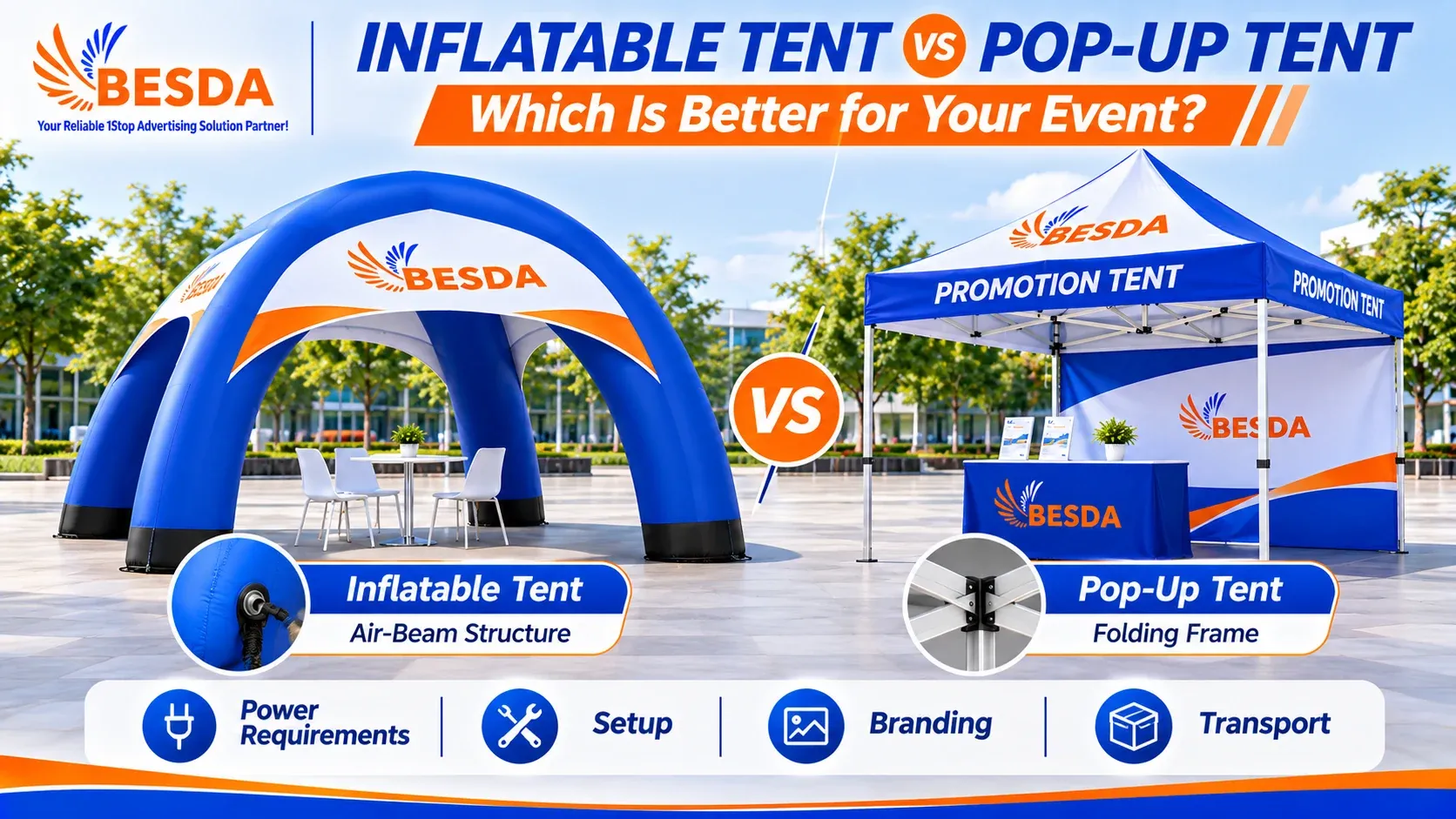
Inflatable tents and pop-up tents solve a similar problem: creating a portable branded shelter for an event. They do it with very different structures. A pop-up canopy uses a folding frame; an inflatable tent relies on air-filled supports. The best choice is not determined by which looks more impressive in a product photo. It depends on crew, power, event frequency, transport, branding and site conditions.
How a Pop-Up Tent Works
A pop-up canopy normally uses a folding frame with scissor-style roof supports and telescoping legs. The canopy fabric attaches to the frame, and optional sidewalls can create more enclosure. The structure is expanded, locked and anchored according to the manufacturer's instructions. Commercial models vary in frame material, profile, joint design, roof fabric, leg adjustment and accessory compatibility. Confirm the actual frame series and replacement parts rather than comparing only the nominal footprint.
How an Inflatable Tent Works
An inflatable tent uses air-filled beams or chambers to support its shape. Some designs require a blower to run continuously; others use sealed chambers. The shape can be curved, arched, dome-like or otherwise distinctive, depending on the construction. Ask which components contain air, how inflation works, how pressure is maintained, and what happens if a blower or valve fails. These details matter more than a generic setup-time claim.
Setup and Crew Requirements
A pop-up tent requires the frame to be expanded and locked, the canopy aligned and the structure anchored. An inflatable model requires the inflation equipment or pump, inflation sequence and anchoring. Crew size and setup time vary with size, model, experience and site conditions. Ask suppliers for an actual setup video of the quoted model and a list of people, tools and accessories required. A demonstration using a small sample is not proof that a larger version can be set up the same way.
Power and Event Infrastructure
A conventional pop-up canopy normally does not need electrical power to remain standing. A continuous-air inflatable model needs a suitable power source while operating. A sealed-air model has a different power requirement after inflation, but still needs a compatible inflation method. If the event is remote, outdoors or subject to strict cable rules, power access can determine which structure is practical. Confirm the blower's electrical rating and venue connection before ordering.
Branding and Visual Impact
Inflatable structures can create distinctive silhouettes and broad curved surfaces that stand out in event photography. Pop-up tents offer roof and sidewall printing options and are familiar for trade shows, markets and recurring outdoor promotions. Compare the actual printable areas, panel seams, logo positions, replacement graphic options and color approval process. A large printed surface is useful only when the message remains legible from the intended viewing distance.
Transport and Storage
A folding canopy frame can be bulky and heavy even when collapsed. Inflatable structures may pack into bags or cases, but the air structure, blower, pump, anchors and accessories all contribute to the complete kit. Request gross weight and package dimensions for the exact configuration. Check whether the complete kit fits the event team's vehicle, storage room or shipping plan. For touring events, consider how quickly the equipment can be inspected and repacked at each stop.
Durability, Repair and Maintenance
A pop-up frame may need replacement joints, sliders, legs, roof fabric or connectors. An inflatable structure may need inspection of valves, welded or sewn seams, air chambers, blower and outer fabric. Both need correct drying, storage and handling. Ask which parts can be replaced independently, whether repair instructions are available and whether spare parts can be ordered by model number. Avoid treating a warranty statement as a substitute for a service-parts plan.
Which Tent Should You Choose?
Choose a pop-up tent when you need a familiar folding structure, no continuous blower and a wide choice of standard canopy accessories. Consider an inflatable tent when its distinctive shape and branded presence serve the activation and the team can manage its inflation, anchoring and power requirements. For either format, site safety comes first. Follow the manufacturer's anchoring instructions and event rules, and stop using the tent when conditions exceed the product's approved limits.
Buyer Comparison Checklist
Compare footprint, peak height, frame or air structure, roof and wall materials, print coverage, setup crew, power, anchoring, packed dimensions, gross weight, replacement parts, warranty terms, quantity and destination. Request the same information for each shortlisted model.
Comparison Table
Support structure — Inflatable tent: Air beams / chambers; Pop-up tent: Folding mechanical frame.
Power — Inflatable tent: Depends on air system; blower may be continuous; Pop-up tent: No power needed to keep frame standing.
Shape — Inflatable tent: Can support distinctive curved forms; Pop-up tent: Usually conventional canopy geometry.
Accessories — Inflatable tent: Model-specific blower, valves, anchors, skins; Pop-up tent: Common roof, sidewall, rail and frame options.
Maintenance — Inflatable tent: Air chambers, seams, valves, blower; Pop-up tent: Frame joints, sliders, legs, canopy.
Best fit — Inflatable tent: Brand activations and distinctive event footprint; Pop-up tent: Markets, trade shows and repeat canopy use.
Frequently Asked Questions
Is an inflatable tent stronger than a pop-up tent?
There is no universal answer. Strength depends on the exact structure, materials, anchoring, size and approved operating conditions.
Does an inflatable tent need a blower running continuously?
Some do; sealed-air models are designed to retain air after inflation. Confirm the exact construction.
Which tent is easier to transport?
Compare the complete packed kit, including frame or air structure, roof, walls, blower, anchors, cases and gross weight.
Can I add sidewalls to both types?
Many pop-up tents and some inflatable systems offer sidewalls or panels. Compatibility and attachment methods are model-specific.
Why Choose BESDA?
BESDA supports B2B projects across custom flags, event tents, portable trade show displays, counters and illuminated signage. We approach each enquiry by confirming the actual application, dimensions, materials, frame or hardware compatibility, artwork, packaging and destination requirements. Product specifications, test evidence and delivery details should be confirmed in the approved quotation and production documents. Send BESDA your event type, tent footprint, frequency of use, power availability, print requirements, transport limits and quantity. We can compare suitable inflatable and folding tent configurations.
Related BESDA resources
Deeper reading on this site: Outdoor Event Branding, Custom Tents, Warehouse & Logistics and FAQ.
Next step
Send us your application, sizes, quantity, artwork status and destination, and we will reply with a specification-led quotation and a confirmed production schedule.
You can reach us on WhatsApp or by email, or use the form on the contact page for a recommendation within one working day.