News & Insights
Inflatable Advertising Tent Buying Guide
Compare inflatable advertising tent structures, air systems, materials, printing, anchoring, blower requirements, packing and event applications before ordering.
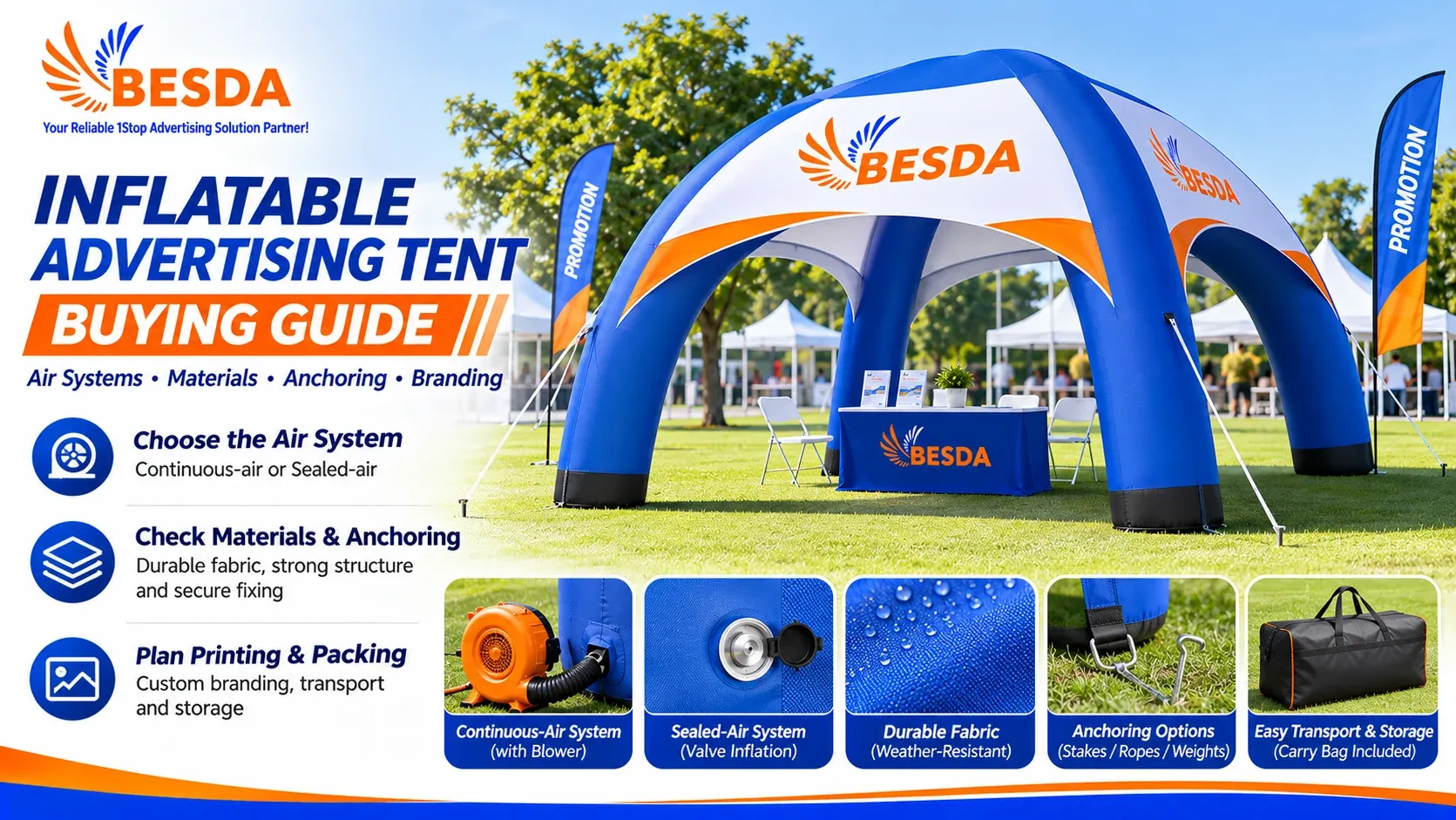
An inflatable advertising tent can create a distinctive event footprint and a large branded surface without a conventional rigid tent frame. But 'inflatable tent' describes several different constructions. Some use a blower that runs continuously; others use sealed air chambers that are inflated and then closed. These systems have different power, maintenance and event-planning requirements. A good purchase starts with the structure—not the shape in a catalogue photo.
What Is an Inflatable Advertising Tent?
An inflatable advertising tent is a portable event shelter or branded structure whose shape is supported by air-filled beams, tubes or chambers. Depending on the design, the roof, legs or complete body may be inflatable. Common applications include brand activations, sports events, outdoor promotions, hospitality areas and product launches. The visible shape does not tell you how the tent holds pressure. Ask for a construction diagram and identify which components are air-supported, fabric-covered or separately framed.
Continuous-Air vs Sealed-Air Construction
A continuous-air model uses a blower to maintain airflow while the structure is in use. It needs a suitable power source and a blower matched to the tent's design. A sealed-air model is inflated through a valve and then closed; it is intended to retain air without a blower running continuously, subject to the design and normal pressure changes. Neither system is automatically superior. Continuous-air designs can be straightforward to inflate and maintain pressure while powered. Sealed-air systems avoid continuous blower operation but require reliable airtight seams, valves and pressure management. Confirm the exact operating method in writing.
Materials: Separate the Air Structure from the Canopy Fabric
The air beams or tubes may use coated fabrics or other airtight materials, while the canopy, walls and printed skins may use polyester, Oxford fabric or another textile. These layers perform different jobs. Ask for a material breakdown by component rather than accepting a single generic 'Oxford fabric' description. For each material, request the actual specification, coating, thickness or fabric weight where relevant, seam or welding method, UV and water-resistance evidence if claimed, and care instructions. A material description alone does not prove weather performance.
Blower, Valve and Power Requirements
For continuous-air models, confirm blower quantity, rated voltage, frequency, wattage, plug type, cable length, noise information and whether a spare blower is available. Check whether the event site provides a suitable electrical outlet and whether extension leads are permitted. For sealed-air models, confirm the inflation valve type, recommended inflation procedure, pressure guidance and compatible pump. Do not assume a standard air mattress pump is appropriate for a commercial structure.
Anchoring and Wind Planning
An inflatable structure still needs an anchoring plan. Ask which ropes, stakes, weights or other anchoring hardware are supplied and which ground surfaces they suit. The correct setup depends on the model, footprint, exposure and site conditions. Do not rely on broad wind-speed claims from another product or supplier. Request model-specific operating limits and follow the manufacturer's instructions. Stop use and deflate or secure the structure when conditions exceed the approved limits. Obtain venue approval where required.
Printing and Brand Visibility
Confirm whether graphics are printed directly on the canopy, attached as removable panels, or supplied as a separate skin. Ask which surfaces can be printed, whether the artwork wraps around seams, and whether the same design can be replaced without replacing the air structure. Approve a full artwork layout showing panel positions, seam allowances, viewing sides and color references. Use high-resolution logos and avoid placing critical text across curved areas where distortion may occur.
Setup, Deflation and Repair
Request a step-by-step setup video, expected crew size, inflation sequence, anchoring sequence and deflation procedure. Ask how the tent should be dried before storage and how small punctures or seam issues are assessed and repaired. A repair kit may be included, but its contents and suitability vary. Confirm whether the supplier can provide replacement valves, blower units, fabric panels or repair materials for the specific model.
Packing, Shipping and Repeat Events
Ask for packed dimensions, gross weight, number of cartons, carry bag or wheeled case details, and whether the blower and anchoring kit fit in the same package. For touring events, consider loading access, vehicle space, warehouse storage and how quickly the structure can be inspected between activations. For a multi-location campaign, standardize the tent model, artwork version, accessories and packing checklist so different event teams can set up the same configuration.
What to Include in an Inflatable Tent RFQ
Provide footprint, peak height, shape, number of enclosed sides, continuous-air or sealed-air preference, event duration, power availability, ground surface, weather exposure, print coverage, quantity, destination and deadline. Ask for a construction drawing, material list, blower or valve specifications, anchoring kit list and packing dimensions.
Comparison Table
Packing — Questions to ask: Gross weight and carton dimensions?; Why it matters: Controls transport planning.
Buying factor — Questions to ask: Questions to ask; Why it matters: Why it matters.
Air system — Questions to ask: Continuous blower or sealed chamber?; Why it matters: Defines power and pressure management.
Materials — Questions to ask: What material is used for each component?; Why it matters: Separates air retention from weather and print functions.
Power — Questions to ask: Voltage, frequency, watts, plug and cable?; Why it matters: Confirms venue compatibility.
Anchoring — Questions to ask: What is supplied for each surface?; Why it matters: Supports correct installation.
Graphics — Questions to ask: Printed skin or replaceable panels?; Why it matters: Affects branding updates and repair.
Service — Questions to ask: Are valves, blowers and repair parts available?; Why it matters: Supports repeat use.
Frequently Asked Questions
Does an inflatable advertising tent need electricity all day?
It depends on the construction. Continuous-air models normally require a blower while in use; sealed-air models are designed to retain air after inflation. Confirm the exact model.
What is the difference between airtight and continuous-air inflatable tents?
Airtight tents use sealed chambers intended to retain pressure. Continuous-air tents use a blower to maintain airflow. Their power, seam and maintenance requirements differ.
Can an inflatable tent be used in rain or wind?
Only within the specific model's approved conditions. Request written weather and anchoring guidance; do not infer a rating from the word 'inflatable'.
Can the graphics be replaced?
Some models use replaceable skins or panels, while others have graphics integrated into the fabric. Confirm the construction before ordering.
Why Choose BESDA?
BESDA supports B2B projects across custom flags, event tents, portable trade show displays, counters and illuminated signage. We approach each enquiry by confirming the actual application, dimensions, materials, frame or hardware compatibility, artwork, packaging and destination requirements. Product specifications, test evidence and delivery details should be confirmed in the approved quotation and production documents. Send BESDA your event footprint, preferred shape, air-system preference, power availability, site surface, branding requirements and quantity. We can help define the structure and accessory specification before quotation.
Related BESDA resources
Deeper reading on this site: Outdoor Event Branding, Custom Tents, Factory Tour and Quality Control.
Next step
Send us your application, sizes, quantity, artwork status and destination, and we will reply with a specification-led quotation and a confirmed production schedule.
You can reach us on WhatsApp or by email, or use the form on the contact page for a recommendation within one working day.