News & Insights
How to Set Up a 10×10 Trade Show Booth on a Budget
Plan a practical 10×10 trade show booth with the right backwall, counter, banners, lighting and lead capture. Check venue rules before ordering displays.
A 10×10 ft booth gives a brand a defined footprint—but not much room for mistakes. Oversized walls, crowded counters, unreadable graphics and missing power or shipping details can waste budget before the show opens. Start with the exhibitor manual and the visitor journey, then choose only the display pieces that help a prospect understand your offer and take the next step.
Start With the Exhibitor Manual, Not the Shopping Cart
Before ordering a backdrop, flag, counter or light box, download the event's exhibitor manual. Check inline booth height limits, front-half restrictions, hanging-sign rules, fire-retardancy requirements, electrical services, floor protection, installation windows, union labour and material-handling deadlines. Rules vary by show, venue, booth type and location. A common rule in some inline-booth schemes limits rear display height differently from the aisle-facing front portion, but this is not universal. Get written confirmation from show management for any unusual structure or height.
Design the Booth Around One Clear Message
Visitors make fast decisions while walking the aisle. Put one concise value proposition at readable height, supported by a clear product visual. Avoid using the company logo as the only message. A visitor should understand what you supply, who it is for and why it matters without reading a paragraph. Use a visual hierarchy: main headline, product or application image, short proof points, then a call to action. Keep essential text away from frame edges and avoid placing small details where they cannot be read from the aisle.
A Practical 10×10 Layout
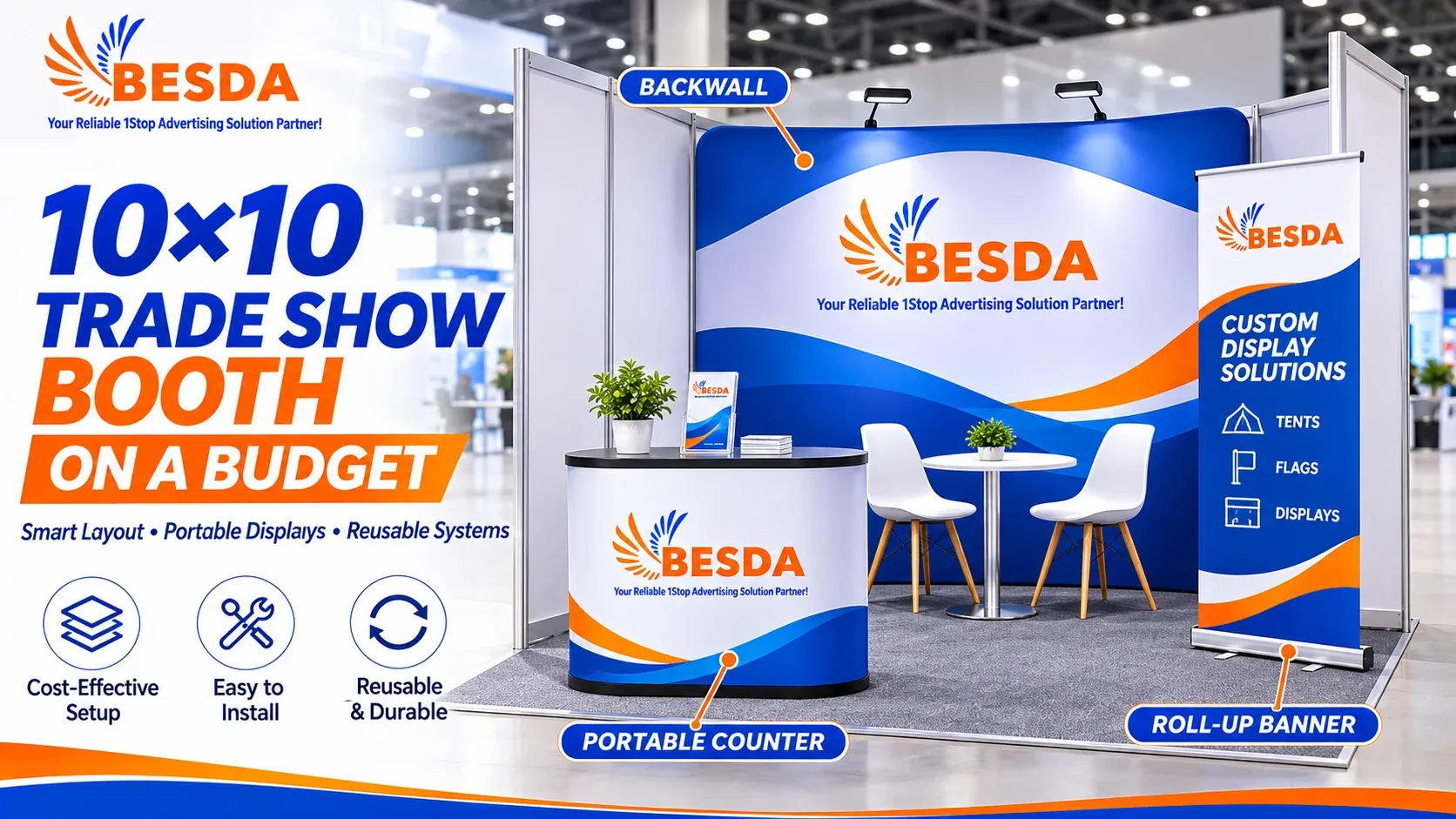
Keep the front open where possible. A rear backwall can establish brand identity; a compact counter can support samples and lead capture; a small side display or light box can highlight one priority product. Leave a clear path for visitors to step in, browse and speak with staff. An L-shaped or U-shaped arrangement may work depending on the products and staffing, but do not let tables or counters create a barrier. Measure the actual furniture depth and visitor clearance, including doors, storage cases and electrical cables.
Which Displays Should You Choose?
A tension-fabric or SEG backwall creates a large graphic surface and can pack into a transport case. A pop-up display may be appropriate when a fast, repeatable setup is important. A roll-up banner adds a vertical message with a small footprint. A portable counter gives staff a place to talk and hold samples. An LED light box can add visibility when illumination supports the message and power is available. Feather flags are usually more useful in approved outdoor areas, entrances or open event spaces than inside a tightly controlled inline booth. Confirm venue rules and overhead clearance before using tall freestanding displays.
Budget Priorities: Spend on What Visitors Notice
Prioritize a readable headline, clean graphics, good lighting, stable hardware, a counter or demo surface if needed, and a lead-capture process. Avoid paying for multiple display structures that repeat the same message. Reusable frames and replaceable graphics can make sense when the brand attends several shows. Budget for more than the product itself: freight, advance warehouse handling, drayage, electrical drops, carpet, furniture, labour, storage, graphic replacement and travel can change the total cost. Ask the show contractor for deadlines and rates before finalizing the display plan.
Plan Setup, Packing and Reuse
Choose displays that fit the team's transport method and setup skill. Confirm packed dimensions, carton or case weight, number of cases, tool requirements, assembly time, graphic replacement method and spare parts. Conduct a test setup before shipping. Label components clearly and photograph the packed kit. Keep the assembly instructions and a parts list with the case. For repeat shows, record what worked, what was damaged and what should be updated before the next event.
A Simple Lead-Capture Plan
Do not treat booth traffic as the final result. Decide what staff should ask, what qualifies a lead and how the visitor's details will be recorded. Use a QR code or short form only if the visitor understands the benefit of responding. Prepare the follow-up message before the show and assign an owner for each lead. A useful booth interaction could be a product comparison, a sample review, a quick configuration assessment or a demonstration. The best activity is directly connected to the buyer's problem—not a giveaway that attracts people with no purchase fit.
Quick Comparison
Backwall / SEG wall — Role in a 10×10 booth: Main brand and product message; When it is useful: Need a large, clean backdrop.
Portable counter — Role in a 10×10 booth: Conversation, samples and lead capture; When it is useful: Staff need a service point.
Roll-up banner — Role in a 10×10 booth: Secondary message or category; When it is useful: Need low-cost vertical messaging.
LED light box — Role in a 10×10 booth: Illuminated product or campaign visual; When it is useful: Power and lighting improve visibility.
Feather flag — Role in a 10×10 booth: Directional outdoor visibility; When it is useful: Venue permits tall freestanding flags.
Frequently Asked Questions
What should I put in a 10×10 trade show booth?
Start with one clear backwall message, a compact counter if needed, one supporting display and a simple lead-capture process. Check the event rules before choosing dimensions.
How tall can a 10×10 trade show booth be?
There is no single universal answer. Height rules depend on the show, venue, booth type and location. Read the exhibitor manual and get written approval for the proposed display.
Are feather flags allowed inside trade show booths?
It depends on the event rules, ceiling clearance, aisle restrictions and fire or stability requirements. Ask show management before ordering or bringing a tall flag.
How can I reduce trade show booth costs?
Reuse frames, replace graphics instead of full systems where compatible, avoid duplicate display pieces, order services before deadlines and plan packed dimensions to control shipping and handling.
Why Work With BESDA?
BESDA supplies custom flags, advertising tents, LED light boxes and portable trade show displays for B2B projects. The most useful supplier discussion starts with the real application, dimensions, artwork, hardware, installation environment, packing and delivery requirements. Product-specific specifications and compatibility should be confirmed in the approved quotation and production documents. Planning a 10×10 or larger exhibition project? Send BESDA your booth dimensions, show rules, display list, artwork status, quantity, destination and event date. We can help coordinate portable backwalls, counters, banners and light boxes as one kit.
Related BESDA resources
Deeper reading on this site: BESDA Portable Trade Show Displays, BESDA LED Light Boxes, BESDA Factory Tour and BESDA FAQ.
Next step
Send us your application, sizes, quantity, artwork status and destination, and we will reply with a specification-led quotation and a confirmed production schedule.
You can reach us on WhatsApp or by email, or use the form on the contact page for a recommendation within one working day.