News & Insights
How to Choose LED Rotating Signage
Choose LED rotating signage by installation type, rotation mechanism, display layers, diameter, lighting, indoor/outdoor protection, power and maintenance.
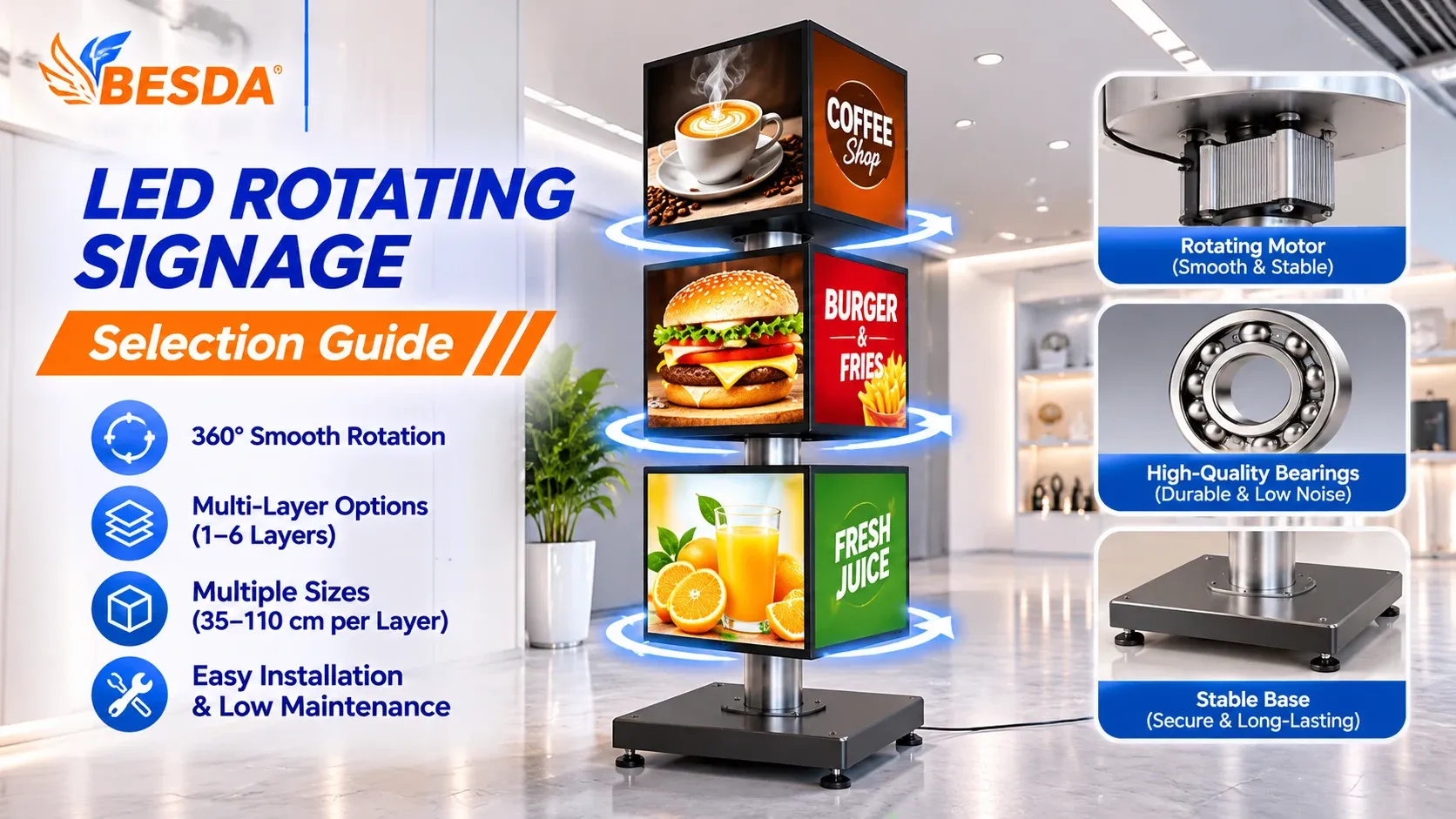
LED rotating signage adds movement to illuminated advertising, helping a message attract attention in retail, commercial and public spaces. But a rotating sign is a mechanical and electrical assembly—not just a light box with a motor. Before ordering, define the mounting method, display layers, dimensions, rotation behavior, power supply, maintenance access and environmental conditions.
What Is LED Rotating Signage?
LED rotating signage is an illuminated advertising display that uses a motor or drive system to rotate one or more sign panels or display layers. Designs may be ceiling-mounted, wall-mounted or floor-standing, with different diameters and numbers of tiers. Ask for a product drawing that shows the fixed structure, rotating components, electrical routing and mounting points. The term 'rotating sign' covers several different mechanisms.
Choose the Installation Type
Ceiling-mounted units need a suitable overhead support and a safe method of routing power. Wall-mounted models require a verified fixing structure and adequate clearance. Floor-standing units need a stable base and protection against accidental contact. Confirm the substrate, fixing points, installation height, access for maintenance and any building or venue approval. Do not rely on the decorative housing to carry an unverified structural load.
Single-Layer vs Multi-Layer Displays
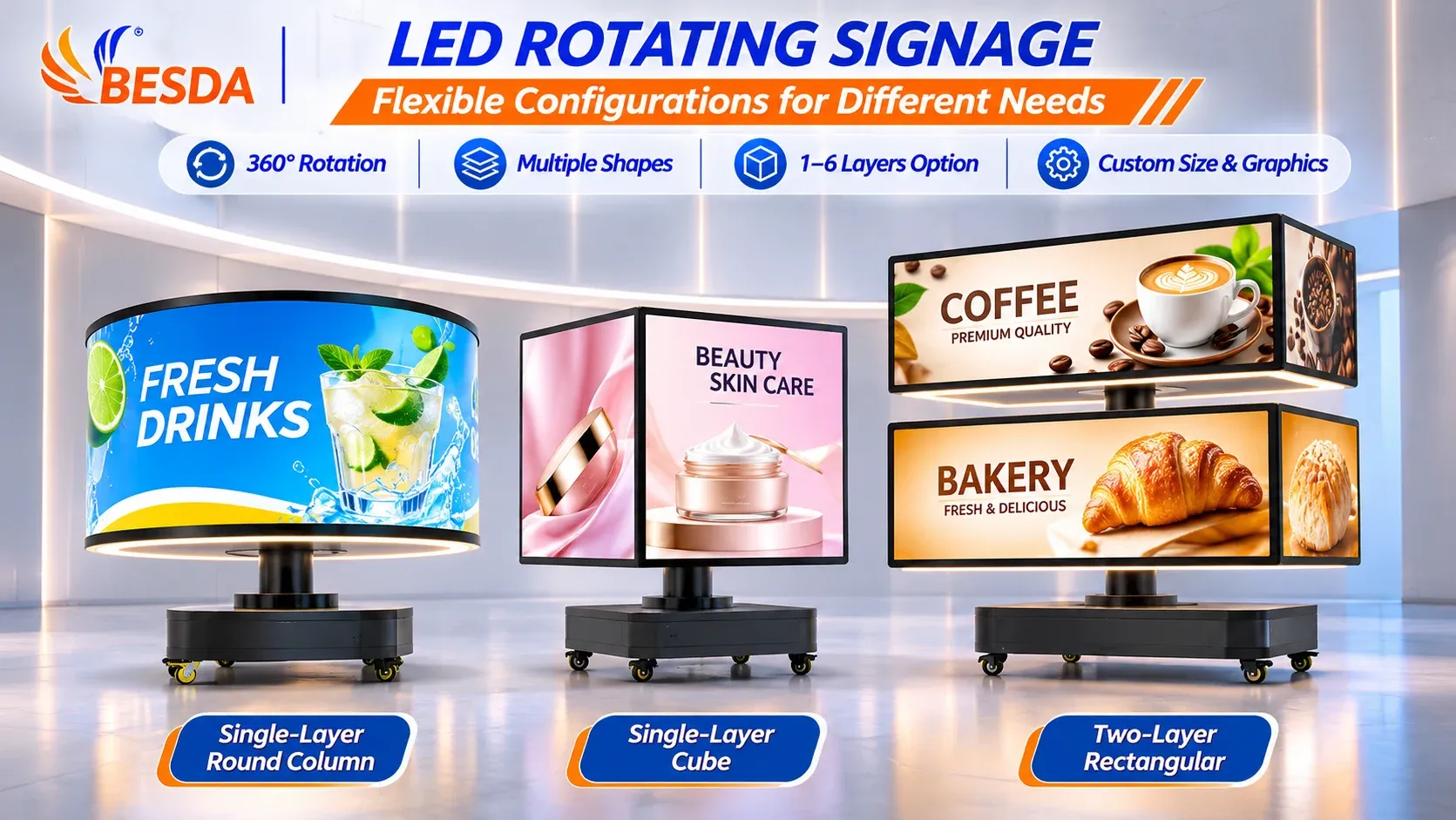
A single-layer unit presents one illuminated display level. Multi-layer designs create several visual bands or panels and can display multiple messages or brands. Additional layers may increase height, weight, wiring complexity and maintenance requirements. Confirm the number of tiers, visible area per tier, total assembled height, spacing, rotation clearance and whether each layer rotates together or independently.
Motor, Drive and Rotation Behavior
Ask for motor type, rated voltage, power, speed range, duty cycle, direction, start/stop behavior and noise information. Confirm whether the motor is designed for continuous operation or intermittent use. A display intended for a quiet retail environment may need different noise and vibration performance from one used in a busy event venue. Request a video of the actual model running.
Bearings, Shafts and Mechanical Alignment
Bearings and shafts support rotation and help maintain alignment. Ask which bearing type is used, how it is protected, whether it is replaceable and how the rotating assembly is balanced. Check for wobble, vibration, scraping, uneven gaps and unusual noise during a sample test. A rotating display should be assessed as a complete mechanical assembly, not by motor specifications alone.
LED Lighting and Graphic Construction
Confirm LED type, color temperature, brightness control, light diffusion, graphic material, access to the illuminated face and replacement method. For multi-layer units, ask whether each layer has a separate lighting circuit. Review the finished sign under normal ambient lighting. Check for hotspots, dark areas, visible wiring and color differences between panels.
Power, Wiring and Electrical Safety
Specify input voltage, frequency, total power, current, driver type, cable exit, plug, grounding or insulation requirements and destination market. The motor and LEDs may have separate electrical requirements. Ask for a wiring diagram and relevant product compliance documents. Installation and mains wiring should be handled by qualified personnel under local requirements.
Indoor vs Outdoor Installation
Outdoor use requires the complete assembly to be designed for the actual exposure, including water ingress, dust, temperature, corrosion, wind and mounting. An IP rating should apply to the relevant finished assembly or component and must be verified from documentation. Do not assume a covered motor or sealed LED module makes the whole rotating sign weatherproof. Request the declared rating and test scope for the complete configuration.
Maintenance, Service Access and Spare Parts
Ask how to access the motor, bearing, driver and LED modules. Confirm whether the graphic or diffuser can be replaced without removing the entire unit and whether spare motors, bearings and power supplies are available. Set a maintenance schedule based on the manufacturer's instructions and operating hours. Inspect fasteners, cables, rotating clearance and unusual noise.
What to Include in an LED Rotating Signage RFQ
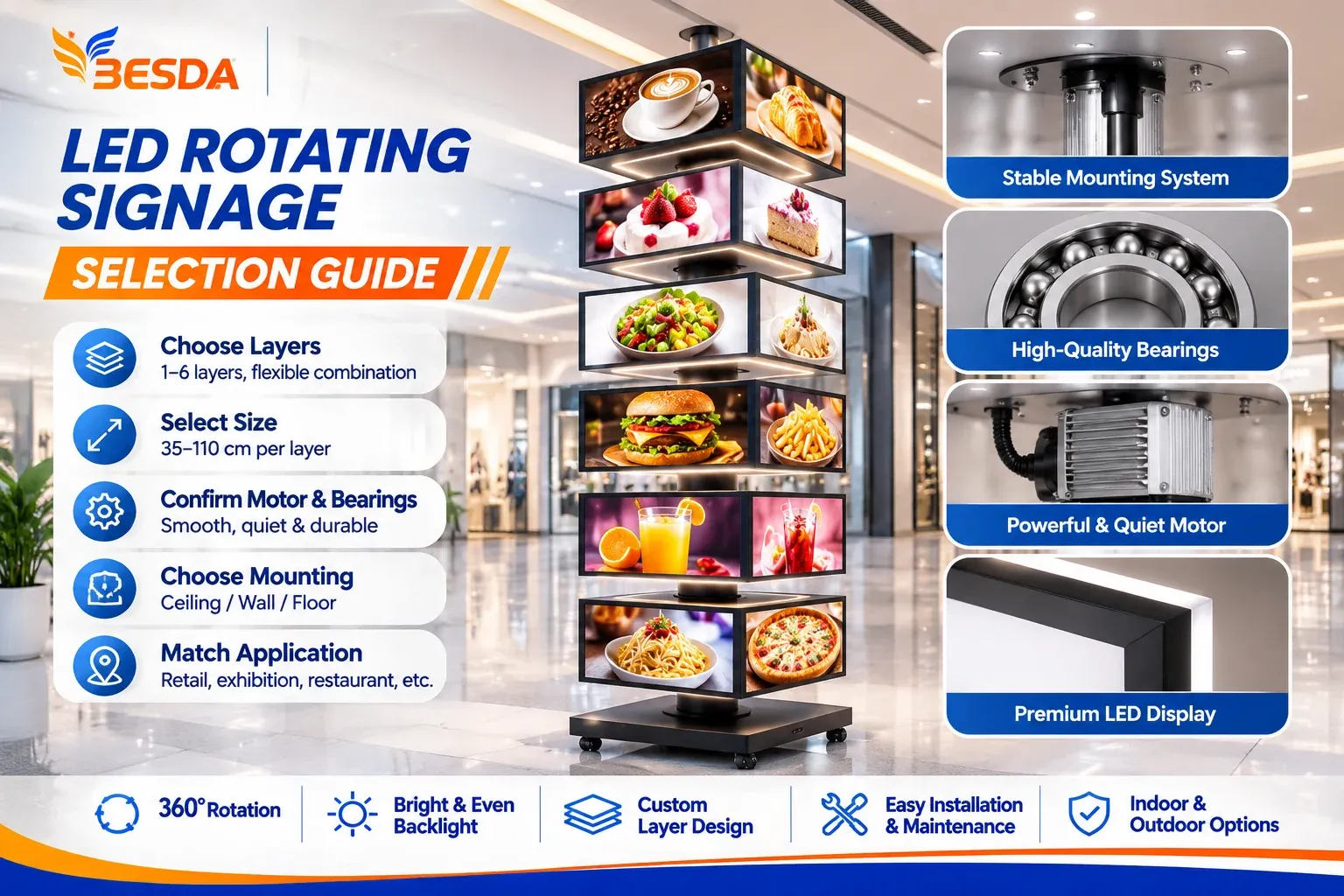
Provide mounting type, number of layers, diameter, total height, indoor/outdoor environment, rotation speed preference, motor duty cycle, LED specification, input power, graphic method, installation substrate, quantity and destination. Request assembly drawings, wiring diagram, test video and maintenance guidance.
Comparison Table
Mounting — Questions to confirm: Ceiling, wall or floor?; Why it matters: Determines fixing and support design.
Layers — Questions to confirm: How many tiers and which rotate?; Why it matters: Defines size, weight and wiring.
Motor — Questions to confirm: Speed, direction, duty cycle, noise; Why it matters: Controls movement and operating suitability.
Bearing — Questions to confirm: Type, load and replacement; Why it matters: Affects alignment and service.
LED — Questions to confirm: Voltage, brightness, color and diffusion; Why it matters: Determines visual performance.
Environment — Questions to confirm: Indoor/outdoor and declared IP rating; Why it matters: Confirms exposure suitability.
Maintenance — Questions to confirm: Access and spare parts; Why it matters: Reduces downtime.
Frequently Asked Questions
Can LED rotating signage be ceiling mounted?
Some models are designed for ceiling installation. Confirm mounting loads, fixing points, clearance and approved installation method.
Can I customize the number of rotating layers?
Some systems offer multiple layers. Confirm the actual model's dimensions, weight, wiring and rotation arrangement.
What causes a rotating sign to wobble?
Possible causes include alignment, bearing wear, mounting issues, imbalance or damaged components. Stop operation and have it inspected.
Can LED rotating signage be used outdoors?
Only if the complete model is specified for the environment and installed according to its instructions.
What should I ask about the motor?
Ask for voltage, power, speed, duty cycle, noise, direction, service access and replacement availability.
Why Choose BESDA?
BESDA supports B2B projects across custom flags, event tents, portable trade show displays, counters and illuminated signage. We approach each enquiry by confirming the actual application, dimensions, materials, frame or hardware compatibility, artwork, packaging and destination requirements. Product specifications, test evidence and delivery details should be confirmed in the approved quotation and production documents. Send BESDA your installation type, number of layers, preferred diameter, indoor/outdoor location, power supply and branding requirements. We can help define the mechanical and electrical specification before quotation.
Related BESDA resources
Deeper reading on this site: Quality Control, Factory Tour and Warehouse & Logistics.
Next step
Send us your application, sizes, quantity, artwork status and destination, and we will reply with a specification-led quotation and a confirmed production schedule.
You can reach us on WhatsApp or by email, or use the form on the contact page for a recommendation within one working day.