News & Insights
How to Choose Custom Tent Sidewalls
Choose custom canopy tent sidewalls by privacy, ventilation, visibility, access, weather exposure, printing, attachment and anchoring requirements.
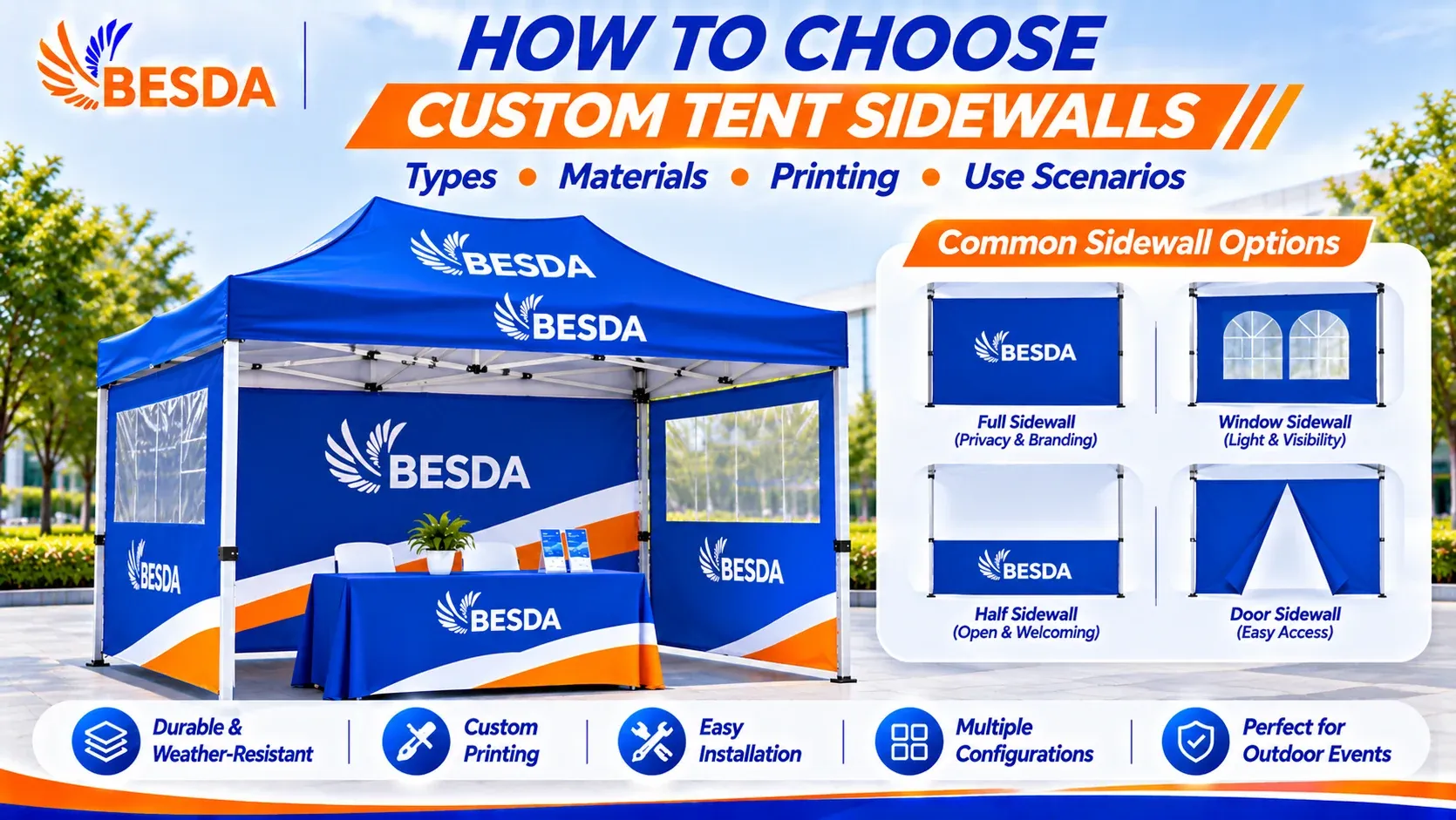
Sidewalls change a canopy tent from an open shelter into a more defined working space. They can provide privacy, create a branded wall, reduce direct sun or rain exposure, add a service window or create a controlled entrance. But every panel changes airflow, visibility and how the structure responds to weather. The right configuration starts with the activity taking place under each side of the tent.
What Do Tent Sidewalls Do?
Tent sidewalls attach to the canopy frame and close some or all of the open bays. They can create a backwall for branding, screen stored products, separate staff space, reduce direct exposure or guide customer flow. Sidewalls may be solid, half-height, mesh, windowed or fitted with a door. Confirm the exact attachment system: hook-and-loop straps, zippers, rails, clips or another method. Panels designed for one frame series may not fit another, even when the tent footprint looks similar.
Full Sidewalls: Privacy and Branding
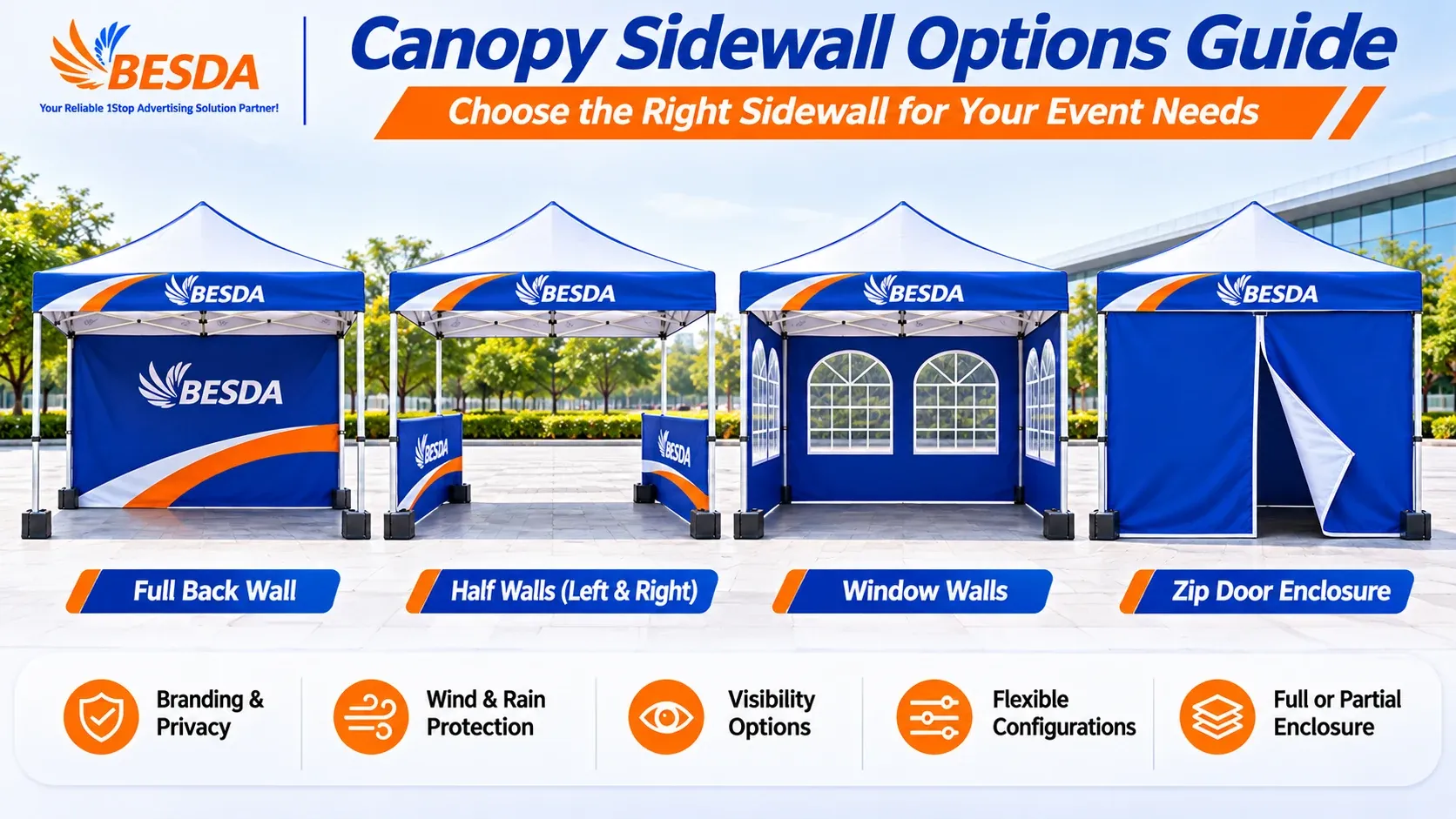
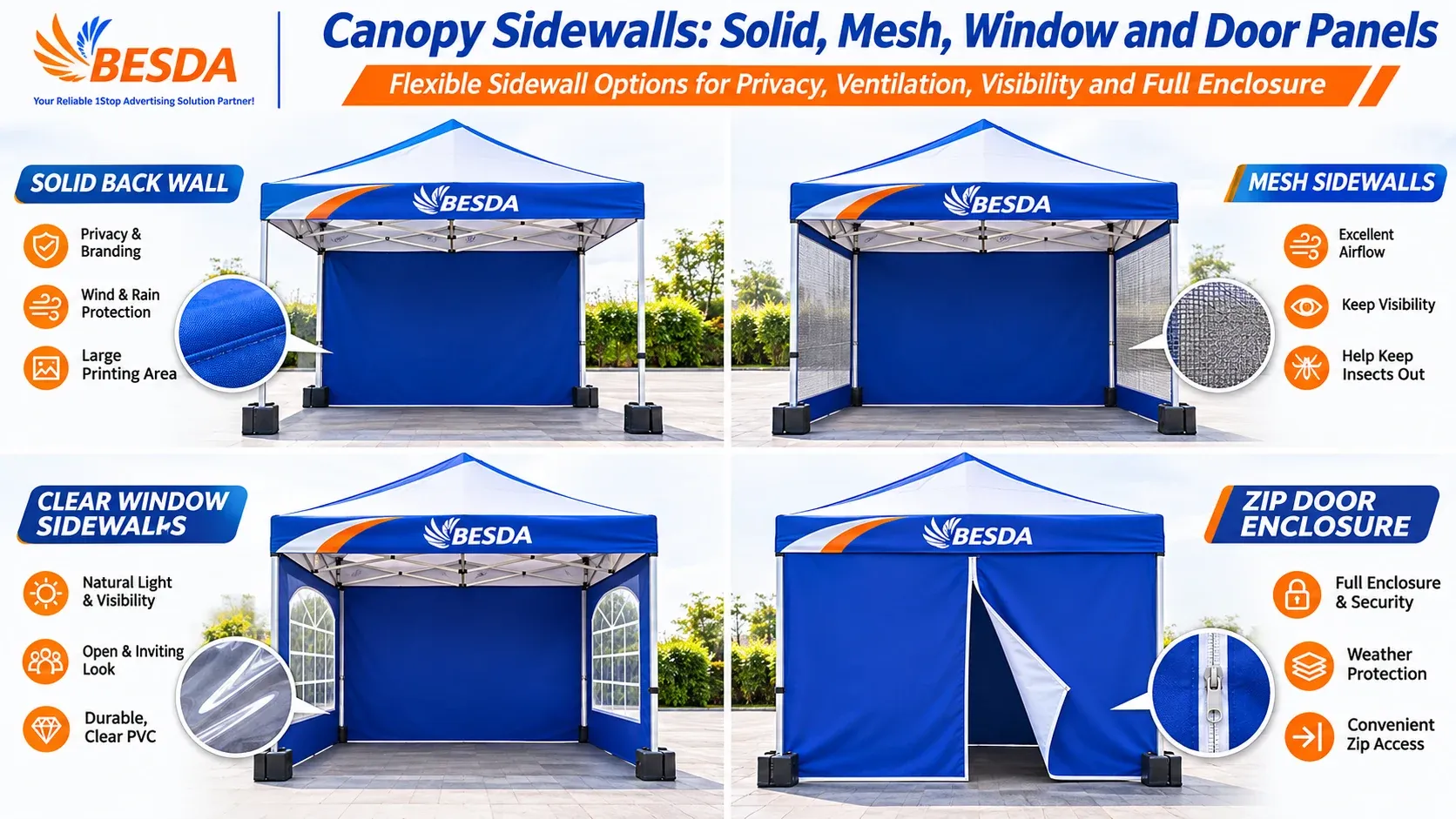
Full walls cover most or all of a tent bay. They provide a large printable surface and can screen stock, create a consultation area or form a more enclosed space. They may also reduce airflow and visibility, and a closed tent can feel warmer in direct sun. A fully enclosed canopy presents more surface area to wind than an open canopy. Do not treat sidewalls as a wind-protection guarantee. Confirm the manufacturer's operating limits and anchoring instructions for the exact tent and wall configuration.
Half Sidewalls: Open Customer Interaction
Half-height walls create a lower boundary while leaving the upper area open. They can define a sampling counter, market stall or service area while allowing customers and staff to see each other. They are often useful where the exhibitor wants a branded lower panel without closing the tent. Check whether the half wall requires a support rail, whether the worktop or counter is integrated, and how the panel attaches to the legs. Confirm the finished height and whether the print is visible from the customer side.
Window Sidewalls: Light and Visibility
A window wall combines a fabric panel with a transparent or translucent section. It can let daylight into the tent and preserve sightlines while providing some separation from the outside. The window material may reflect light, fog or require specific cleaning. Specify window material, opening size, position, transparency, print area and care instructions. If the window is used for customer service, confirm that the opening is practical for the intended counter height.
Mesh Sidewalls: Ventilation and Screening
Mesh panels allow more airflow than solid walls and can help screen insects or create a visual boundary. They do not provide the same rain protection or privacy as a solid panel. Mesh openness, yarn, edge reinforcement and attachment details vary. Choose mesh based on the environment and the job it must do. Do not describe a mesh panel as waterproof unless the exact product specification supports that claim.
Door Sidewalls: Entry and Exit
Door panels create a defined entrance, often with a zipper or roll-up opening. They can help staff enter an enclosed tent without removing the entire wall. Check the clear opening width, zipper position, roll-up straps and whether the door can be operated from both sides. For public events, confirm that the opening and layout comply with venue access and emergency egress requirements. A fabric door is not automatically a code-compliant exit.
Mixing Wall Types Around One Tent
A practical layout might use a full printed backwall, a half wall along the customer-facing counter, a window panel on the sunny side and a door at the staff entrance. This can create a more functional booth than installing four identical solid walls. Draw a top view and label each side by position: front, rear, left and right. Identify the customer approach, staff workflow, product storage, sun direction and likely wind exposure. Confirm that the panels are compatible with the same frame and can connect at the corners.
Materials, Printing and Attachment Checks
Ask for fabric composition, denier or GSM where relevant, coating, water-resistance evidence, UV or color-fastness evidence if claimed, seam construction and edge reinforcement. For printed walls, approve the artwork across panel seams and confirm print sides. Check zippers, hook-and-loop straps, corner connections, roofline attachment and bottom edge. Request a sample or detailed photos of the attachment points before a large order.
What to Include in a Sidewall RFQ
Provide tent model and footprint, number of bays, wall position, full/half/window/mesh/door selection, finished panel dimensions, material, print sides, attachment method, site conditions, quantity and destination. Include a top-view sketch and photos of the existing tent if the walls are replacement parts.
Comparison Table
Full — Main benefit: Privacy and large print area; Main trade-off: Less airflow; greater wind exposure; Useful application: Backwall, storage screen, enclosed booth.
Half — Main benefit: Keeps interaction open; Main trade-off: Limited privacy and weather coverage; Useful application: Market stall, sampling counter.
Window — Main benefit: Light and visibility; Main trade-off: Reflection and window care; Useful application: Service booth, display tent.
Mesh — Main benefit: Airflow and screening; Main trade-off: Limited rain protection and privacy; Useful application: Warm-weather booth, insect screening.
Door — Main benefit: Defined staff/customer access; Main trade-off: Opening and egress need planning; Useful application: Enclosed event or service tent.
Frequently Asked Questions
Can I mix full and half tent sidewalls?
Many tent systems allow mixed wall configurations, but confirm panel and frame compatibility, corner connections and support rails.
Do tent sidewalls make a canopy safer in wind?
Not automatically. Solid walls can increase exposed surface area and wind loading. Follow the exact manufacturer's anchoring and operating instructions.
Are mesh sidewalls waterproof?
Mesh is designed to allow airflow and generally does not provide the same rain protection as a solid coated panel.
How do I order replacement tent sidewalls?
Provide the tent model, footprint, wall position, panel dimensions, attachment details and photos of the existing frame and wall.
Why Choose BESDA?
BESDA supports B2B projects across custom flags, event tents, portable trade show displays, counters and illuminated signage. We approach each enquiry by confirming the actual application, dimensions, materials, frame or hardware compatibility, artwork, packaging and destination requirements. Product specifications, test evidence and delivery details should be confirmed in the approved quotation and production documents. Send BESDA your tent size, frame model, site photos, wall layout and preferred panel types. We can help specify compatible full, half, window, mesh and door sidewalls for your event or retail setup.
Related BESDA resources
Deeper reading on this site: Outdoor Event Branding, BESDA Custom Tents, BESDA Factory Tour and BESDA Quality Control.
Next step
Send us your application, sizes, quantity, artwork status and destination, and we will reply with a specification-led quotation and a confirmed production schedule.
You can reach us on WhatsApp or by email, or use the form on the contact page for a recommendation within one working day.