News & Insights
Feather Flag Replacement Pole Guide
Find a compatible feather flag replacement pole. Check flag shape, assembled height, section count, connector diameter, sleeve fit, base socket and pole material.
A broken or missing feather flag pole does not always mean the entire display must be replaced. However, ordering a pole because it looks similar can lead to a poor fit, incorrect flag tension or an incompatible base. The safest approach is to identify the existing system and confirm each connection point before purchasing replacement hardware.
What Is a Feather Flag Replacement Pole?
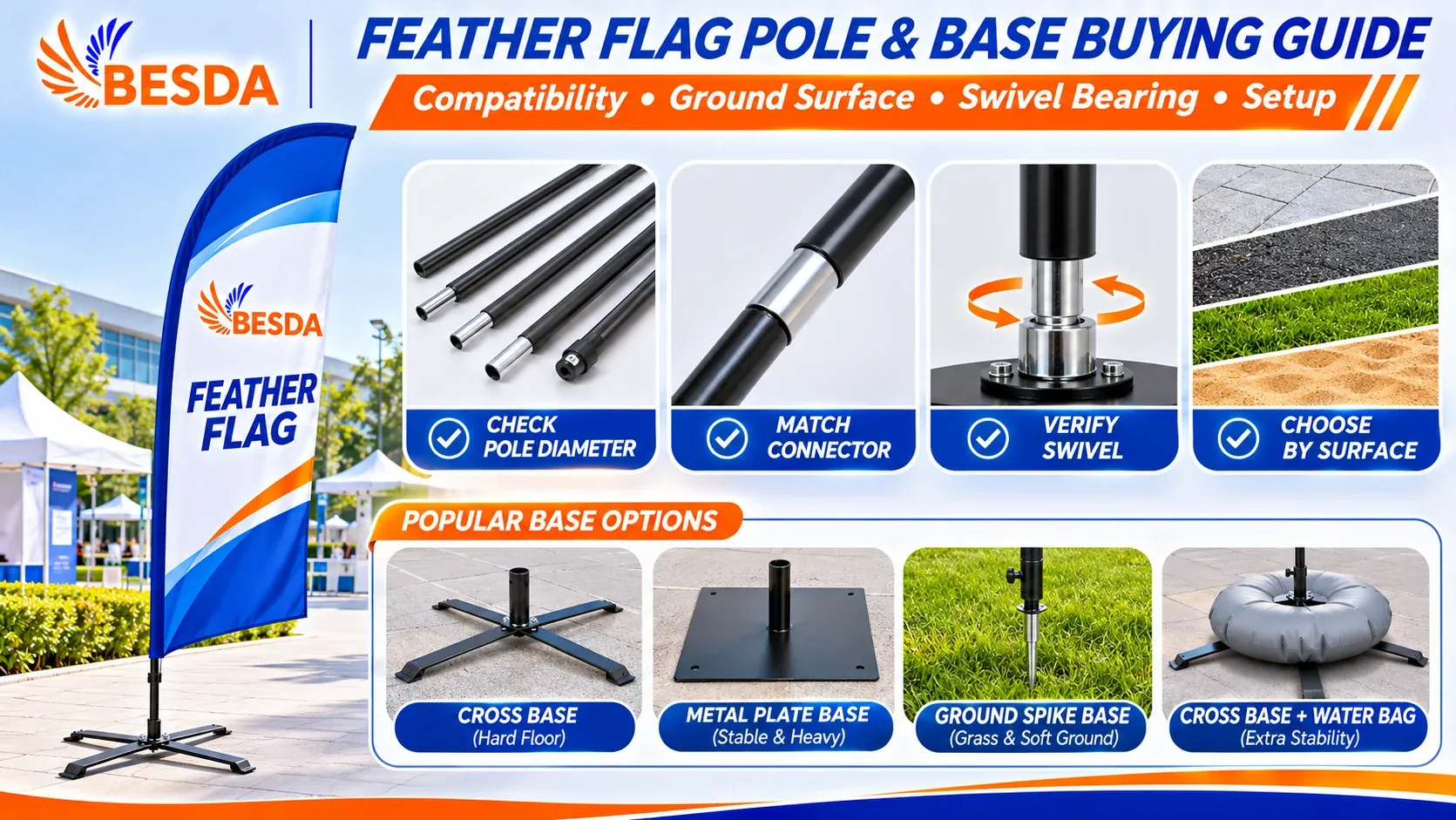
A feather flag pole kit is usually a set of connected sections designed to create a specific curved or angled support shape. Depending on the model, it may combine flexible and more rigid sections, ferrules, elastic or cord components, and a lower connector that fits a base spindle. Pole kits are not universal. Feather, teardrop and other flag shapes may use different curves, lengths, section counts and sleeve patterns.
Identify the Exact Flag System First
Record the flag shape, finished graphic dimensions, total assembled height, pole orientation and the position of the pole sleeve. Photograph the complete flag, each pole section, the lower connector and the base socket. If a product label or previous invoice exists, include its model or product code. Do not measure only the fabric height. Overall assembled height may include the pole and base, while the graphic itself is shorter. Ask the supplier which measurement is used in the replacement specification.
Measure Pole Sections and Connectors
Measure each intact section from end to end and note its outside diameter, shape, ferrule length and connection method. Check whether the section is round, oval, tapered or keyed. Record the lower pole diameter and the base spindle or socket dimensions separately. A few millimetres can matter at a connector. Avoid forcing a section into a socket or modifying the fitting to make it appear compatible. Provide clear close-up photos with a ruler or caliper for scale.
Aluminum, Fiberglass and Hybrid Pole Systems
Aluminum sections can offer a rigid, corrosion-resistant structure with relatively consistent dimensions. Fiberglass or composite sections can provide flexibility, which may be part of the intended flag design. Some systems combine materials. The best option depends on the product's engineering and intended application, not on a generic claim that one material is always stronger. Ask for the material of each section, wall or tube dimensions where relevant, joint construction, finish and spare-part availability. Do not replace a flexible section with a rigid one unless the manufacturer confirms the design remains compatible.
Check the Flag Sleeve and Pole Orientation
The sleeve must fit the intended pole profile and length. Confirm whether the pole pocket is on the left or right when viewing the printed face, and check any sleeve reinforcement or opening details. A replacement pole that changes the curve or orientation can distort the flag shape or make the artwork face the wrong direction. If the old flag is still available, photograph it mounted on the original pole. If not, send the artwork proof and sleeve measurements.
Confirm Base Compatibility
The bottom pole section must fit the base connector or spindle. Check the connector diameter, insertion depth, rotation feature and any retaining mechanism. Base models may look alike while using different sockets. Tell the supplier whether you have a cross base, metal plate, water base, ground spike or car base. Ask them to confirm the exact pole-to-base interface in writing.
Replacement Pole RFQ Checklist
Send flag type, graphic size, assembled height, section count, section lengths, diameters, connector photos, base model, material preference, quantity and destination. If only one section is damaged, identify its position in the assembly and ask whether that section can be supplied separately. Request a drawing or marked-up photograph before ordering. For repeat projects, keep a spare-parts record with model numbers and approved dimensions.
Quick Comparison
Flag type and size — What to record: Feather / teardrop; graphic and standing height; Why it matters: Defines the pole geometry.
Section profile — What to record: Count, length, diameter and shape; Why it matters: Ensures sections connect correctly.
Joint details — What to record: Ferrule, insert, connector and retention; Why it matters: Prevents loose or forced joints.
Sleeve — What to record: Length, opening and orientation; Why it matters: Maintains correct flag shape.
Base interface — What to record: Socket / spindle diameter and depth; Why it matters: Ensures pole fits the base.
Frequently Asked Questions
Are feather flag poles universal?
No. Pole geometry, section count, connectors, sleeve fit and base interfaces vary by product and manufacturer.
Can I replace only one broken pole section?
Sometimes. The supplier must confirm the section profile, length, connector and material match the existing system.
Can I use a teardrop pole for a feather flag?
Do not assume so. The curve, section lengths and sleeve geometry are different in many systems. Confirm compatibility with the manufacturer.
What photos should I send for a replacement pole quote?
Send the full assembled flag, every pole section, close-ups of both ends, the base socket and the flag sleeve, ideally with a ruler for scale.
Why Choose BESDA?
BESDA supports B2B projects involving custom advertising flags, event tents, LED light boxes and portable display systems. A reliable quotation begins with the actual application, dimensions, materials, artwork, hardware, installation environment, packing and delivery requirements. Product-specific specifications and compatibility should be confirmed in the approved quotation and production documents. Need replacement feather flag poles or spare sections? Send BESDA photos, measurements, flag shape, base type and quantity. We will review the connection details before confirming a compatible replacement.
Related BESDA resources
Deeper reading on this site: Custom Feather Flags, BESDA FAQ and BESDA Quality Control.
Next step
Send us your application, sizes, quantity, artwork status and destination, and we will reply with a specification-led quotation and a confirmed production schedule.
You can reach us on WhatsApp or by email, or use the form on the contact page for a recommendation within one working day.