News & Insights
Trade Show Booth Backwall Design Guide
Plan a trade show booth backwall with clear messaging, product imagery, readable hierarchy, safe margins, lighting, counters and a strong buyer call to action.
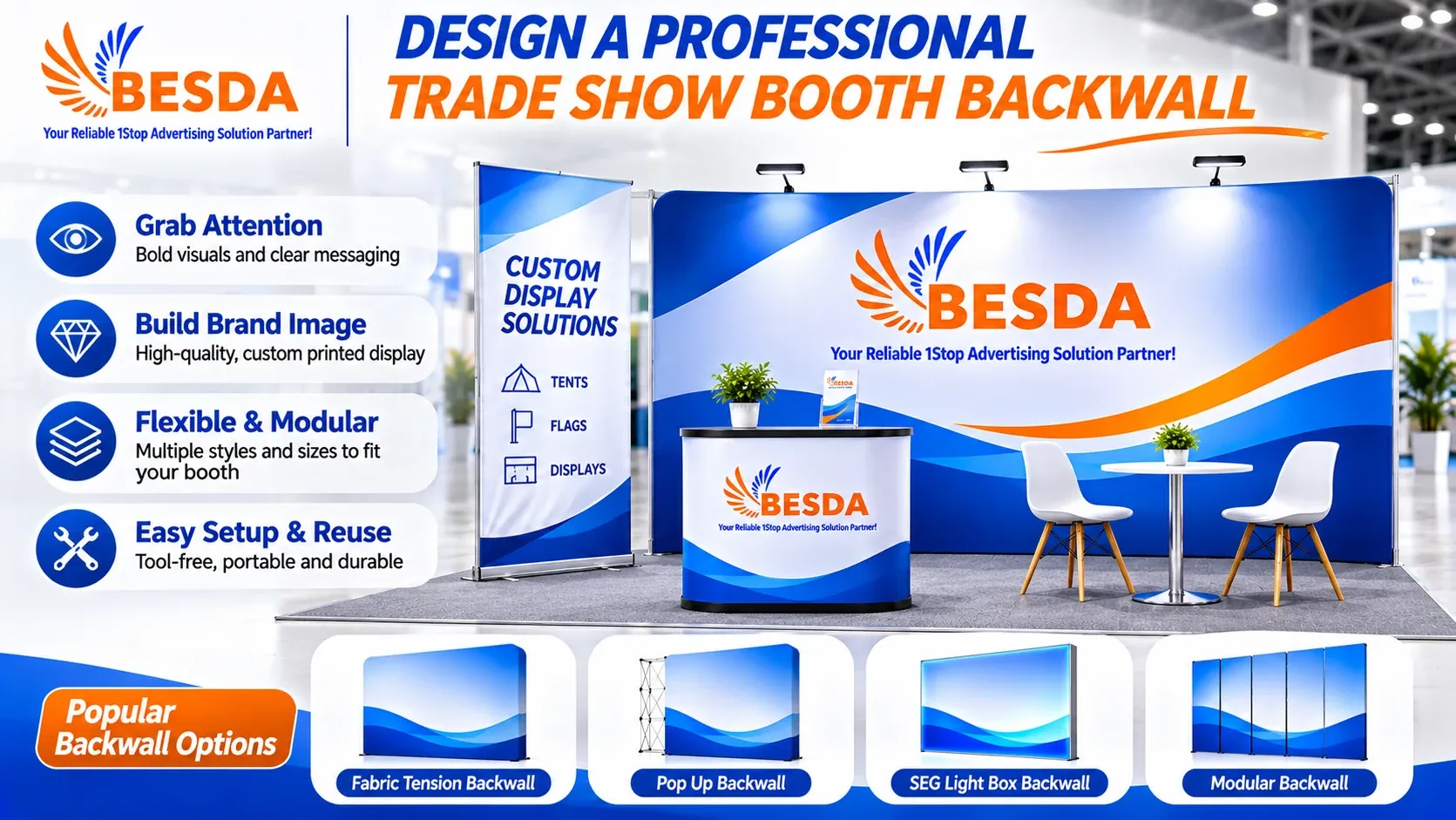
A large backdrop does not automatically create a strong booth. Visitors may pass in seconds, so the backwall needs to communicate who you are, what you offer and why they should stop. The design must also work with the frame, lighting, booth layout and viewing distance. A professional result comes from combining a clear message with accurate production dimensions.
Start With the Visitor's First Question
A buyer approaching the booth wants to understand the company and product category quickly. Lead with a recognizable brand and a concise headline. Add a product image or application scene that helps visitors identify what you manufacture or supply. Avoid starting with a long company history or a wall of technical copy. Put detailed specifications, certifications and secondary information on supporting displays or handouts where visitors can examine them.
Build a Clear Visual Hierarchy
A practical hierarchy is brand name, main product or solution, one key benefit and a next step. Use size, contrast, spacing and image placement to guide the eye. A visitor should not have to decide which of ten competing headlines matters most. Keep the primary message in the area that remains visible when visitors, counters or product samples are in front of the wall. Check the layout from the aisle, not only on a desktop monitor.
Choose Images That Prove the Product
Use genuine product, factory, installation or application photography wherever possible. A close-up can show materials, connectors, seams or finish quality; a full view shows scale and use. Make sure the image represents the actual product configuration being offered. Do not use an image of a product that differs from the hardware or material being quoted. If the display is custom, label illustrative concepts clearly and approve the production sample before mass manufacture.
Keep Text Readable at the Expected Distance
A headline seen from across an aisle needs larger type than a technical label read at the counter. Limit the number of words, use strong contrast and avoid thin type over busy photographs. QR codes should be large enough to scan at the intended distance and should be tested on the printed proof. Move long URLs, full paragraphs and dense specification lists to a brochure, counter graphic or digital page. The backwall is a visual anchor, not a product catalogue.
Design for the Actual Frame and Graphic System
A pop-up, pillowcase fabric, SEG frame and modular wall may place seams, zippers, channels or edge returns in different positions. Obtain the manufacturer's template and safe-area guidance before laying out the artwork. Do not place important text across a seam or close to a silicone edge. Confirm whether the graphic is single- or double-sided, whether the frame is straight or curved, and whether the visible face differs from the finished fabric size.
Use Lighting Carefully
Backlighting can improve visibility, but the print must be prepared for the light source and the frame must distribute illumination appropriately. A graphic designed for front lighting may appear too dark when backlit. Approve the print on the intended fabric and review the display when illuminated. Check brightness, uniformity, color temperature, glare and cable routing. Do not use a bright light source to compensate for unsuitable fabric or poor print preparation.
Coordinate the Backwall With Counters and Displays
The backwall should work with the promotional counter, literature holder, product plinths and banner stands. Use the counter for a short offer, QR code or conversation prompt. Keep products at a height where visitors can see them and leave a clear path into the booth. A good layout gives staff a place to talk without blocking the headline or main product image. Plan cable runs and storage before finalizing the artwork.
Proofing and Production Checks
Approve the artwork at final dimensions and check spelling, logo proportions, color references, image resolution, safe margins, seams and hardware clearances. Ask for a dimensioned drawing and, where the project warrants it, a printed sample or production photo. For repeat campaigns, keep the approved artwork, color reference, frame model, graphic size and packing instructions together. This makes future replacement graphics more consistent.
A Practical Booth Backwall Brief
Send the booth footprint, event manual, frame type, visible graphic size, viewing distance, brand assets, product photos, main message, CTA, lighting requirement, counter position, quantity and deadline. Ask the supplier to confirm the artwork template and production tolerances before print.
Comparison Table
Headline — Good practice: One clear product or solution message; Common problem: Too many competing claims.
Product image — Good practice: Authentic, high-resolution and relevant; Common problem: Generic or inaccurate product image.
Typography — Good practice: Readable from aisle distance; Common problem: Small paragraphs and low contrast.
Safe area — Good practice: Respect seams, channels and edges; Common problem: Text cut off or hidden by frame.
Lighting — Good practice: Use print and LED system designed together; Common problem: Dark print, hotspots or glare.
CTA — Good practice: One clear next action; Common problem: No obvious way to contact or respond.
Frequently Asked Questions
What should a trade show backdrop say?
Show the brand, main product or solution, one meaningful benefit and a clear next step. Keep detailed specifications for supporting materials.
How many words should a booth backwall have?
There is no universal word count. Use only the text visitors can read at the expected distance and move detailed information to a counter or brochure.
Should I use a product photo or a lifestyle photo?
Use the image that helps the target buyer understand the product and its application. Authentic product and installation images can build credibility when they match the offered specification.
When should I receive the artwork template?
Request the exact template after the frame model and graphic dimensions are confirmed, before final artwork production.
Why Choose BESDA?
BESDA supports B2B projects across custom flags, event tents, portable trade show displays, counters and illuminated signage. We approach each enquiry by confirming the actual application, dimensions, materials, frame or hardware compatibility, artwork, packaging and destination requirements. Product specifications, test evidence and delivery details should be confirmed in the approved quotation and production documents. Send BESDA your booth size, frame type, brand assets, product photos, key message and counter layout. We can help align the display hardware and printed graphic specification before production.
Related BESDA resources
Deeper reading on this site: Trade Show Branding Solutions, Testimonials, BESDA Quality Control and BESDA Factory Tour.
Next step
Send us your application, sizes, quantity, artwork status and destination, and we will reply with a specification-led quotation and a confirmed production schedule.
You can reach us on WhatsApp or by email, or use the form on the contact page for a recommendation within one working day.